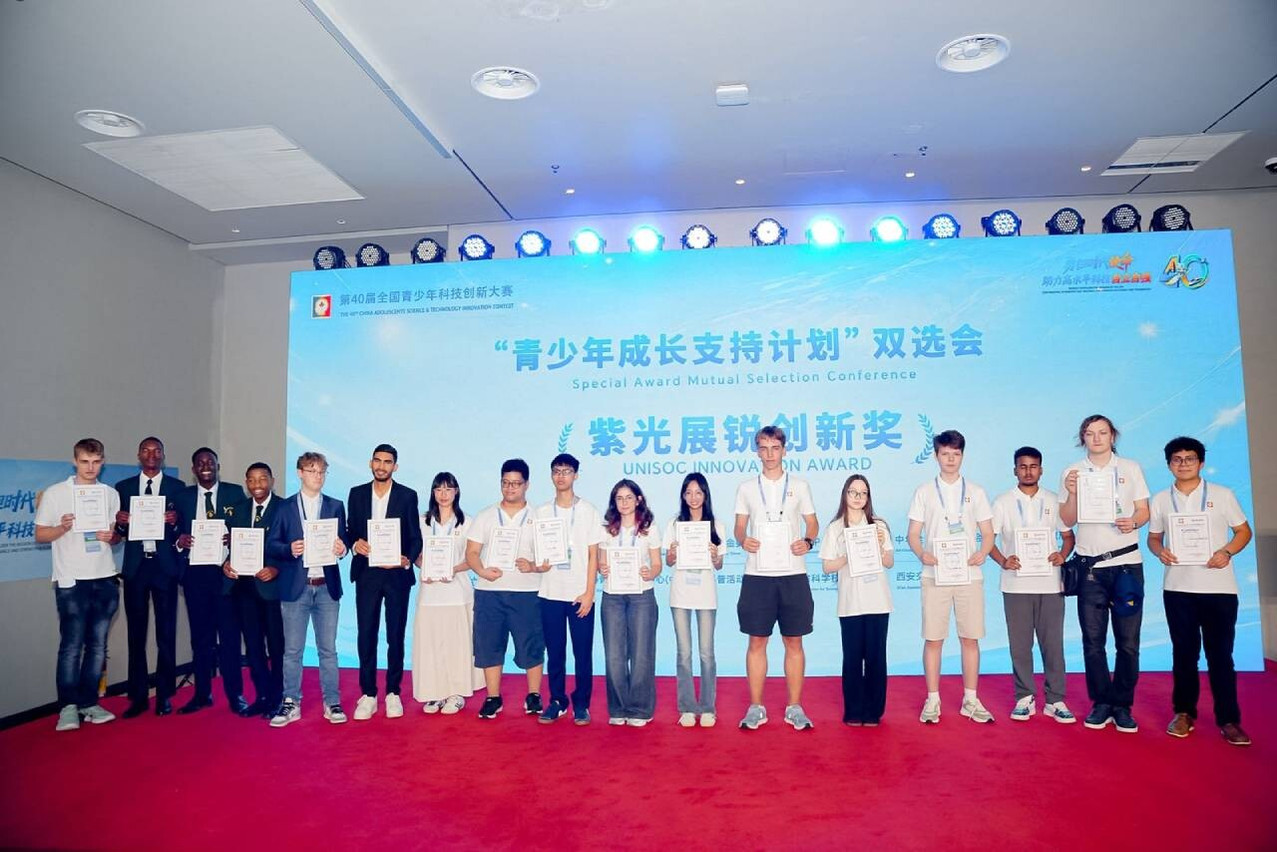
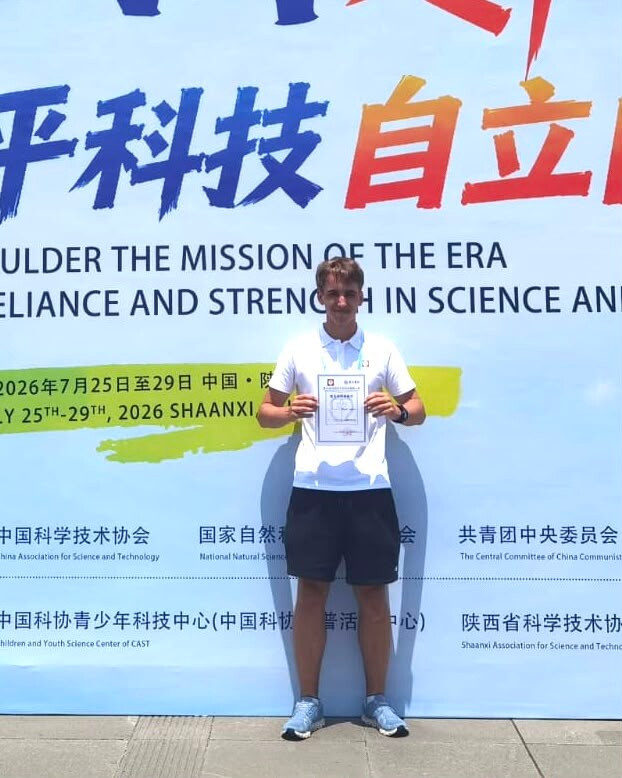
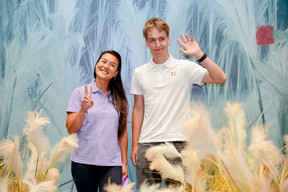
Maxim Lebedev, an 18-year-old from Luxembourg, is among the top 20 international participants at the 40th China Adolescents Science and Technology Innovation Contest (Castic), held in Xi’an. Selected by the Luxembourg Young Scientists Foundation (FJSL), the sixth-form student received the Unisoc Innovation Award, competing against 83 international participants from 27 countries. For nearly 15 years, the FJSL has been sending a winner of the national Jonk Fuerscher competition to this event, which brings together several hundred young Chinese scientists and delegations from all five continents.
Traffic simulation in Luxembourg City wins award
For his project ‘Adaptive Urban Traffic Analysis: A Simulation of Traffic Congestion within and around Luxembourg City’, Maxim Lebedev developed a multi-agent traffic simulation for Luxembourg City and its surrounding area. Using demographic data, commuting statistics and road information from OpenStreetMap, he created a virtual population of commuters before modelling the behaviour of each vehicle in a microsimulation.
According to the FJSL, the results obtained correspond to the congestion patterns observed on Google Maps and demonstrate how this type of model could, in the long term, help to identify inefficient traffic lights or congested roads. It was this project that enabled him to represent Luxembourg at Castic, where his performance in the scientific competitions earned him the Unisoc Innovation Award.
“Castic is a high-calibre and rather competitive event, but as a participant, you rarely feel as though you’re competing against the other students. Instead, you feel as though you’re tackling the challenges as one big group,” says Maxim Lebedev. He adds that “the discussions and the anticipation surrounding the challenges strengthened bonds with international participants, such as those from China”, and that the visits to Xi’an were “an incredible way to discover other cultures, whilst remaining within a scientific context”.
A programme developed in partnership with the Young Scientists Foundation
Maxim Lebedev has been involved in the activities of the Luxembourg Young Scientists Foundation since the age of 11. A five-time winner of the Jonk Fuerscher competition, he has also taken part in the Science Trips, the Mobisciences programme in Toulouse and a maths summer camp in Bulgaria. “Maxim owes this honour to his curiosity, his perseverance and the immense amount of work he has put in,” emphasises Sousana Eang, director-general of the FJSL. “Being here in Xi’an to share this moment with him makes me extremely proud of him, of how far he has come and of the brilliant young scientist he is becoming.”

Cooperation between the FJSL and Castic continues
The collaboration between the Luxembourg Young Scientists Foundation and Castic is based on a formal agreement signed in 2018, which makes the Luxembourg International Science Expo (LISE) prize an official award of the Chinese competition. This year, the FJSL presented this prize to five pupils from Australia, Cambodia, China, Thailand and Vietnam. The winners will take part in the next edition of the LISE, to be held from 18 to 24 October 2026, with an exhibition open to the public free of charge on 22 and 23 October at the Lycée Vauban.