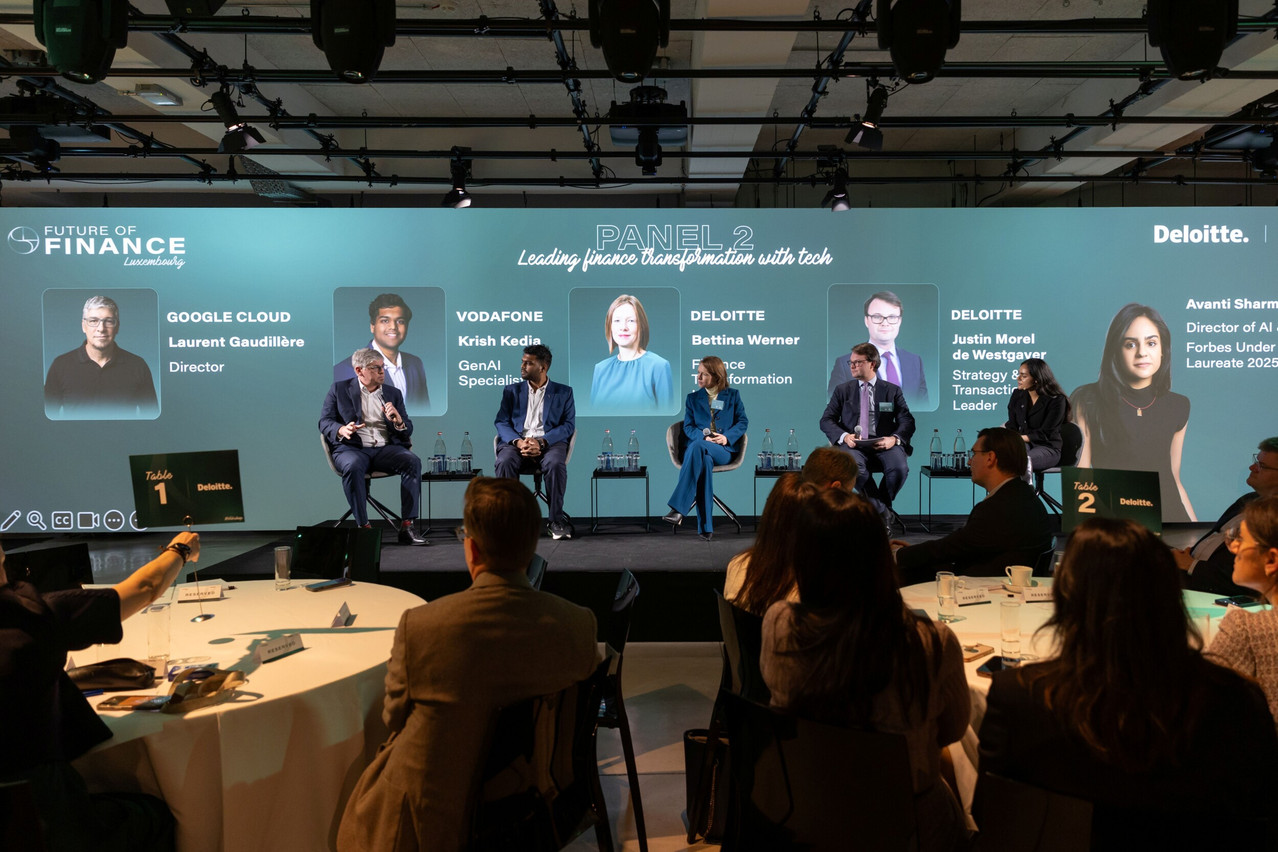
When Krish Kedia was an intern at Vodafone, part of his morning routine consisted of assessing the financial health of the telecommunications group's suppliers. With a procurement organisation dealing with around 100,000 suppliers, identifying potential financial difficulties among business partners was a particularly demanding exercise. Every morning, he would analyse the financial statements of five or six companies, examine their debt levels, calculate financial ratios and search for potential warning signs. By midday, he was expected to deliver detailed reports that could inform multimillion-dollar business decisions.
One weekend, a request to assess 40 suppliers from Germany by Monday prompted him to rethink the entire process. Speaking at Deloitte's inaugural Future of Finance conference in Luxembourg, Krish Kedia, now a GenAI specialist at Vodafone, explained how this experience led to the development of an AI agent capable of assessing suppliers' financial health and classifying them according to a red, amber or green risk rating.
The first attempt, however, was far from convincing. One of the company's largest suppliers was incorrectly classified as high risk. The mistake triggered discussions with compliance and legal teams, whose input helped refine the solution over six months. Today, according to Krish Kedia, the agent operates across several countries, including Romania, Greece and South Africa, analysing suppliers in different languages and identifying potential financial difficulties well before they materialise.
“It's able to not only analyse these suppliers, but tell you these warning signals six months in advance. You can prepare yourself,” he explained. The example illustrates how artificial intelligence is beginning to move beyond the automation of repetitive tasks towards something potentially more valuable for finance departments: anticipating risks and supporting business decisions.
From €6,000 to a $25 subscription
The economics of developing financial tools are also changing dramatically. Krish Kedia recalled how commissioning a Power BI dashboard could previously involve submitting a request to a team based abroad, waiting two months and receiving a bill of €6,000. Today, he argued, an analyst equipped with a $25 AI subscription could potentially develop the dashboard independently. Such developments are challenging not only the cost of technology but also the traditional division of responsibilities between finance professionals and IT departments.
For Laurent Gaudillère, director at Google Cloud, innovation should no longer be expected to come exclusively from centralised technology teams. The employees dealing with operational challenges on a daily basis may be better positioned to identify where artificial intelligence can make a difference. “Don't expect that your global team, IT department, will come with the solution,” he said, advocating a continuous approach based on testing, failure and adaptation.
The emergence of so-called vibe coding, which allows users to develop software through natural language instructions, is further accelerating this shift. Finance professionals who previously depended on specialist developers can increasingly experiment with building their own tools. Laurent Gaudillère argued that companies should provide employees with technological platforms and appropriate safeguards rather than restricting experimentation to a handful of centrally managed projects.
The most valuable innovation may ultimately come from an employee whose idea was never considered by the organisation's technology department.
When productivity gains become an accounting illusion ?
Yet cheaper technology and faster processes do not automatically translate into financial returns. Justin Morel de Westgaver, partner in strategy and transactions at Deloitte Luxembourg, challenged finance executives to apply the same investment discipline to artificial intelligence as they would to any other capital expenditure. “If you're not able to name a P&L line, a cash flow item or a risk factor that is being changed as a result of this initiative, you probably don't have a business case yet,” he warned.
For Justin Morel de Westgaver, assessing the value of AI requires looking at three dimensions: efficiency, effectiveness, and trust and adoption. Efficiency can be measured through hours saved, transaction costs or shorter financial closing periods. Effectiveness relates to tangible improvements such as more accurate forecasts, faster decision-making or better working capital management. Adoption, meanwhile, can be assessed through usage rates, error rates and the frequency of human overrides.
But he cautioned against automatically translating hours saved into financial benefits. “I would challenge you to only account for those if the capacity that you freed up can be redeployed or removed, because otherwise we are only talking about notional savings.” In other words, an AI tool that saves hundreds of working hours does not necessarily create financial value if the organisation fails to make productive use of that additional capacity.
Justin Morel de Westgaver also proposed a staged investment approach. Companies should look for early signs of success within three to six months, measurable financial results within 12 to 18 months, and longer-term benefits, such as reusable data and organisational capabilities, within two to three years. Crucially, companies should also establish what he described as “kill criteria” before committing capital. “You fund each and every stage and then you kill what doesn't prove to be effective.”
Poor data quality: an increasingly expensive excuse
One of the most frequently cited obstacles to deploying artificial intelligence remains the quality of corporate data. For Bettina Werner, partner in finance transformation at Deloitte Luxembourg, the problem often starts with something more fundamental than technology: the absence of a common language within organisations. “If you go back to your company and you ask three people in different functions about what is revenue for them or what is headcount, I think you come back with four different answers,” she said.
Establishing common definitions, assigning clear ownership of financial data and implementing appropriate controls are therefore essential foundations for scaling artificial intelligence. However, Bettina Werner challenged the argument that organisations should wait until their data is sufficiently clean before experimenting with AI. “You've been operating with those numbers for the past 20 years and it wasn't anything that was blocking you,” she said. “I think it's just an excuse and it can be quite an expensive excuse if you wait for too long.”
Rather than treating imperfect data as a reason to postpone investment, companies could use artificial intelligence to identify inconsistencies and progressively improve the quality of their information. Bettina Werner also stressed that transforming finance requires involving departments beyond the CFO's immediate remit. Sales, operations and human resources all contribute to processes that ultimately feed into financial reporting and decision-making.
Automating an isolated task within the finance department may deliver incremental efficiency gains, but it risks overlooking the opportunity to redesign an entire business process.
The hidden risks of restricting AI
While companies seek to establish governance frameworks around artificial intelligence, excessively restrictive policies could generate a different category of risk. Bettina Werner pointed to employees who are already experimenting with AI outside their organisation's approved technological environment. “They are sending data to their own PC and do it at home because they don't have access,” she said. Her recommendation to finance leaders was deliberately simple: “Let them play.”
The objective, she explained, should be to provide employees with access to AI within a secure environment, allowing them to identify practical applications while protecting corporate information. Laurent Gaudillère echoed this concern, warning about the emergence of “shadow AI” — the use of artificial intelligence tools without the knowledge or approval of an organisation. “Your data will be exposed somewhere else and that's a real risk that you need to cover,” he said.
The challenge for companies is therefore to strike a balance between protecting sensitive information and giving employees sufficient autonomy to experiment. Restricting access does not necessarily prevent the use of artificial intelligence. It may simply push that activity beyond the visibility of the organisation.
From scorekeeper to strategist
Ultimately, the transformation of corporate finance may be less about the disappearance of the CFO than about a fundamental change in the purpose of the finance function. As automation increasingly handles transactional work and predictive tools turn forecasting into a more continuous exercise, finance leaders will have to decide how to use the additional capacity and insights generated by technology.
For Krish Kedia, the success of AI should also be measured through its ability to develop employees' capabilities, encourage curiosity and give teams the opportunity to address business problems that they previously lacked the time to explore.
Justin Morel de Westgaver argued that the greatest opportunity for CFOs lies not in efficiency itself but in using those additional resources to steer capital allocation, strengthen business resilience and support growth in real time.
Doing so will require more than technological investment. Companies will also need to reconsider their operating models, talent requirements and data infrastructure.The CFO's transition from scorekeeper to strategist may ultimately be one of the most significant consequences of artificial intelligence in corporate finance.
As Justin Morel de Westgaver put it, the question finance leaders should increasingly be asking themselves is: “Is my finance team set up to report the numbers or to change them?”