Few players… but ideas that are shaking up the status quo. The paradox is striking: whilst Luxembourg is one of the European countries hardest hit by the housing crisis, alternative models remain underdeveloped. Whilst other countries are rolling out a range of schemes such as shared housing, flexible tenancies and hybrid housing schemes, Luxembourg has only a handful of organisations involved.
Among them is Roomie Radar focuses on matching landlords and tenants. WeConnect promotes intergenerational coexistence. Vauban&Fort, which has taken over LuxFriends, is bringing a professional approach to co-living, whilst Loft68 and Furnished.lu are continuing their activities, albeit more discreetly. Even the Kirchberg Fund is experimenting with these new forms of housing with Kiem 2050, whilst the Luxembourg School of Religion and Society (LSRS) provides accommodation for its students at the Centre Jean XXIII–Grand Séminaire. They are all taking different approaches. Yet they all share the same aim: to maximise the potential of existing accommodation.
We would like to encourage more homeowners to make their spare rooms available.

Roomie Radar focuses on “lonely” rooms
For Roomie Radar, the solution to the crisis does not lie solely in building new properties. “We want to encourage more landlords to make their unoccupied rooms available. Every empty room has the potential to become a home,” say co-founders Salvador Reynés and Javier Geisseler, young Spanish expats who found themselves “thrown in at the deep end” in Luxembourg’s accommodation jungle and were resourceful enough to come up with a solution to the shortage straight away.
The pair have indeed observed an increase in “empty nests” – those vacant bedrooms in the homes of parents whose children have gone off to study in other (perhaps sunnier?) climes. Choosing to let such a room is certainly no consolation for the absence of the prodigal child, but it is a mutually beneficial arrangement for both the tenant and the landlord.

According to the founders of Roomie Radar, “every empty room holds the potential to become a home”. (Photo: Julian Pierrot/Paperjam)
This is because – in a significant development – letting rooms on an individual basis is proving increasingly attractive to landlords, both as a way of improving their returns and of offering more affordable accommodation. It is also a way of making better use of existing property stock, without further encroaching on land or having to wait for new housing developments to be completed, in a context where every available square metre counts.
The start-up is also accelerating its growth. An interactive map, a presence in Brussels with seven partner companies, collaborations with Amazon and EY, an official endorsement from the University of Luxembourg… All these milestones demonstrate the company’s growing momentum and its determination to make shared accommodation a genuine driver of residential mobility, extending well beyond the Luxembourg market alone.
WeConnect brings generations together
In the same vein, WeConnect promotes intergenerational cohabitation. The company aims to demonstrate that a spare room in a senior citizen’s home can meet the needs of a student or a young professional. “Our aim is to show that there is another way to tackle the housing crisis,” says Ivo Silva, one of the platform’s founders. The model is based on a supervised matching process, where the expectations of both parties are taken into account to foster a long-term living arrangement based on trust and mutual respect.
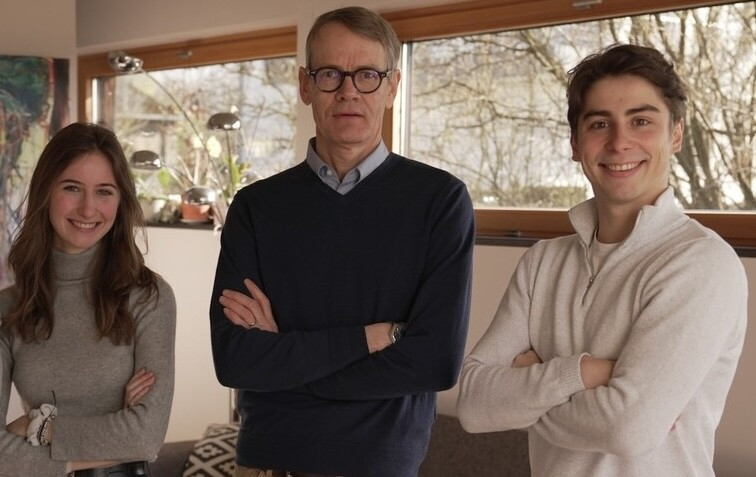
Alternatively, WeConnect aims to show that a spare room in a senior citizen’s home can meet the needs of a student or a young professional. (Photo: Paperjam)
The company is aiming for around 150 active co-living arrangements before considering a fundraising round in 2027, followed by expansion across Europe. Its mission centres on housing, but also on fostering social connections, by combating isolation amongst older people whilst offering a practical solution to the housing access challenges faced by younger people.
Even property developers are rethinking their plans
Platforms are no longer the only ones driving innovation in shared spaces. For example, with the Kiem 2050 project, the Kirchberg Fund is incorporating these new practices into a fully-fledged urban development. “Live where you work” – that’s a slogan that really catches the eye. The future neighbourhood will feature hybrid housing that blends private life with professional activity, as well as several co-living spaces designed for young workers.
Consequently, the home becomes a space capable of evolving in line with the needs of its occupants, maximising time savings and, by extension, financial savings and quality of life. Communal spaces, shared services and close proximity to shops, transport and leisure facilities also contribute to this new way of living, where usage is gradually taking precedence over mere ownership. This approach meets both the aspirations of the younger generations and the imperatives of sustainability and resource optimisation.
A market still struggling to gain momentum
The sector is slowly beginning to take shape. Vauban&Fort, which has merged with LuxFriends, now manages more than 90 properties with an occupancy rate of 97%. Loft 68 remains active, although its profile has diminished, whilst Furnished.lu continues to operate more discreetly. Alongside these companies, the Luxembourg School of Religion and Society also offers rooms for its students through the Jean XXIII Centre. A number of local initiatives are also emerging, often on a still modest scale, evidence that the market is gradually seeking a new balance in the face of demand that continues to far outstrip supply.
An observation that is ultimately as simple as it is thought-provoking: despite property market pressures that are amongst the highest in Europe, innovations remain in their infancy. The few players involved are, however, exploring avenues that are worth monitoring closely. After all, building more homes will remain essential. But integrating the concept of sharing existing homes in a more sustainable way could well become, in the future, part of the solution – one that is both practical and virtuous.
This article was written for the supplement Living & Workspace from the October 2026 issue of Paperjam magazine, published on 16 September. The content is produced exclusively for the magazine. It is published on the website to contribute to Paperjam’s comprehensive archive. Click on this link to subscribe to the magazine.
Is your company a member of the Paperjam Club? You can apply for a subscription in your name. Please let us know via club@paperjam.lu.