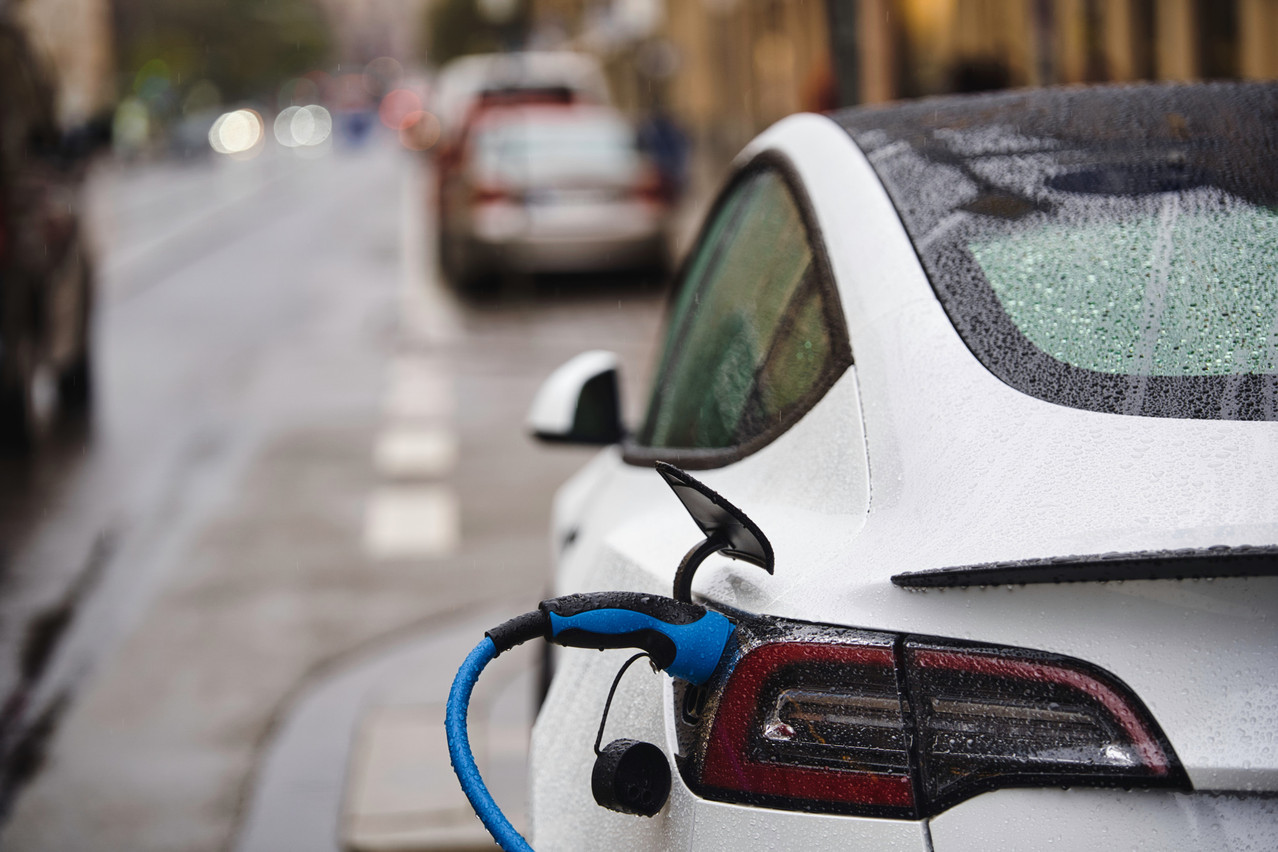
The transition to electric cars is progressing in Luxembourg, but at a rate that is insufficient to achieve the targets set by the National Energy-Climate Plan. This was the central conclusion drawn by Frédéric Meys, economist at Idea, at a public debate held on Wednesday at the Chamber of Commerce. Despite a high proportion of new electric and plug-in hybrid registrations - between 30 and 35% by the end of 2025 - the current momentum would only allow electric vehicles to account for between 17 and 20% of the total car fleet by 2030, well short of the national target of 49%.
This slowness contrasts with several of Luxembourg’s structural strengths. The car fleet is relatively young, with an average age of between 6 and 8 years, compared with around 12 years in the European Union, which means it can be replaced more quickly. Almost 22% of vehicles are company cars, which are generally renewed on short cycles. The high standard of living and a dense recharging infrastructure - Luxembourg ranks second in Europe in terms of the number of charging points per 100km, behind the Netherlands - are also favourable factors. However, these advantages find their limits as soon as you go outside the national territory, particularly in France, where recharging coverage is much less developed, which weighs on the perception of long-distance use.
Multiple barriers to adoption
There are still many barriers to electromobility. The technology on offer is evolving rapidly, with regular advances in batteries and range, which is fuelling consumer hesitation about the “right time” to invest. Added to this is persistent anxiety about the actual range of vehicles, as well as an additional purchase cost that remains a deterrent for some households, despite existing subsidies.
It is precisely on this economic terrain that Frédéric Meys’s keynote provides figures. His analysis is based on a comparison of 15 pairs of vehicles that are as similar as possible, differing only in their engines, such as the BMW X1 and iX1. Two scenarios were studied: a six-year purchase with 15,000km driven per year, and a three-year lease with 20,000km driven per year. The calculation of the total cost of ownership includes acquisition, energy, maintenance, insurance and tax, the latter playing a marginal role in the final differential.
The results show that, including premiums, the electric vehicle is financially more advantageous in 12 out of 15 cases for a six-year purchase. The average saving remains modest, at around €2,255 over the period, but it is real. However, without a purchase incentive, the advantage is systematically reversed in favour of the internal combustion engine. In leasing, the advantage of electric vehicles is even clearer: in 14 out of 15 cases, the electric option is more advantageous. These results confirm the decisive role of public subsidies in the current economic equation.
In detail, the initial extra cost of purchasing electric vehicles is gradually being offset by lower running costs, mainly due to lower energy consumption and maintenance costs. On the other hand, annual taxation remains too low - around €30 a year for an electric vehicle - to really influence consumer choice. A peculiarity of Luxembourg also emerges from the analysis: in the absence of incentives, the overall tax burden of an electric vehicle may turn out to be higher than that of a combustion vehicle, due to the application of VAT on a higher purchase price, a phenomenon little observed in other European countries.
A costly strategy
Beyond the cost to households, the study looks at a dimension that is rarely quantified in the public debate: the environmental cost of electrification policy for public finances. Frédéric Meys uses the abatement cost method, which relates the discounted cost differential between an electric vehicle and a combustion vehicle to the tonnes of CO2 avoided. Four scenarios are analysed, ranging from a strictly national scope - in line with the Pnec - to an approach integrating vehicle production and imported electricity, including when the vehicle is manufactured outside Europe.
According to these assumptions, the total cost per tonne of CO2 avoided is around €400 to €900. For public authorities alone, the cost varies from €533 to over €1,200 per tonne, depending on the scenario adopted, while the private differential is negative, reflecting a financial gain for the household. By way of comparison, the price of a tonne of CO2 on the European ETS market hovered around €70 to €75 last year. These orders of magnitude underline the costly nature, in budgetary terms, of the current strategy to electrify the car fleet.
Faced with this observation, several avenues for reflection have been put forward. Social leasing and direct deduction of the purchase premium are among the measures already envisaged or being implemented, with a variable budgetary impact depending on how they are targeted. Other levers are considered possible but politically sensitive, such as the development of low-emission zones, greater modulation of the annual road tax or the introduction of a road tax geared towards internal combustion engines. Better communication on the real economic benefits of electric and, more broadly, policies aimed at reducing the total number of vehicles on the road were also mentioned.
Differences on the levers to be activated
For 

These discussions highlighted a central tension: while electromobility appears to be rational in economic terms and effective from a climate perspective, it remains politically and socially complex to generalise. Where the economist questions budgetary efficiency and the cost per tonne of CO2 avoided, the politician evokes social acceptability and the transformation of uses, while the automotive sector recalls the concrete constraints of the market and consumer behaviour.
In the background, the debate has shifted the question. It is no longer just a question of knowing whether the electric car makes economic sense, but of determining how to combine incentives, infrastructure, taxation and communication to align economic rationality, political credibility and the reality on the ground. It’s a question that goes far beyond technology alone, and one that calls, beyond the figures, for a societal choice about the place of the car in tomorrow’s mobility.