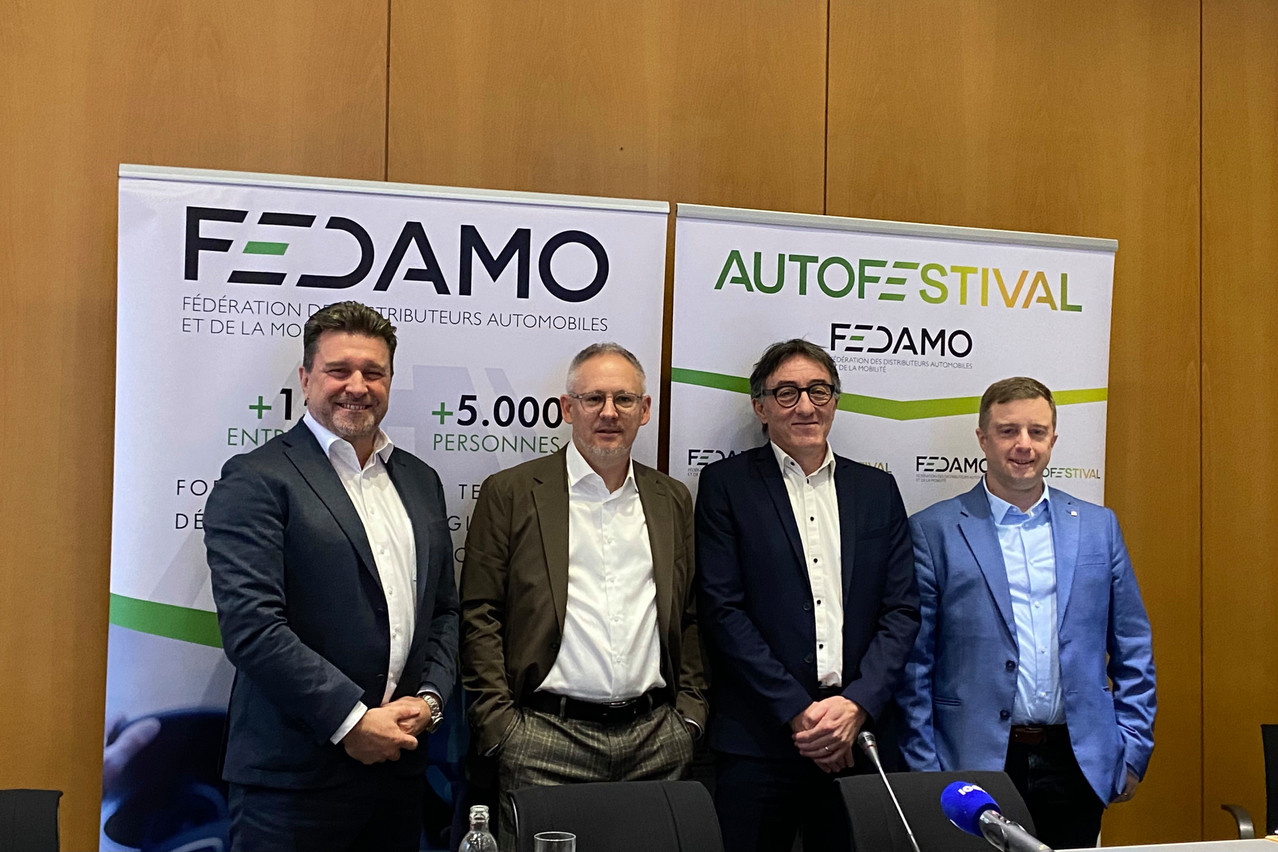
“Autofestival still has a bright future ahead of it and we will continue to push this operating model for many reasons. Admittedly, we no longer see sales peaks like we did some 15 years ago, but that’s because the market, customers and the way they buy cars have changed,” analysed Philippe Mersch, president of the Federation of Automobile Distributors and Mobility (Fedamo) on Monday 12 January, at the press conference for the new edition of Autofestival.
This year’s event will run from 24 January to 2 February. For one week, more than 90 car and motorbike dealerships across the country will open 190 showrooms to mark the 62nd edition of Autofestival.
The government must continue its investment in the electricity network.

“It’s also an opportunity to focus on the automotive sector, its difficulties, and get our messages across,” the chairman explained. These include, in particular, the need to maintain support after 30 June 2026 “in order to halt this downward trend [in 100% electric vehicle registrations, editor’s note] and maintain the appeal of zero-emission electric mobility. […] The government must continue to invest in the electricity grid, develop the charging infrastructure and facilitate the installation of charging points for private individuals and businesses,” continued Philippe Mersch.
Return to normal for vans
The latest figures published at the beginning of January show that Luxembourg’s car fleet remains overwhelmingly internal combustion-powered. Petrol and diesel vehicles still account for almost 76% of cars on the road, illustrating the structural inertia of the fleet despite the rapid growth in sales. Electrified powertrains are gaining ground, but remain in the minority: hybrids, whether rechargeable or not, account for 15.5% of the fleet, while 100% electric cars account for 8.7%. Alternative powertrains remain marginal.
According to statistics from the SNCA (national road traffic authority), 47,161 new cars were registered in Luxembourg during 2025, which ended with a slight increase of 1.1% on the previous year. At the same time, 4,755 vans (+19%) were put on the road: “This is a return to normal compared with a year 2024 marked by a crisis in the construction sector,” noted Manuel Ruggiu, operational director of the SNCA.
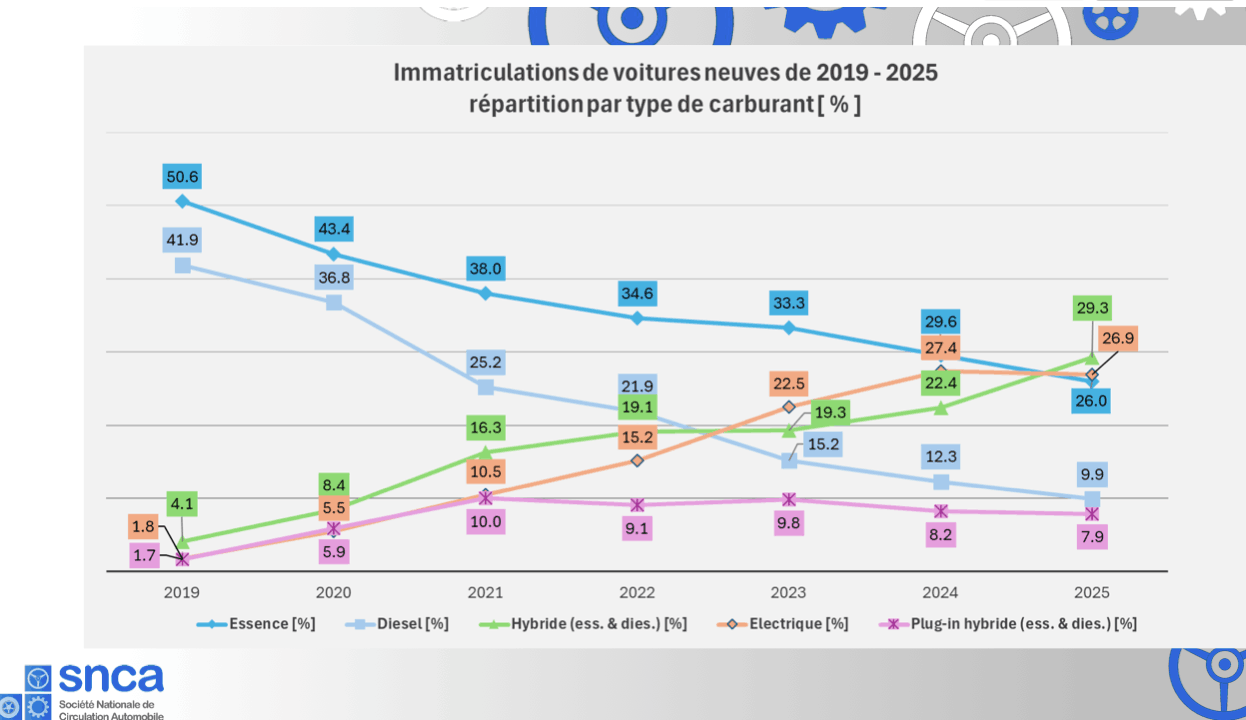
Distribution by fuel type of new car registrations, from 2019 to 2025. (Photo: SNCA screenshot)
All vehicle categories combined, 133,587 vehicles were registered in 2025, an increase of +3.4% compared to 2024. 75,235 used vehicles were registered, including 62,017 cars, an increase of 4.5%. The new car market continues to stagnate, while the used car market continues to grow. The market share of cars that can be recharged with an electric socket stands at 34.7%, representing just over a third of new cars.
For internal combustion engines (not externally rechargeable), the market share of diesel engines is 14.6%, compared with 64.7% in 2016. The market share of petrol engines is 50.6%, compared with 33.4% in 2016. “We are clearly seeing a paradigm shift and the largest share of registrations is now hybrid-powered vehicles, which are recording the biggest growth, from 10,455 to 13,825 units [+32.2%, editor’s note],” reported the national company.
The forecast was 50% [electric] by 2030 and we can see that this is not unrealistic, it’s simply impossible.
Although plug-in models are down -2.8%, from 3,824 to 3,718 units, SNCA statistics show that 64% of new registrations are electrified and 34.7% are plug-in models. “However, we note that, for the first time in years, the number of electric car registrations was down slightly, [from] 12,777 units in 2024 to 12,664 units in 2025 (-0.5%),” noted Manuel Ruggiu further.
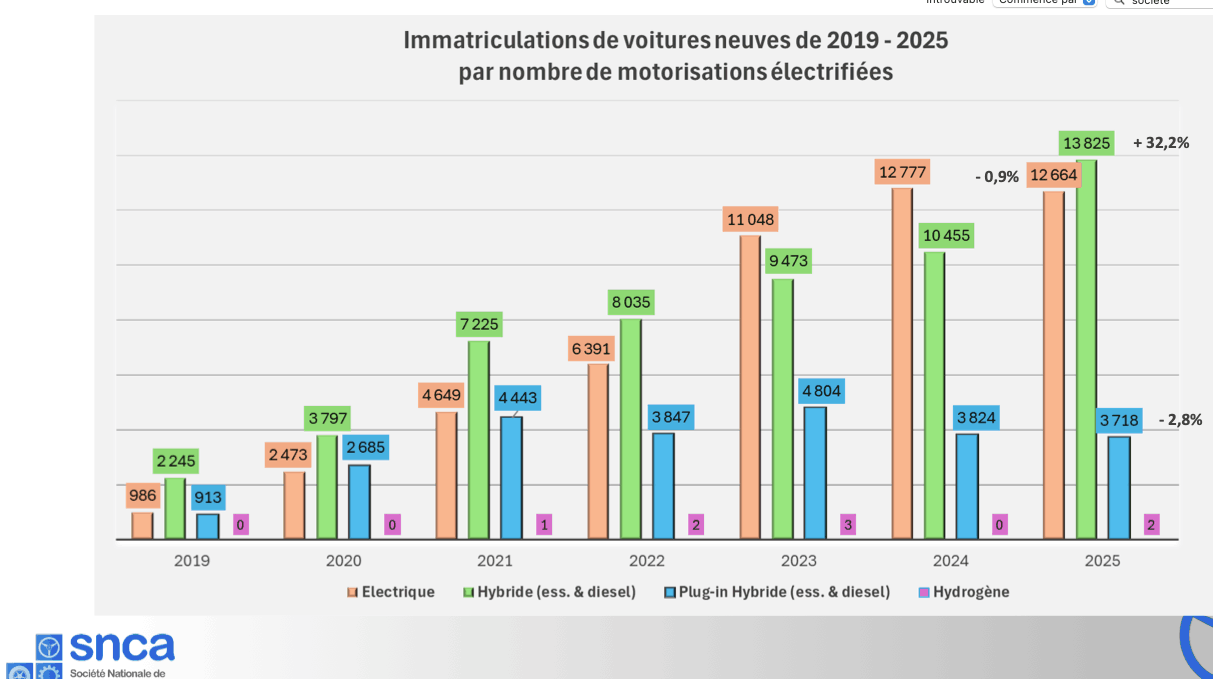
Evolution of new car registrations, by type of electrified powertrain. (Photo: SNCA screenshot)
“Impossible” targets to achieve
And while the European Commission recently abandoned its target of achieving a 100% electric fleet by 2035, what does the future hold for electric motoring in Luxembourg? “Under the PCEN*, the target was 50% by 2030, and it’s clear that this is not unrealistic—it’s quite simply impossible. Even if we are optimistic, we shouldn’t exceed 30%,” added Philippe Mersch.
For many years, the country has based its automotive economy on company vehicles, “a market that is also shrinking because we are seeing a decline in operational leasing contracts, due to taxation that has become unfavourable”. Luxembourg may therefore have to reinvent its automotive sector, which nevertheless accounts for almost 6,000 direct and indirect jobs, with significant tax revenues.
*Luxembourg’s integrated national energy and climate plan.