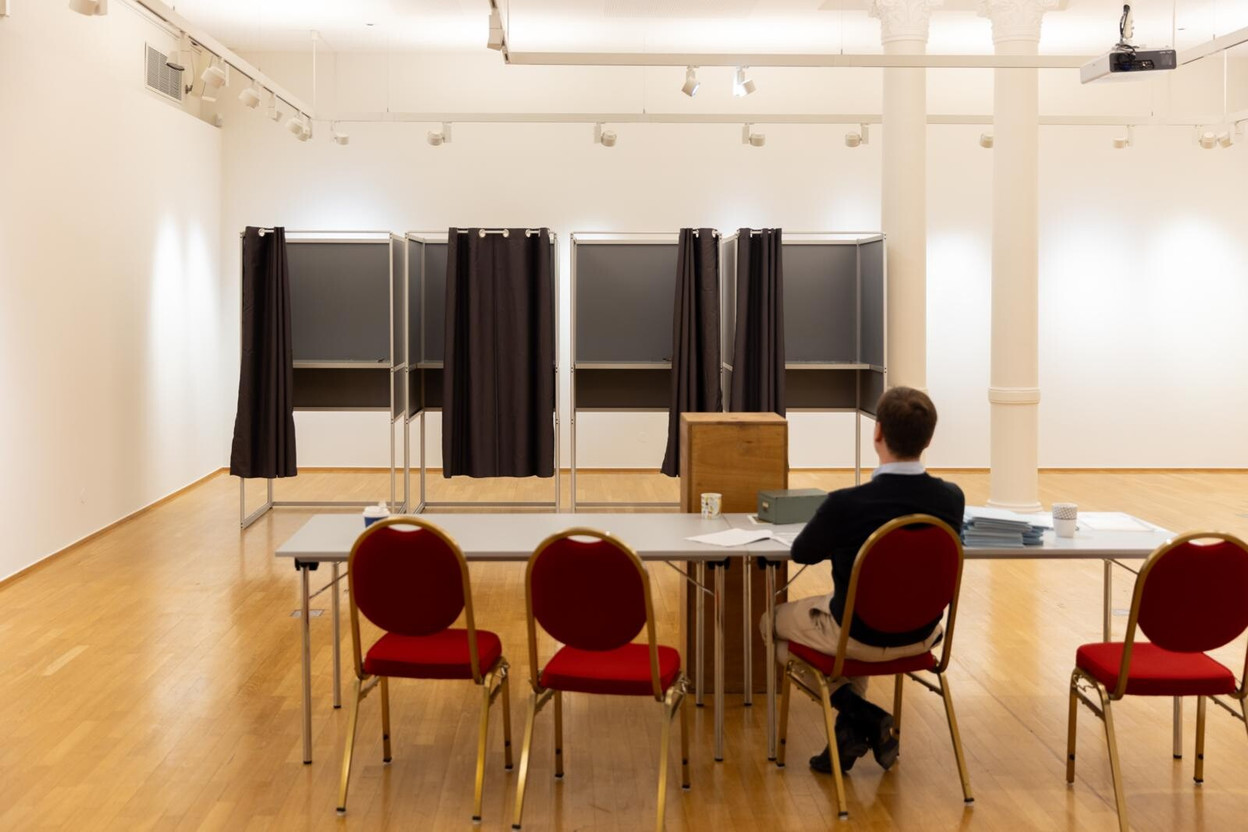
Luxembourg is considering internet voting to help citizens abroad avoid postal delays and make complicated ballot papers easier to complete. After parliament requested a proposal in April, the Centre des technologies de l'information de l'État (CTIE) outlined a possible system to MPs on 26 October.
But Laurent Zeimet, the CSV MP who chairs parliament's institutions committee and proposed the motion, says the country is far from deciding to introduce it. “I wouldn't say there is a consensus that we should introduce it,” he told Paperjam on 29 October. The argument centres on whether an election result could be independently trusted if the count were challenged.
A mandate, not approval
Parliament adopted motion 4782 on 28 April by 51 votes to four, with five abstentions. It asked the government for a proposal, a possible pilot and a roadmap addressing costs, technology and safeguards. The vote authorised preparation, not online elections.
Citizens abroad were seen as possible first users. CTIE figures show that ballots failed to reach ballot boxes for about 4.5% of postal-vote requests in recent national and European elections, compared with 6.5% in municipal elections. The agency cautions that postal delays, procedural errors and voters not returning ballots all contribute; it cannot say how many votes an online alternative would recover.
The proposed online ballot could also warn people when they had allocated more votes than permitted or left votes unused. The CTIE says digital checks might reduce errors, but it cannot quantify how many invalid paper ballots are caused by mistakes rather than deliberate choices.
The preliminary system would let electors register through MyGuichet.lu and submit encrypted ballots before polling day. Their identities would be separated from votes, with designated officials jointly controlling the key to decrypt them. Voting online would rule out a subsequent paper or postal vote, and ballots could not be changed once cast.
Zeimet sees the convenience but draws a distinction between everyday digital services and elections. “We also trust our bank, don't we? But the electoral process is something different,” he said. A disputed count, particularly in a national election, would have consequences well beyond a technical malfunction.
Who can recount the votes?
At the October hearing, CSV MP Alex Donnersbach asked how votes could be recounted after a suspected attack. Paper ballots can be examined again by another team. What would replace that safeguard in an electronic election?
CTIE representative Nico Majerus said technical logs could help specialists investigate interference and independent audits would examine both security and electoral procedures. He acknowledged that absolute security was impossible. Donnersbach pressed him on whether ordinary citizens would have to accept the conclusions of a small group of highly specialised experts.
“That's correct, yes. That's one of the risks,” Majerus replied.
Zeimet identified the same obstacle in his interview. “One of the main problems for people is that verification of the results can only be done by some specialists,” he said. ADR MP Fred Keup also expressed scepticism, while DP MP André Bauler stressed that paper ballots remained available if a result were contested: “At least we have documents that can be counted again.”
Audits versus verification
The CTIE's technical note accepts that a fully verifiable system is possible but considers it much more complex. In written answers to Paperjam on 3 November, the agency confirmed that its model would not include end-to-end verification. Instead it favours transparent procedures, specialist audits and technical checks to balance confidence with accessibility.
End-to-end verification aims to let voters and observers check that ballots were correctly recorded and counted without exposing individual choices. Audits can inspect code and procedures, but their conclusions depend on trusted specialists.
Peter Roenne, a researcher at the University of Luxembourg's Interdisciplinary Centre for Security, Reliability and Trust (SnT), co-authored a CTIE-commissioned study in April 2025 that stresses verifiability. “We always recommend having a fully verifiable system,” he told Paperjam on 3 November.
He also explained the limits of technical inspections. “So audits can bring something, but just seeing that you don't find a flaw doesn't mean that there are no flaws,” he said.
The April 2025 study warns against assuming that any technology can already make large, high-stakes internet elections simultaneously secure, practical and easy to use. Roenne had not seen the October proposal when interviewed. After receiving it, he wrote on 10 November: “Independent audits require trusted auditors, and certification can bring you a level of assurance, but not the same level as verifiable systems.” Parliament's motion had required verifiability but had not specifically demanded end-to-end cryptographic checks.
Risks beyond hacking
A reliable count would not prevent pressure on someone voting from home or interference through a compromised device. A cryptographically verifiable result would not, by itself, eliminate either danger.
Roenne explained the difficulty of combining verification with safeguards against coercion. “Yes, there are methods to achieve this, but the challenge is to achieve this and still not be able to sell your vote, like give a proof to a vote buyer that you actually voted in a specific way, or to have coercion resistance,” he said.
Estonia allows voters to replace an online ballot, including later with a paper vote, to reduce the coercion risk. Luxembourg's proposed single-vote rule would offer no equivalent protection.
Majerus said allowing replacement votes would complicate secrecy and security. The CTIE subsequently confirmed that its single-vote approach was provisional; Roenne said the implications depended on the design and could also complicate verification.
Small electorates present another risk. If the votes of a few online electors were reported separately, individual choices might become easier to infer. The CTIE proposes a minimum number of online votes per constituency; wider aggregation could also help, Roenne said, depending on legal reporting requirements.
Costs and political choices
The CTIE estimates four to five years of preparation, potentially allowing use after 2030. Its €2.7m initial estimate includes €2m for development, €500,000 for audits and €200,000 for expertise. It assumes permanent in-house capacity and excludes some equipment, recurring security work and costs of future elections. The agency says a reliable overall budget cannot yet be given. Its proposals would also require a permanent organisation to manage the election system, tests and repeated audits.
Zeimet questions whether five years is realistic and has doubts about beginning with national elections. Less consequential contests, such as social elections, might provide a first test. He is not currently in favour of offering internet voting to the entire electorate.
His concern also extends to what election day means. People currently discuss their choices until polling day before participating in a collective decision. “If everybody votes for himself from home, wherever he is on a different day, that's not the same election as it is today,” he said.
The CTIE proposes a non-binding full election simulation to test the system before real votes are cast. Separately, it envisages a permanent online ballot simulator, allowing people to practise allocating votes and receive warnings about errors without submitting actual ballots. Zeimet considers the practice tool useful even if binding internet voting does not proceed.
Parliamentary groups are due to discuss the project with Prime Minister Luc Frieden on 30 November. Zeimet wants them to decide whether to continue, stop or take a more limited approach. A ballot-practice tool could proceed without committing Luxembourg to online elections. The full voting system, by contrast, would still require technical design, testing and changes to electoral law before any binding use.