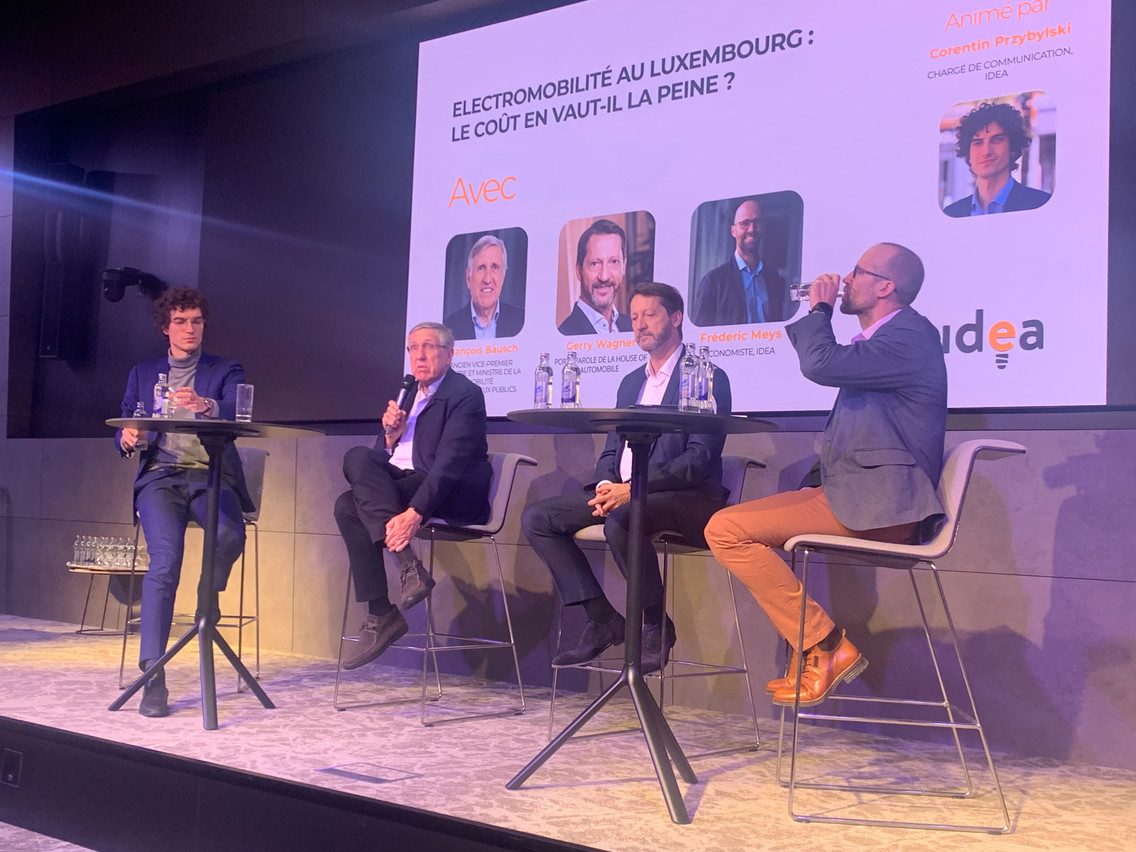
As things stand, Luxembourg will not achieve its electric car targets: take-up is too marginal, said Frédéric Meys, an economist at the Idea Foundation, at a new format of the think tank, between noon and 2pm at the Chamber of Commerce. While the transition to electric mobility is progressing in Luxembourg, it is still hampered by one key factor: range. This is one of the cross-cutting findings of the debate bringing together representatives of the automotive sector, politicians and economists. Although the total cost of ownership of electric vehicles is now competitive with combustion engines, including incentives, this progress is not enough to dispel the reservations of some motorists.
Presented alongside the debate, a recent study by Auto Touring ACL puts this mistrust into figures. Tested in realistic winter conditions, 14 electric models show an average difference of 41.3% between the advertised WLTP range and the range actually measured. The difference was even as high as 57% for fuel consumption, while rapid recharging recovered an average of just 34% of the starting capacity in 20 minutes. Results that confirm a reality already widely felt in the field, particularly during long-distance journeys in winter, as this test was carried out by cooling the selected cars for 14 to 18 hours at zero degrees before asking them to complete a journey on the motorway between Munich and Berlin, at a speed of between 113 and 116km/h, with the cabin heated to between 20 and 23 degrees.
Not all models are in the same boat, however. According to Auto Touring ACL [members-only article], the Tesla Model Y, the Polestar 4 and the Audi A6 Avant e-tron stand out for their greater consistency between promises and actual performance, with gaps that are more contained than average. Conversely, some vehicles show much more marked discrepancies, fuelling the perception that the technology is still imperfect.
This question of autonomy is, however, for some stakeholders, more psychological than technical. 
Recharging promises not kept
The fact remains that perception is not limited to the distance that can be covered. The reliability of the estimates displayed on board, the actual recharging speed and the availability of infrastructure all play a decisive role in the acceptance of the technology. As François Bausch pointed out, frustration stems less from reduced range than from a promise of fast charging that is not kept in practice. A point also raised by several participants from the audience, referring to charging points boasting high power but delivering far inferior performance in real-life conditions.
For 
Beyond the technical aspects, the debate also highlighted a wider strategic issue. Frédéric Meys, an economist at Idea, pointed out that the instability of European political signals, particularly around the 2035 horizon, blurs the clarity for consumers and manufacturers alike. Against a backdrop of increased competition from Chinese manufacturers, the credibility of the electric transition also depends on Europe’s ability to control the industrial chain, particularly battery production.
In the short term, therefore, range remains the crystallisation point for doubts, whether based on experience or perception. Until the gap between claimed autonomy and experienced autonomy is better understood, explained and reduced, electric cars will struggle to win over users who have already been won over. This is a central challenge if Luxembourg is to achieve the target of 49% electric and plug-in hybrid vehicles set by its National Energy-Climate Plan by 2030.