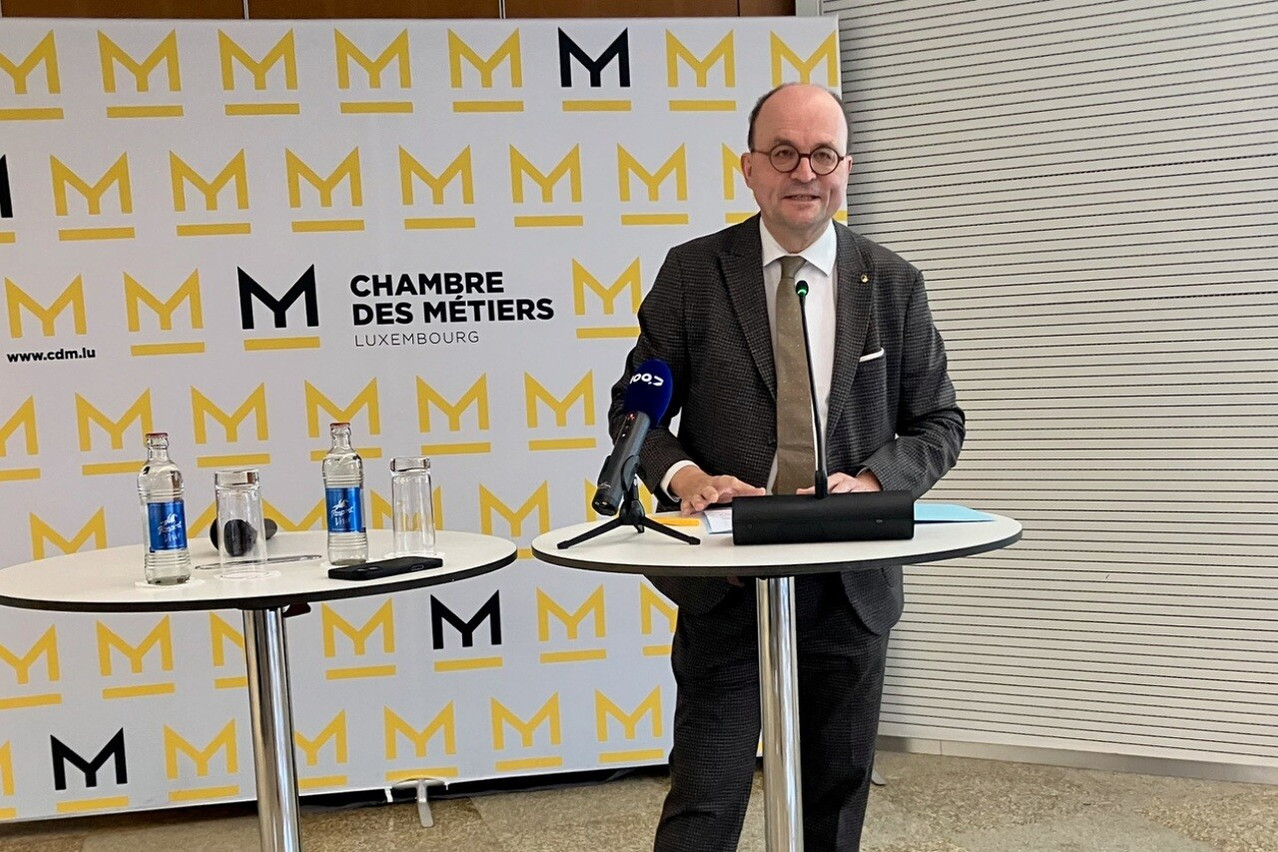
In its opinion presented on Thursday 19 November, the Chamber of Trades argues that “continuing to pursue a largely reactive policy aimed at producing short-term effects that are noticeable to the public leads to long-term deficits and jeopardises the prosperity of future generations”.
In the view of its chief executive, 
The cost of immediate support
The government intends to support growth by boosting households’ purchasing power and the competitiveness of businesses. According to figures presented by the Chamber of Trades, the new measures as a whole would have a net budgetary cost of €939m in 2027 and nearly €2bn from 2028 onwards.
For this second year, the Chamber has identified, in particular, €810m in measures to boost purchasing power and €193m to enhance business competitiveness. It welcomes the one-point reduction in local authority income tax and the increase in the tax credit for digital, environmental and energy investments.
However, she believes that the expected gains from the tax reform are too small in relation to its cost. In her view, the government is banking on growth generating sufficient revenue to fund these measures in the long term. If growth falls short of expectations, the state will have less scope to invest in housing and to cope with rising expenditure on healthcare and pensions.
Higher revenue, a larger deficit
Max Urbany, chief economist at the Chamber of Trades, compared two successive forecasts for 2027. The central government’s expected revenue has been revised upwards by €1.4bn in the space of a year. The projected deficit has also been revised upwards by €450m, to €1.95bn. Over the period 2025–2030, the updated forecast shows cumulative deficits of €11.9bn.
Part of the revenue surplus is due to one-off factors, including an exceptional number of inheritances and the faster processing of tax returns. The Chamber believes that this revenue provides the government with financial leeway, which it should use to prepare for future expenditure.
Ways to spend money more wisely
“We are not here merely to criticise, but also to put forward proposals,” emphasised Tom Wirion during the presentation. Among the ideas put forward by Gilles Walers, Director of Strategic, Legal and European Affairs, is a proposal to allocate a portion of the tax revenue linked to the financial centre’s performance to the Intergenerational Sovereign Fund.
The Chamber also wishes to review the allocation of expenditure. In 2027, the social budget is set to rise by 8.4%, whilst direct and indirect investment by central government is set to fall by 0.7%. This is an unwelcome imbalance.
Gilles Walers advocates targeting support more specifically at the most vulnerable households. According to the Chamber, the savings thus generated could be used to fund housing and energy-efficiency refurbishments. To better control the costs and timelines of public works projects, it also proposes involving contractors, architects and engineering firms from the project design stage onwards.
With regard to the funding of the social model, the Chamber is calling for structural pension reform, closer monitoring of the CNS’s expenditure before any further increase in health insurance contributions, and a genuine policy to tackle absenteeism.
Finally, she wants every budget programme to be accompanied by measurable targets, so that the government can decide, on the basis of the results, which areas of spending to maintain, redirect or cut.