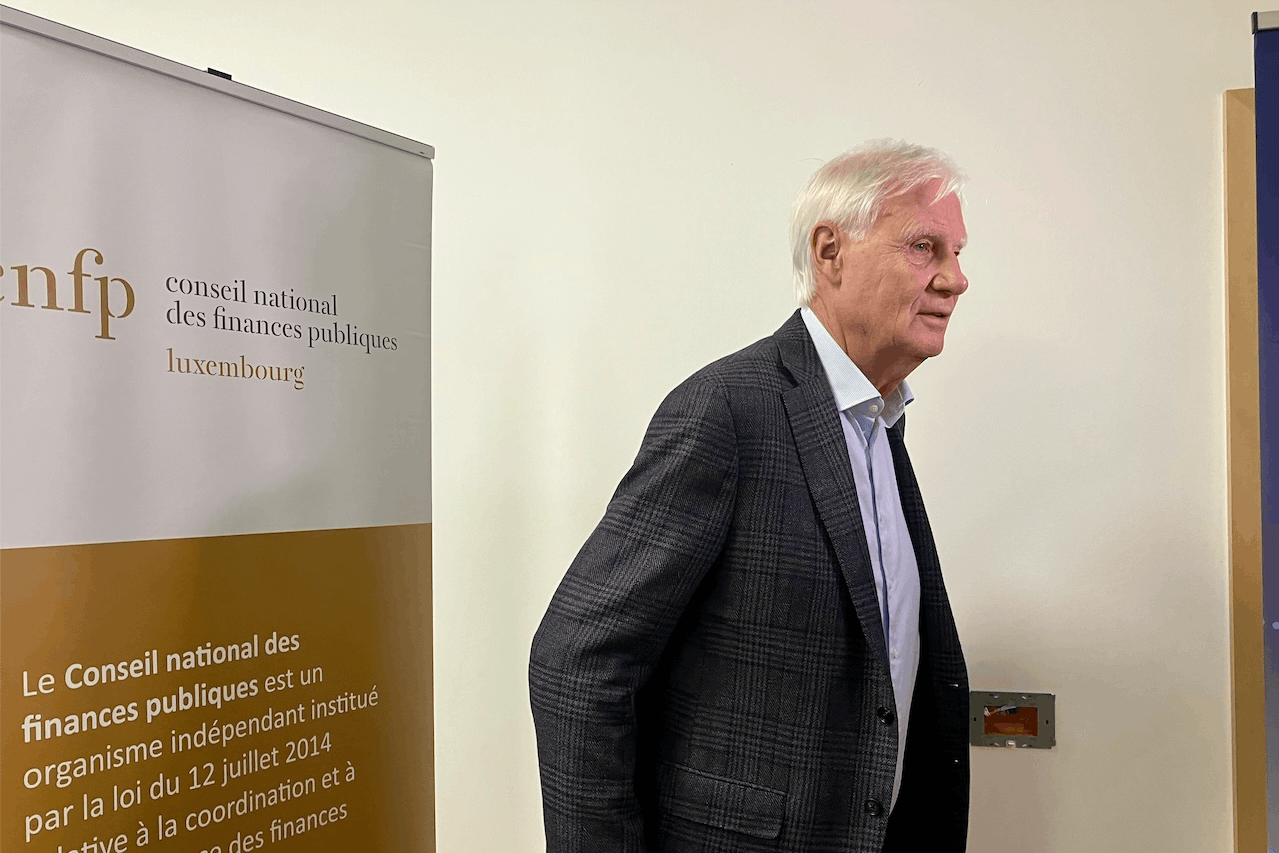
Luxembourg is still able to fund its budgetary choices. However, it must prepare the trade-offs that will enable it to keep costs under control. Presenting the assessment of the 2027 draft budget and the 2026–2030 financial programme on 17 November, the chair of the National Council for Public Finance (CNFP), 
Admittedly, Luxembourg’s low level of public debt gives it the leeway to pursue this policy, which the government describes as “counter-cyclical”. However, this capacity for action does not mean there is no need to plan for the future. The improvement forecast from 2029 onwards will depend on the government’s ability to curb current expenditure in the long term and/or to influence revenue. However, the needs arising from an ageing population, defence, housing, infrastructure, and the climate and digital transitions will continue to grow.
Romain Bausch also highlights the limitations of budgetary support in a small, highly open economy: part of the expenditure benefits economic activity abroad. The benefits to the Luxembourg economy cannot, therefore, be total.
Improvement masks deterioration
Over the entire 2026–2030 period, the general government sector is expected to remain in deficit, averaging €896m per year, or 0.9% of GDP. Central government alone would post an average annual deficit of €1.92bn. Compared with the previous forecast, however, the overall balance has improved slightly: by an average of €132m per year over 2027–2029. However, this favourable revision stems from local authorities and the social security system. It offsets a deterioration of €508m per year in the central government’s balance, whose expenditure has been increased more than the revenue.
Short-term results are also benefiting from one-off inflows. The CNFP notes the accelerated processing of previous tax returns and, in 2026, an exceptional estate worth over €400m. The return to a surplus for local authorities in 2027 is thought to be due, in particular, to the receipt of outstanding local business tax payments relating to previous financial years.
We have to make some decisions that aren’t very pleasant.

As for expenditure control, this remains to be seen. The Council points out that the forecasts set at the end of the period are regularly revised upwards in subsequent planning cycles. The slowdown announced today therefore does not guarantee that it will materialise tomorrow.
A rule for imposing choices
For Romain Bausch, the main challenge lies in the dynamics of spending. When asked how this could be curbed, he believes it is possible, but warns: “We will have to make some decisions that are not very pleasant.”
The CNFP questions the effectiveness of national oversight. The spending ceilings set previously have been exceeded in all comparable years. Their successive revisions, which have not been adequately explained, reduce their effectiveness as a tool for budgetary discipline.
Romain Bausch, a former official at the ministry of Finance, points out that there used to be a rule governing the increase in expenditure in line with real economic growth, plus inflation. Ministries’ requests had to be allocated within this budget. Adjustments were still possible, but, he insists, the rule was effectively adhered to.
Whilst not formally proposing to reinstate this mechanism in exactly the same form, the Council recommends replacing the current ceilings with a more effective system. The aim is to place the government and the Parliament under pressure to prioritise between different areas.
The European framework is not sufficient to achieve this outcome. In 2027, growth in net primary expenditure is projected to reach 6.4%, compared with a ceiling of 3.8%. The non-compliance observed in 2025 does not, however, give rise to corrective measures as long as Luxembourg meets the Maastricht criteria on the deficit and debt. This lack of immediate consequences does not make the trajectory sustainable in the long term, warns Romain Bausch.
Pensions and defence will remain a major burden beyond 2030
The pressures will continue to mount. The social security surplus, which helps to offset the central government deficit, is projected to fall from €952m in 2026 to €147m in 2030, a decline of nearly 85%. Despite the increase in pension insurance contributions, expenditure is projected to rise faster than revenue from 2027 onwards. With regard to pensions, Romain Bausch emphasises that the reform helps to postpone the difficulties, but that further measures will be needed to tackle future deficits.
Defence is the other major commitment. Expenditure is projected to reach 2.4% of gross national income (GNI) in 2030. It is then expected to rise more rapidly to meet the target of 3.5% of GNI by 2035 for military expenditure proper. The current planning therefore covers only part of the ramp-up.
Public debt is projected to rise by 42% over the same period, from €23.7bn in 2025 to €33.7bn in 2030. Whilst its share of GDP would remain contained at 28.6% by the end of the period, interest payments would reach €959m in 2030, more than double their 2026 level.
Decisions to be reflected in the budget
The extension of energy subsidies in 2027 also highlights the disconnect between political decisions and their budgetary implications. Romain Bausch points out that the announced cost of around €150m has not been included in the draft budget. The CNFP believes that the draft budget should be amended accordingly.
When questioned on this matter, the ministry of Finance merely replied that “amendments to the Budget Act will be made should they prove necessary”. At the time of the CNFP’s presentation, the government had not tabled any amendments.
The Council therefore calls for a gradual rebuilding of budgetary buffers to safeguard investment and cope with further shocks. The low level of debt still makes it possible to finance the government’s priorities. The recovery announced for 2029, however, will require effective decisions on expenditure and revenue.