
As global central banks navigate a complex macroeconomic environment, international investors face an encouraging paradox: whilst macro headlines are dominated by bond market volatility and fiscal headwinds, corporate micro fundamentals continue to deliver solid earnings resilience (see chart 1), said Christopher Dembik, senior investment advisor at Pictet Asset Management, in a webcast on 2 October 2026.
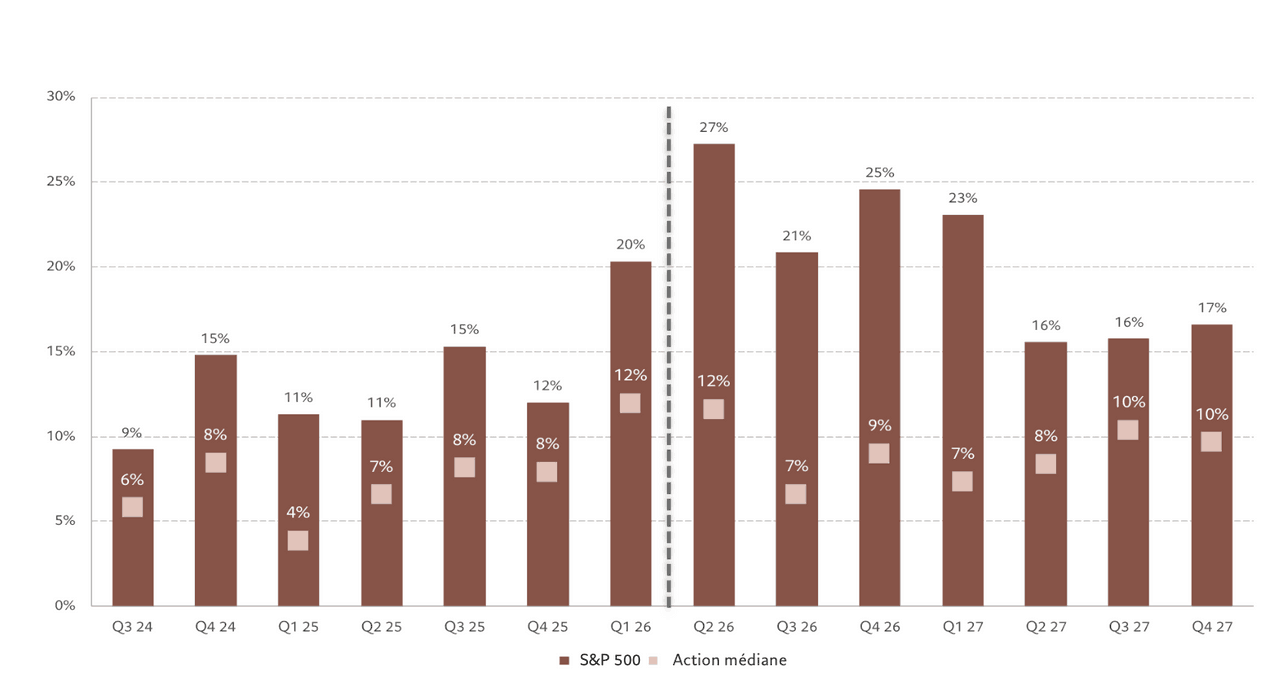
Chart 1 : U.S. Market: Quarterly EPS Growth Trends and Consensus Outlook Source: Refinitiv, Pictet Asset Management. Bottom-up consensus estimates as of August 19, 2026. Growth rates represent year-over-year earnings per share (EPS) growth. IBES consensus estimates are used for future periods and for companies that have not yet reported their earnings.
Across developed and emerging economies, corporate balance sheets are proving far more agile than pessimistic consensus forecasts had assumed. With 60% of central banks globally maintaining or reducing interest rates, liquidity across international markets remains supportive.
Dembik noted that investors seeking durable yield are focusing on structural opportunities across energy infrastructure, biotechnology, and resilient emerging market sovereign debt.
Diverging paths in central bank policy
A central theme for global fixed income is central bank interest rates, where consensus appears excessively hawkish for the US Federal Reserve. Money markets price in two additional rate increases of 25 basis points in October and December.
It reflects a U.S. labour market that remains resilient and inflation that is persistently high. Some FOMC members have explicitly pointed to structural factors keeping inflation elevated.
In US politics, inflation concerns are centered on everyday living costs, where beef prices have risen to 26%, prompting tariff relief for 500,000 tonnes of imports (see chart 2).
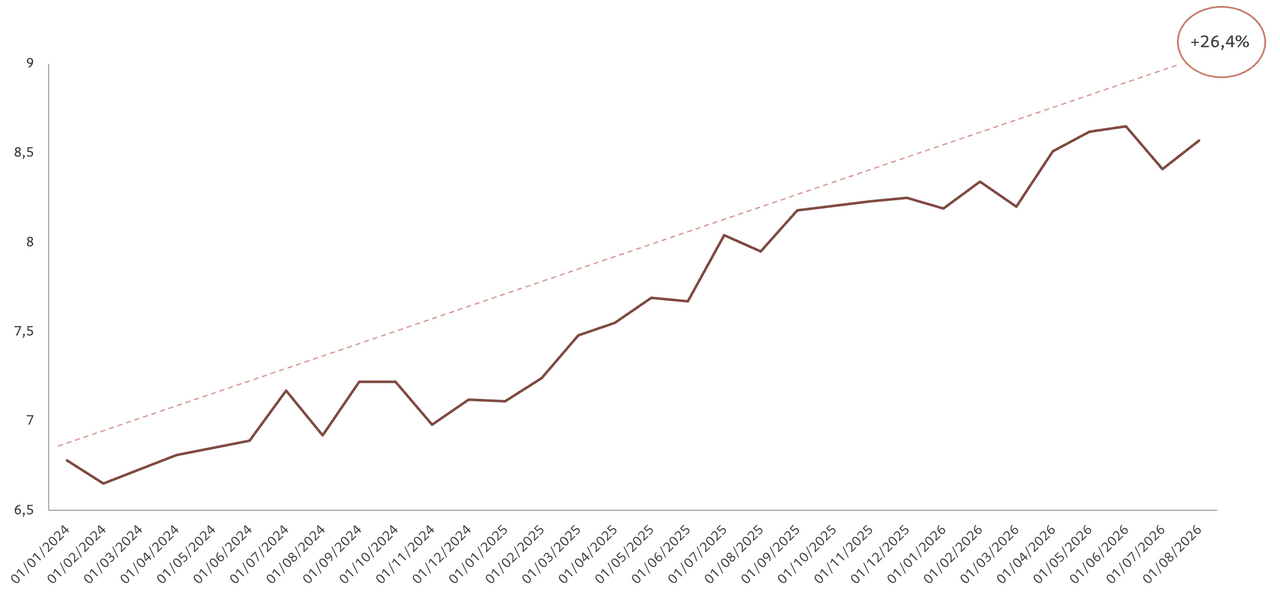
Chart 2: Average Price of Ground Beef per Pound (1 livre = 0,45 kg) in the United States, 2024–2026 (US Dollars, Monthly Data) Source : U.S. Bureau of Labor Statistics, via Macrotrends, August 2026
However, detailed policy analysis suggests this tightening path is exaggerated. “A single 25 basis point adjustment in December is far more likely, followed by potential rate cuts next year, by central banks, in general,” said Dembik. As rate pressures stabilize, bond yields could pull back.
The rise in long-term U.S. interest rates is partly driven by repeated upward revisions to growth forecasts for the U.S. economy. Predictions have been systematically too negative, he noted.
Fiscal pressure and global sovereign debt
In Europe, sovereign borrowing presents acute challenges, particularly in France, where ten-year bond yields have risen rapidly towards 5%. French issuances, with ten-year yields at 4.93% and 22-year paper at 5.40%, reflect a widening credit spread against German bunds reaching 146 basis points—a 13-year high.
France faces an arduous €350bn refinancing burden next year. Although treasury auctions remain oversubscribed by two to three times supply, elevated yields impose a fiscal drag.
Concurrently, the euro has experienced a 3% monthly decline against the US dollar (currently at 1.12), with forecasts targeting 1.10. This shift reflects an oversold dollar and widening differentials, argued Dembik.
Emerging market stability and sovereign debt
In contrast to European fiscal strains, emerging markets show compelling performance, with Brazilian equities returning nearly 26%, outperforming regional peers like Mexico and establishing the country as a primary destination for foreign capital within emerging markets.
Official poll counters in Brasília published the first-round presidential election, where Flávio Bolsonaro secured a 47% of the vote against 45.2% for outgoing president Luiz Inácio Lula da Silva. However, yesterday’s outcome introduces short-term uncertainty that will test these gains.
Dembik stressed that “short-term tactical caution is required ahead of the run-off” on 25 October vote, whilst emphasising that the underlying structural case for Brazilian assets remains intact.
Crucially, Brazil’s sovereign debt structure has undergone a structural shift. Domestic institutional investors have absorbed local paper, replacing foreign capital and providing “a crucial cushion for local market stability.”
Short-duration local currency debt maturing within five years shows lower volatility than developed market paper, supported by steady foreign direct investment inflows and strong resource earnings.
Sectoral innovation and growth opportunities
Beyond regional debt dynamics, equity momentum is broadening across specialised industries. In electrical grid infrastructure, South Korean group Kepco exemplifies emerging market leadership, leveraging deep expertise in grid digitalisation and subsea cabling to expand exports.
Meanwhile, biotechnology presents a timely opportunity. Hedge funds hold their largest net long position in five years, driven by M&A catalysts as major pharmaceutical firms face impending patent expirations. With 70% of new FDA drug approvals coming from biotech firms, corporate cash flows remain supported.