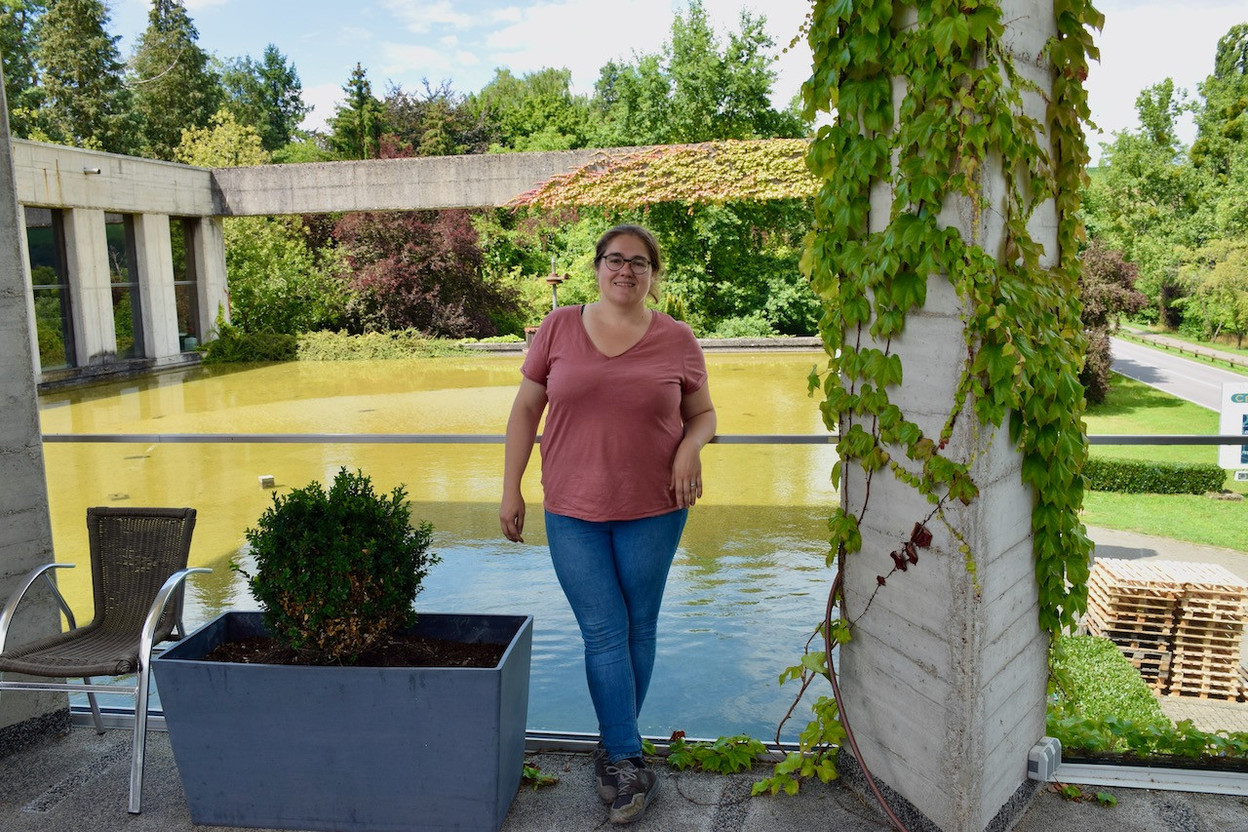
As we await the harvest, Paperjam is off to talk to young winemakers about their passion: wine. Today: Michèle Mannes, head of the Häremillen wine estate.
Michèle Mannes has been running the Häremillen estate since 2021. This 15-hectare estate was founded by her father Max Mannes in 1988. The name of the estate refers to the mill that once belonged to the monks of the Grand Chapter of Trier and which is now at the heart of the estate, where it serves as a tasting room. Assuming the top position on the estate was not an obvious choice for her. “Taking over Häremillen was neither a goal nor a priority for me. When I finished school, I studied to be a landscape architect. After my studies, the idea grew and I came to work at the estate to see all the facets of the profession. And in the end, I stayed.”
Because of the covid crisis, she didn’t have the opportunity to study viticulture and oenology. So her father taught her the trade on the job. And although he’s no longer active, “when he’s needed, he’s there.” Max still plays the role of adviser to his daughter. “I always ask him for advice and we discuss the choices to be made together. But in the end, he leaves me my freedom.”
Single-vineyard growing
Michèle can also count on a loyal team and an experienced cellar master in the person of Andreas Krebs, who knows the particularities of the estate and its production inside out, and who helps oversee the work in the vineyard and cellar. Crémant accounts for half of the production, the rest being mainly white wine made from all the traditional Moselle grape varieties. The estate’s hallmark is to bring out the specific characteristics of the grapes and their terroir in each bottle. So there are no blended wines, with the exception of crémants and rosés. “With the soils we have,” says Michèle, “we offer our customers dry wines with a beautiful minerality. Given that we mainly make single-varietal wines, we try each year to bring out the typicity of the grape variety. This brings out the difference between years. I often say that a whole year and its characteristics--sun, temperature, rain--can be found in our bottles. Unlike our crémants and rosés, which are drunk as a refreshing drink, our single-vineyard wines have a gastronomic vocation. I’m not saying that our crémants don’t also have this vocation, but it’s very marked in our white wines.”
Although Häremillen is not certified organic, it is run in this spirit. “We work in an integrated way. In other words, we don’t work in the same way as traditional winegrowers. We work as closely as possible to nature. We don’t use herbicides--everything is done mechanically or by hand--and we keep the inputs into the vines to a minimum. And when we have to use products, we use organic products.” So why not apply for certification? “The process is complicated, involving frequent checks and not inconsiderable costs. What’s more, not all our plots are close to the estate, which poses logistical problems,” she adds.
Administration versus romance
For Michèle, repetitive administrative tasks and ever more stringent and restrictive regulations somewhat kill off the romantic side of the profession. “As far as the day’s work is concerned, we’re increasingly distancing ourselves from the idea that, as soon as you work with nature, you’re freer. In a way, winegrowing has become a job like any other.” She adds that it is becoming more and more constrained by the efforts needed in terms of marketing and presence on social networks to win over a clientele that consumes less and is increasingly looking for new things. Or at least things they haven’t tried yet. “You always have to be present either at trade fairs, festivals or with open doors and offer activities to customers to maintain your appeal and find new outlets,” she says.
“In recent years, the administrative side of things has grown by an unimaginable amount,” she adds with a sigh, lettering her frustration show.
Some 90% of the estate’s production is sold within the country, both to nationals and expatriates. “Expatriates are very interested in local production. They are proud to show the products they have found to their families and friends. They do it with pride. It’s a pleasure to see.” The estate also works with the hotel and restaurant trade, and has been producing a range of wines and crémants exclusively for Cactus for almost 30 years. The rest of the production is mainly marketed in the greater region.
Global warming versus local particularism
Changing drinking habits continue to be a major challenge for the profession. “Despite campaigns against alcohol,” says Michèle, “people are still drinking. Less, but still. Wine is no longer an everyday product, but one associated with special occasions. During the lockdown, people rediscovered local produce. It was one of our best years. We hoped that this would start a good dynamic. Unfortunately, it didn’t.”
The other big challenge is climate change. “On the one hand, we are benefiting from it. Pinot grape varieties benefit from rising temperatures and hot summers. But on the other hand, our typical acidity and minerality are beginning to be lost. Our wines are becoming more international in the sense that they are less distinctive compared to wines from warmer regions. What’s more, the increasing number of extreme weather events is being reflected in the bottles, which may upset some customers who are looking for a certain stability in the taste characteristics of a wine. Finally, with increasingly frequent droughts, we have to irrigate our fields. Something like that was unthinkable just a few years ago. So far, traditional grape varieties are still coping well with the ups and downs of the weather. But we’re seeing the emergence of more disease-resistant varieties that are becoming established on organic farms, because they require less treatment.”
This article was originally published in French.