(Update: Since the publication of this article, the international conference scheduled for next week at UN headquarters in New York to revive the two-state solution for Israel and Palestine has been postponed. This announcement was made by French president Emmanuel Macron, who was scheduled to chair the conference with Saudi Arabia. No new date has yet been announced.)
Between the hardening of Israel’s desire to eliminate Hamas from the landscape in Palestine--even at the cost of civilian casualties as great as they are unjustifiable--and last night’s strikes against Iran in the face of the imminent threat of the Mullahs’ regime acquiring nuclear-tipped bombs, prime minister 
He also indicated that he would be taking part, with foreign minister 
Following Israel’s bombing of Iran this morning, Frieden called on both sides to respect international law in their actions and to do everything possible to promote a de-escalation; otherwise, the entire planet would suffer the consequences of these developments. Iran is a major oil producer.
Defending Schengen
“Tomorrow is 14 June and we are celebrating the 40th anniversary of the Schengen agreement. And this is no ordinary anniversary,” he said. “It was in Schengen, in our country, that a five-country agreement was signed and today generalised. A symbol of the free movement of people and goods, it is one of the most tangible symbols of the European Union. It is a political decision.”
In the silence of the European Union in the face of targeted border closures, particularly to and from Germany, the prime minister expressed his confidence in his good relations with our neighbours to, at worst, be able to obtain bilateral agreements that would preserve the Schengen Agreement.
Frieden will travel to Berlin after 28 June at the invitation of the new German chancellor, Friedrich Merz. The issue of border controls will be discussed.
Upcoming Nato summit
“If the other 31 members agree on a certain percentage, Luxembourg as a solidarity member of Nato--whose security depends on Nato and the armies--we will rally to this compromise," he also said before the Nato summit in The Hague, during which an increase to 5% of defence spending is expected to be discussed. “The increase under discussion is very high: 3 to 5%. We hope to achieve this within a certain timeframe by looking at the return on these investments in the Luxembourg economy. This is work that various ministries will be doing over the coming weeks.”
For the prime minister, spending 5% of gross national income (GNI) on defence today is simply impossible. It should be remembered that while Nato member countries are required to calculate their defence spending in relation to their gross domestic product (GDP), Luxembourg, at the Vilnius summit, obtained the right to calculate its spending in relation to its gross national income. The result is a healthy economy, with the country’s GDP approaching €86.1bn whilst its GNI stands at €59.1bn. Frieden will travel to The Hague with defence minister 
New measures to support housing and mobility
Frieden also announced an extension of subsidies for the installation of electric charging stations at home, with a higher amount for those who commit to more efficient and smarter technologies, both for individuals and for condominiums and condominium associations. Procedures will be further simplified to encourage applications for subsidies.
He also mentioned the creation of a new green zone (second green zone) for disconnected blocks, a measure already announced in the housing package. Municipalities will be able to adapt their general development plans (plan d'aménagement géneral, PAG) to allow work on isolated homes in green zones.
The economy ministry and the digitalisation ministry have also been authorised to take part in one or more international consortia around AI gigafactories, on the understanding that the grand duchy is too small to commit directly to the creation of these giant factories.
What about 28 June?
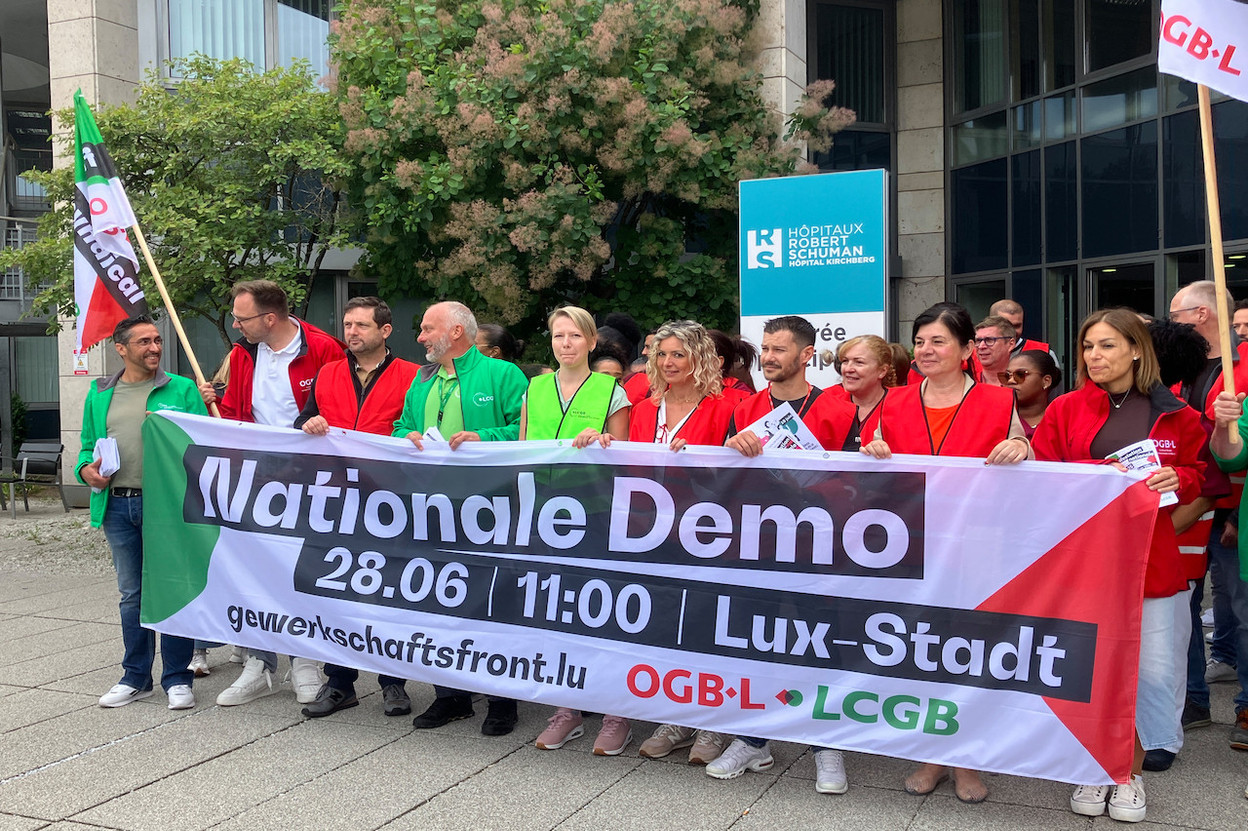
Asked about his relationship with the unions as the national demonstration on 28 June approaches, the prime minister--once again--reiterated his commitment to social dialogue. “We are for social dialogue and we are available for it. The goal of democracy is to achieve majorities and work together. It’s normal for us to have disagreements. But it’s through dialogue that we move forward.”
What will Frieden do on 28 June? He says he doesn’t know. “The next few weeks will be busy. On 28 June, I might go for a walk,” he said, and recalled the invitation extended to social partners for a meeting on 9 July. The conclusions of the consultation on pensions led by social security minister 
This article was originally published in French.