
Young people are already involved. On the ground.
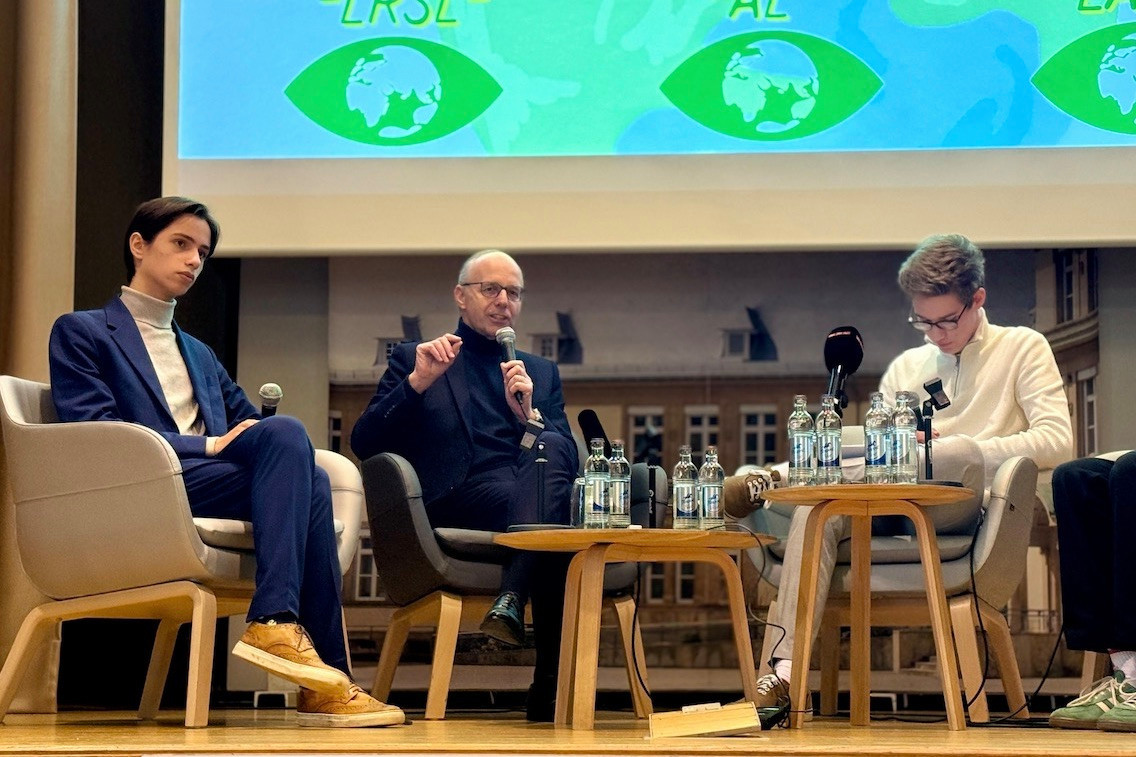
A little background: “ActionTeam4Future” is an internal initiative at the Lycée Robert Schuman that has evolved from a simple idea to a concrete project in six months, as Julien Lemmer Veloso sums up. Initiated by the school’s sustainability committee, the project aims to create a platform for committed young people in Luxembourg and to make the Cop29 processes more transparent. In this context, the members are taking part in the work of “Youth4ClimateAction,” a grassroots association that works to ensure that young people are involved in the climate debate. Five secondary school students who are members of this association have been selected to represent Luxembourg in the official delegation, with the aim of promoting an active exchange and representing the problems of the Luxembourg school community.
Trip to Baku
On site for 10 days, they produced a five-minute video every day for the We Do Not Have Time platform. Above all, they were confronted with the reality behind the scenes of major international negotiations, where divergent interests come together. At the Cop, they came across pro-climate activists and fossil fuel lobbyists--including Azerbaijan, the host country. Maximilian de Pauw Gerlings, a student at the Athénée in Luxembourg and a member of the delegation that made the trip, sees these as sources of questions and even frustration.
Cop29 ended on 22 November with the promise of a budget of $300bn per year by 2035, compared with the current figure of $100bn, with a global climate financing target of “at least $1.3trn by 2035.” It’s a historic agreement for developed countries--but an insult to developing countries, which wanted a $1trn envelope.
Is the glass half-full or half-empty?
A question of timing
For Frieden, the glass seems quite full. All the more so since, with the outcome of the presidential election in the United States, such a result is unthinkable for the Cop30 meeting taking place in Belém, Brazil next year.
On a subject that worries schoolchildren, the subtlety of international negotiations--realpolitik or the art of the possible, take your pick--is hard to get across. The principle is understood. But it doesn’t go down well. For them, the glass is rather empty. Frieden tried to explain the importance of discussing a subject like this again and again, of taking things “step by step.” “As a government, we want to encourage people and businesses to change their behaviour by helping them, not forcing them,” he said to sum up his approach.
While de Pauw Gerlings said he understood this, he also added that “what we need is ambition, ambition and ambition.” Young people are in a hurry. And they’re always right in the end. It’s the order of things.
The students were delighted with the visit. For Lemmer Veloso, the fact that the prime minister came to talk to young people was important. “He was able to convince his audience of his interest in the issue.” The same feeling for de Pauw Gerlings felt the same way, who believed that Frieden was able to address the audience’s concerns. “The fact that he came is already a step towards a better future.”
This article was originally published in French.