In 2022, developed countries, as defined by the Organisation for Economic Co-operation and Development (OECD), of which Luxembourg is a member, mobilised and provided $115.9bn for the climate. This is more than the target of $100bn a year set in 2009 under the United Nations Framework Convention on Climate Change. Originally, this target was to be reached by 2020, but the deadline was extended to 2025. In its report “Climate finance provided and mobilised by developed countries in 2013-2022,” published on Wednesday 29 May, the OECD makes a seventh assessment of the progress made.
“According to new figures from the OECD, in 2022 climate finance was up by 30% from 2021, or by $26.3bn,” states a press release from the organisation, before adding that “this is the biggest year-on-year increase to date.” All the better to help developing countries adapt to climate change and mitigate its effects.
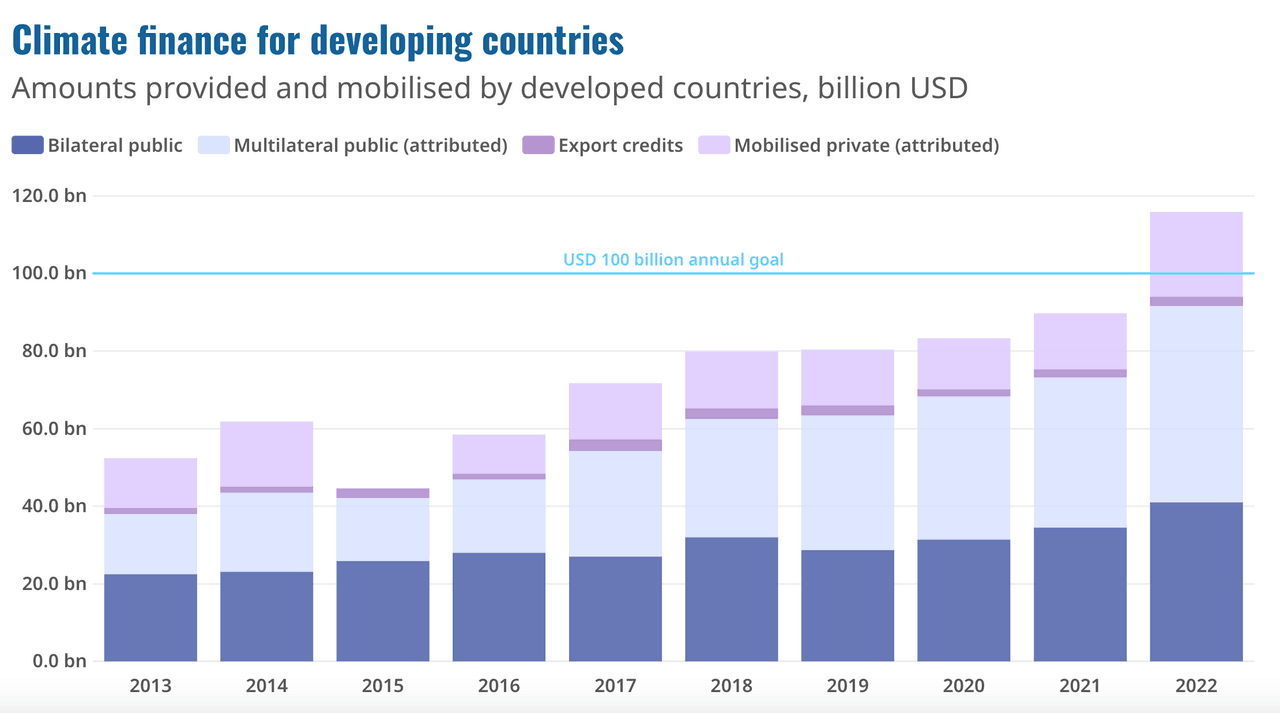
The gap in the private finance series in 2015 is due to the implementation of enhanced measurement methodologies. As a result, private flows for 2016-22 cannot be directly compared with private flows for 2013-14. Image: OECD
The 2022 shows that “public funds, from both bilateral and multilateral channels, continue to make up the bulk of climate finance, accounting for 80% of the total.” Loans continued to represent the “lion’s share of public climate finance,” added the OECD.
The amount of funds mobilised by the private sector--which had been stagnating for several years--increased by 52% (or $7.5bn) to reach $21.9bn. “Most private climate finance was mobilised through investments in companies and special purpose vehicles, guarantees and syndicated loans.”
Lower-middle-income countries benefit most
The analysis also reveals that the funds allocated to adaptation action have particularly increased: “Following a small drop in 2021, adaptation finance reached $32.4bn in 2022, three times the 2016 level.” In fact, total climate funding is split between two themes--adaptation and mitigation--although some cross-cutting activities may cover both at the same time.
As regards the sectoral breakdown of these funds, “trends remained largely unchanged since 2016,” explains the OECD. The majority of mitigation funding was concentrated in the energy and transport sectors, which accounted for 62% of total mitigation funding provided and mobilised. “Adaptation finance was more evenly distributed across a larger number of sectors,” although water supply and sanitation, agriculture, forestry and fisheries accounted for the largest shares.
Lower-middle-income countries (LMIs) accounted for 40% of the total 2022 funding, receiving $46.5bn; upper-middle-income countries (UMICs) accounted for 30% and low-income countries (LICs) 10%.
Find the full report here.
This article was first published in French on Paperjam. It has been translated and edited for Delano.