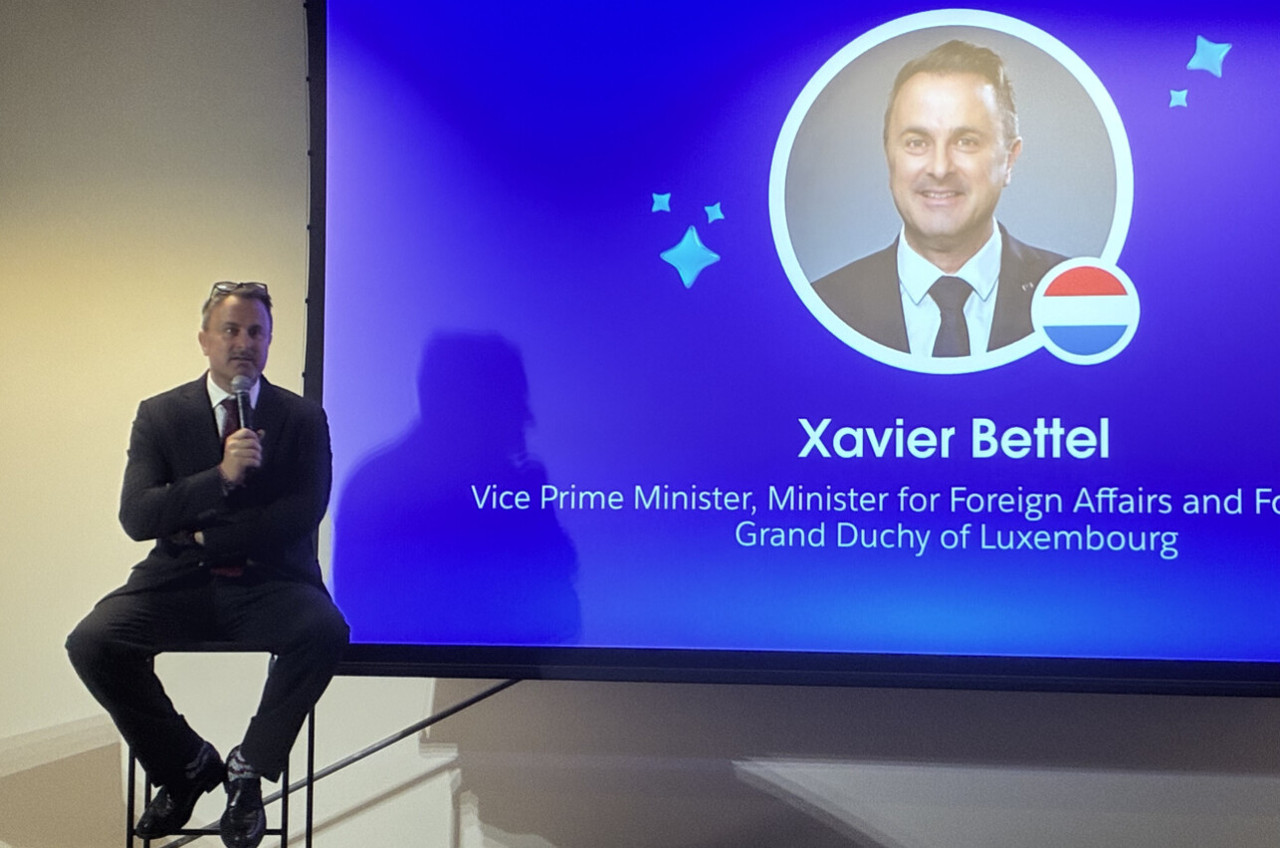
It takes time to build trust, a few seconds to lose it, and much longer to regain it. Speaking to an audience who had come to try out the latest Salesforce tools – and after pulling out a photo of his ‘friend’, Marc Benioff, the CEO of Salesforce – 
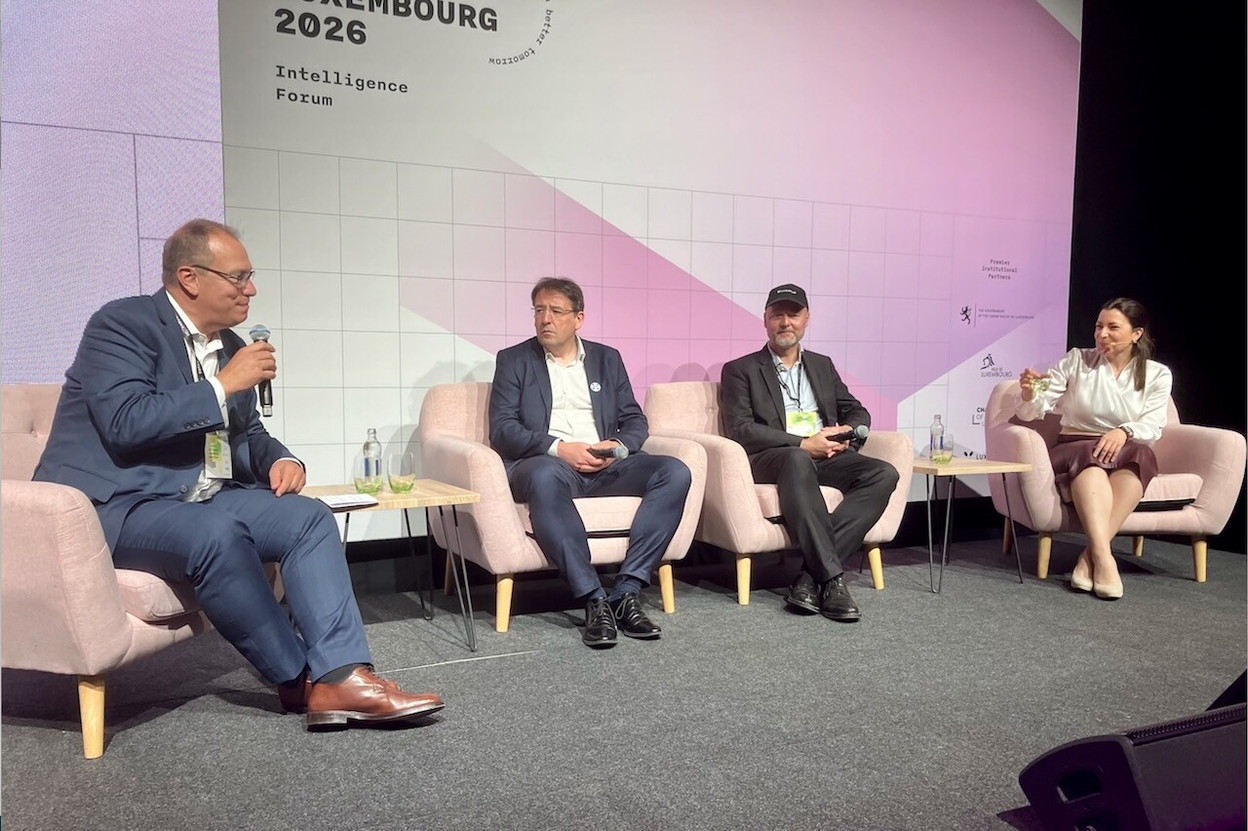
The American company’s Innovation Day Luxembourg brought together some 200 customers, partners and experts on Monday 23 November at GridX. Following the announcements at Dreamforce, Salesforce sought to bring its solutions to life with demonstrations, workshops and eight sessions focusing in particular on customer relations, marketing, industry, finance and data preparation.
The Minister for Foreign Affairs and Foreign Trade was invited to set out his vision of technological developments and Luxembourg’s ambitions. He spoke, above all, about trust. This highlights the main obstacle faced by AI providers: before delegating a task to an agent, a company must know what information it is working with, what it is authorised to do and who is liable for its errors.
Ten pages that nobody reads
“When it comes to AI, people sometimes trust it blindly because we still know relatively little about it,” Xavier Bettel observed. He compared this to the terms and conditions that almost no one reads before clicking “accept”.
In the view of the former Minister for Communications and Media, regulation should not be seen as a barrier to innovation. He recalled the criticism levelled at Europe when its data protection rules were adopted. These rules subsequently served, in his view, as a benchmark beyond the continent. The issue, however, goes beyond the protection of users alone. Xavier Bettel acknowledged that some jobs would disappear as a result of AI, whilst others would be created. Above all, he warned against Europe’s technological dependence, with the continent caught between the United States and Asia.
Smartphones, search engines and the main platforms used in Europe are predominantly American or Asian. In his view, the answer does not lie in Europe turning in on itself, but in forging partnerships whilst imposing rules capable of maintaining trust.
This trust also relies on predictability. However, this is being eroded by cyber-attacks, geopolitical tensions, disinformation and the circulation of content whose origin is becoming difficult to identify. “Disinformation is the greatest enemy of trust,” said the minister, before calling on his audience to continue supporting professional journalism.
ArcelorMittal wants to move away from isolated pilot schemes
This policy discussion has found an industrial counterpart in Santosh Pandey, Chief Transformation Officer at ArcelorMittal. The steelmaker is already using AI and machine learning in its production, supply chain and certain commercial functions, particularly for pricing. What is new is not so much the emergence of AI as its maturity and its expansion into customer-facing activities. “The technological foundations have changed and matured. We are also making progress as a company,” explained Santosh Pandey.
ArcelorMittal does not systematically favour either in-house development or the purchase of an existing tool. The group keeps technologies in-house when they are based on expertise that differentiates it from others in the sector. For more generic needs, however, it favours off-the-shelf platforms, particularly when speed of deployment is a key consideration.
“The starting point is always the problem we want to solve,” the executive summarised. Salesforce falls into this second category: a shared platform can avoid the need to rebuild functions that are already available, whilst linking them to the company’s data and processes.
ArcelorMittal’s aim is now to move beyond the separate experiments that have been carried out. The group wants to move from scattered pilot projects to a unified approach, based on platforms and its own ‘AI Factory’.
In commercial operations, this architecture must enable end-to-end process tracking, from the customer’s initial enquiry through to payment and collection. Agents would take on some of the intermediate tasks in order to free up time for the sales and operations teams.
Salesforce joins Copilot
This drive to enable staff to move between different tools is in line with Salesforce’s new strategy. On 17 November, the group announced Copilotforce, a partnership with Microsoft designed to integrate Salesforce’s customer data and certain business processes into Microsoft Copilot and Teams.
In time, a sales representative will be able to prepare for a meeting by combining the customer’s history stored in Salesforce with Outlook emails, Teams meetings and internal documents. They will also be able to analyse the risks associated with a sale or update certain details in the CRM without leaving their workspace. The system also provides for a two-way connection between Salesforce Data 360 and Microsoft Fabric. The ‘zero-copy’ principle should enable data to be queried wherever it is located, without systematically creating a new copy. Not all of these features have been rolled out to the same extent yet. Salesforce in Microsoft Copilot is available as a public beta. Integration with Teams remains in the pilot phase. Data federation with Microsoft Fabric, however, has been announced as available.
At Dreamforce, Salesforce had already unveiled Agentforce Coworker, which is capable of searching for information in the CRM and carrying out a series of actions, as well as agents specialising in lead generation, customer service or administrative tasks. The company has also introduced monitoring tools designed to identify incorrect responses, latency issues or silent failures on the part of an agent.
The technology demonstration alone does not, therefore, resolve the issue raised at GridX. The more data agents can access, the more they can coordinate with other agents and the more they can act within the company’s systems, the more critical access rights, controls and accountability become. Trust is no longer merely a marketing promise. It is becoming a technical prerequisite for moving from pilot schemes to full-scale deployment.