
As institutional investors reduce exposure to crowded technology trades, water companies are attracting attention for their earnings prospects and valuations, according to Louis Veilleux, senior investment manager at Pictet Asset Management.
The global water sector has been among the main beneficiaries, outperforming world equity benchmarks by 5% since technology stocks peaked in late spring. Separately, the Pictet Water fund, launched in January 2000, has outperformed its reference benchmark, the MSCI AC World Index, by an annualised 100 basis points.
The opportunity extends beyond regulated utilities to companies supplying filtration, fluid engineering and water-treatment technology. Pictet’s investment case spans AI infrastructure, pollution treatment and the expansion of water services.
A $1.4trn market beyond public utilities
Water investing may evoke slow-growing municipal utilities. Yet Pictet estimates that the broader water industry represents a $1.4trn global market growing by 3% to 5% annually, with regulated utilities accounting for only part of it.
Pictet’s Water strategy invests across this wider market, including industrial and technology companies operating in areas with high barriers to entry.
Recent portfolio changes reflect that approach. According to the managers, the fund exited residential-exposed businesses Pool Corp, A. O. Smith and Geberit amid weakening construction activity.
It added commercial plumbing suppliers Watts Water and Mueller Industries, while increasing positions in Ebara, Donaldson and Organo. Companies with market capitalisations of $10bn to $30bn account for 45% of assets, according to Pictet.
The liquid backbone of artificial intelligence
AI infrastructure is an important source of demand, even as investors reassess their exposure to technology stocks.
Veilleux estimates that 30% to 35% of the portfolio benefits from AI-related investment across power generation, semiconductor production and data-centre cooling.
Expanding computing capacity increases cooling requirements. Semiconductor manufacturing also depends on ultra-pure water, supporting demand for specialised treatment and filtration equipment.
For Pictet, these requirements create opportunities among the suppliers behind digital infrastructure. Veilleux cited Vertiv and Veralto among the companies positioned to benefit.
The connection also raises a question for investors: how much of the sector’s expected growth depends on continued AI capital spending?
Treating the PFAS legacy
Pollution treatment provides another source of demand.
Per- and polyfluoroalkyl substances, known as PFAS or “forever chemicals,” have become a focus for water testing and treatment. A US Geological Survey study estimated that at least one PFAS could be detected in about 45% of US drinking-water samples.
Veilleux expects monitoring and remediation requirements to create business opportunities for testing, treatment and environmental-services companies. He cited Clean Harbors, Casella Waste Systems and Jacobs Solutions as businesses with exposure to this market.
Treatment methods require careful distinction. Removing PFAS from water, disposing of contaminated material and destroying the compounds involve different processes. EPA’s guidance identifies uncertainties in destruction and disposal technologies, including thermal treatment.
More generally, Marc-Olivier Buffle, senior client portfolio manager at Pictet noted the global environmental threats are accelerating, from toxic PFAS chemical contamination volatile climate disasters like severe flooding (see chart 1).
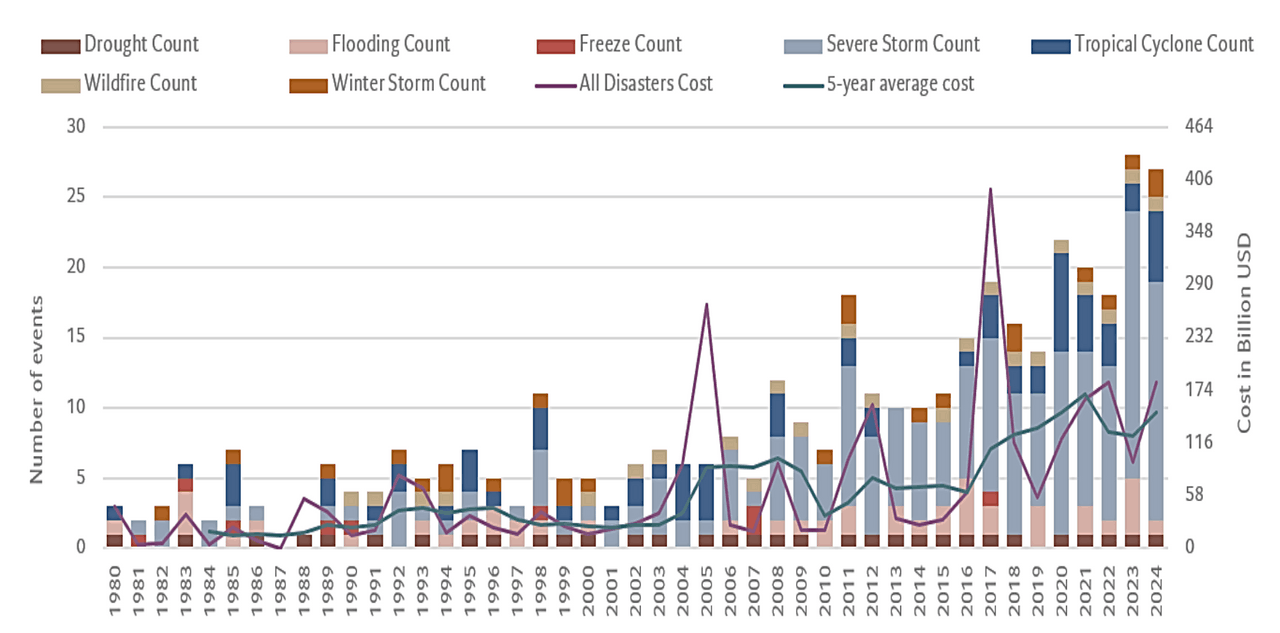
Chart 1: US billion-dollar weather disasters 1980-2024 (CPI adjusted)1 Source: Pictet Asset Management, 2025. 1NOAA NCEI Billion-dollar Disasters, 2025.
Earnings growth and valuation
Despite structural demand drivers, public market valuations for water equities remain remarkably attractive, argued Buffle. He said portfolio companies were delivering annual operating profit growth of 12% to 13%, with consensus forecasts pointing to continued growth through 2028.
Brazil offers another avenue for investment. Its national sanitation framework targets drinking-water access for 99% of the population and sewage collection and treatment for 90% by 2033.
Veilleux cited Copasa, Equatorial and Sabesp as holdings positioned to benefit from expanding services and investment in infrastructure.
For Pictet, the investment case rests on the combination of earnings growth and lower relative valuations. Whether that translates into stronger shareholder returns will depend on companies delivering the growth the managers expect.