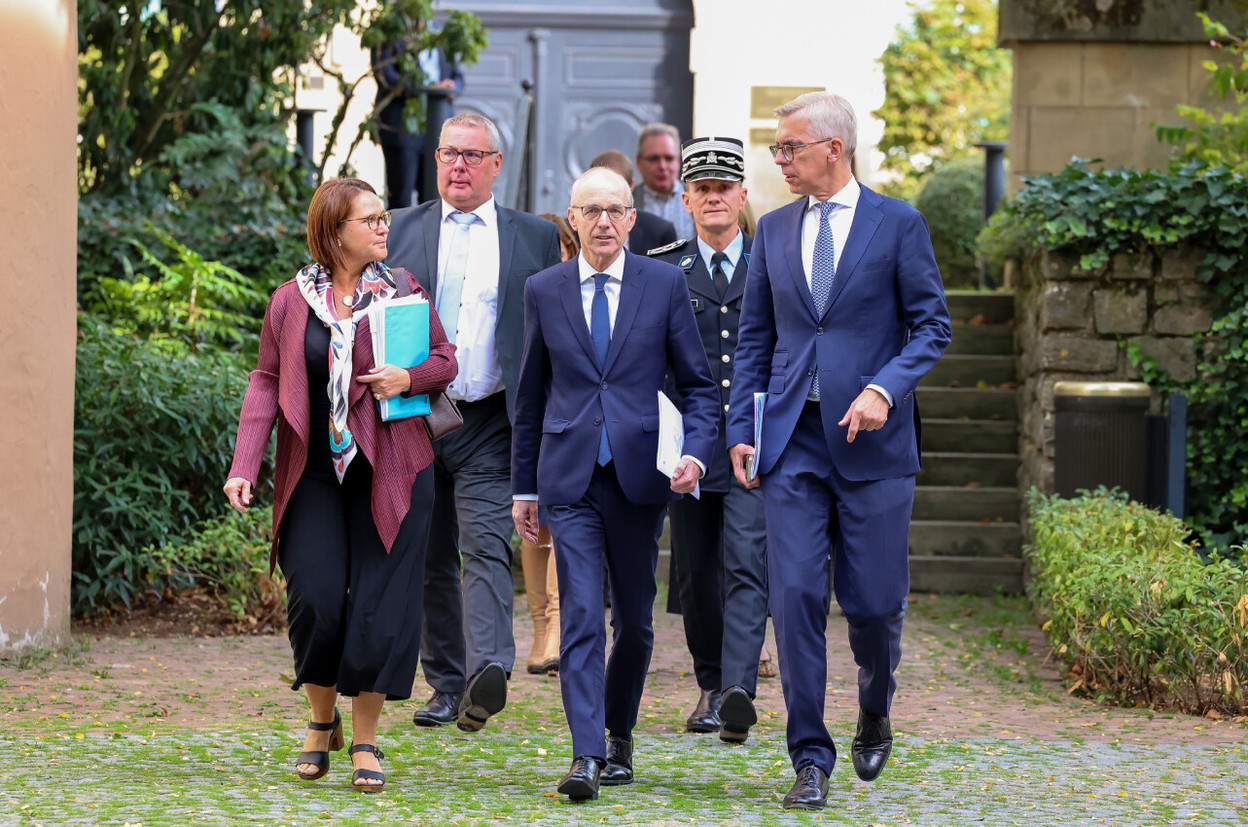
Two months after September's alerts, Luxembourg's authorities still cannot establish whether the objects reported near Findel and Medernach were drones. Prime Minister Luc Frieden disclosed the findings on Monday 23 November after briefing MPs at parliament.
“We cannot confirm today, on the basis of what the services tell us, that these were drones. There may have been some, but the services have no technical evidence,” Frieden told reporters. The assessment drew on the police, army, airport and aviation authorities, with assistance from abroad.
Interior Minister Léon Gloden explained what the detection equipment had shown. “At Findel, no frequencies could be determined. At Medernach, frequencies were identified, but those frequencies could not be attributed to any object,” he said.
The September account
At a press conference on 24 September, High Commissioner for National Protection Guy Bley reported that larger drones had been observed near Medernach, with two detections recorded between 15 and 18 September. The same briefing, however, revealed uncertainty about what had been seen at Findel.
Andrea Drescher, director of the air navigation administration, confirmed sightings of objects with position lights. “Was it a fixed-wing aircraft or a multicopter? We cannot say, not because we don't want to, but because we don't know,” he said. Their dimensions were also unconfirmed: Frieden's reference to a one- or two-metre drone concerned the danger of shooting one down, not a measured observation.
The government had already warned in September that the evidence did not permit definitive conclusions, and no drone was recovered. Nevertheless, reports of suspicious objects prompted two closures of Findel, on 18 and 21 September. The first disruption diverted 19 flights.
Precaution versus preparedness
Frieden defended those decisions despite the uncertainty. “When you don't know exactly what is going on, you have to take measures to protect the public,” he said. The authorities could not simply dismiss reports from residents and airport personnel, he argued.
Gloden maintained that Luxembourg's detection systems had performed well, citing assessments by foreign authorities. “Even the equipment that the French gendarmerie brought to Luxembourg did not establish any more or less than our own equipment,” he said. The police had also cooperated with Belgian and German counterparts.
Among MPs interviewed after the briefing, CSV MP Alex Donnersbach stressed the importance of eyewitness evidence. “There were visual sightings which could not be confirmed technically afterwards. Those sightings came from members of the public and from the police,” he said.
The government's earlier public statements drew sharper criticism from LSAP MP Liz Braz. “I'm stunned that we had to wait two months, not to be told where the drones came from, but to be told that perhaps there weren't any drones at all,” she told Paperjam. She called September's communication amateurish and said her parliamentary question about drone testing remained unanswered despite an extended deadline.
Earlier assurances about preparedness also came under fire. Greens MP Meris Sehovic recalled being told that Luxembourg was well equipped to handle drones. “I am not confident today that we are properly equipped to deal with this problem in the future,” he said.
DP MP Corinne Cahen defended the government's account. “The government also has to be honest. If no technical equipment could establish that there was a drone, then of course it has to say so. That is its role,” she said. ADR MP Tom Weidig acknowledged shortcomings in the initial communication but argued that lessons had been learnt: “The government did not communicate perfectly, but I think it has learnt its lessons from that, and that's good.”
New spending and powers
Some detection equipment originally scheduled for purchase in 2027 had already been acquired this year, Frieden said. Gloden outlined a separate allocation: “In next year's budget, the police have set aside between €10m and €11m to strengthen their equipment, both for detection and for bringing drones down.” The police purchases depend on parliament approving the budget.
Pirate MP Marc Goergen questioned whether additional spending would address the failures he believed the investigation had exposed. “The chamber needs to keep an eye on those security systems and make sure they deliver what we've been promised,” he said. Ministers had been unable to tell him whether the frequencies detected near Medernach were commercial or military, he added.
On Friday 20 November, the government approved a bill proposing powers for the police and army to disable unmanned vehicles. Gloden said the proposal would extend beyond aircraft to certain vehicles on land or water, and allow an existing police security-zone provision to apply vertically up to 120 metres. The government's published summary does not detail those provisions, and the bill has not become law.
Gloden also urged people not to confine reports of suspected drones to the airport area. “An MP asked whether reports should be limited to the area around the airport. The answer is clearly no. In general, if people see something, or think they have seen something, they should alert the police as a precaution,” he said. In its general guidance, the police reserves 113 for emergencies and directs non-urgent enquiries to the Ligne bleue on 244 244 244.