Dominika Repcikova never expected entrepreneurship to be part of her career. Originally from Slovakia, the 35-year-old studied psychology and cognitive neuroscience in the Netherlands before moving to Luxembourg for a PhD focused on the links between psychosocial adversity, epigenetics and mental health. “There was never the goal of being a businesswoman or an entrepreneur,” she says.
The business she eventually created grew out of a problem that had followed her since adolescence. Repcikova was first diagnosed with iron deficiency at 14 and spent years going through cycles of treatment. In her early twenties, while studying in the Netherlands, she began experiencing heart palpitations, anxiety, panic attacks and vertigo. Doctors initially suggested stress from her studies could be responsible, she recalls, before another doctor tested her iron levels and found them to be very low.
Repcikova says repeated treatment caused digestive side effects, prompting her to look for another way to maintain her iron intake through her diet. She eventually went online searching for something very specific: an iron-fortified snack bar containing 15mg of iron. She found plenty of protein products, but nothing corresponding to what she wanted. “So I created one.”
From her kitchen to a business
At that stage, Repcikova was still thinking like a scientist rather than an entrepreneur. She opened an iron capsule, emptied it into dough and made a bar in her kitchen, initially as an experiment rather than the prototype of a future company. The turning point came when she began discussing it with other women. Many told her they had been looking for something similar or disliked existing supplements. “I was shocked by how many women responded extremely positively to this idea,” she recalls. That response made her consider, for the first time, that her personal solution could become a viable business.
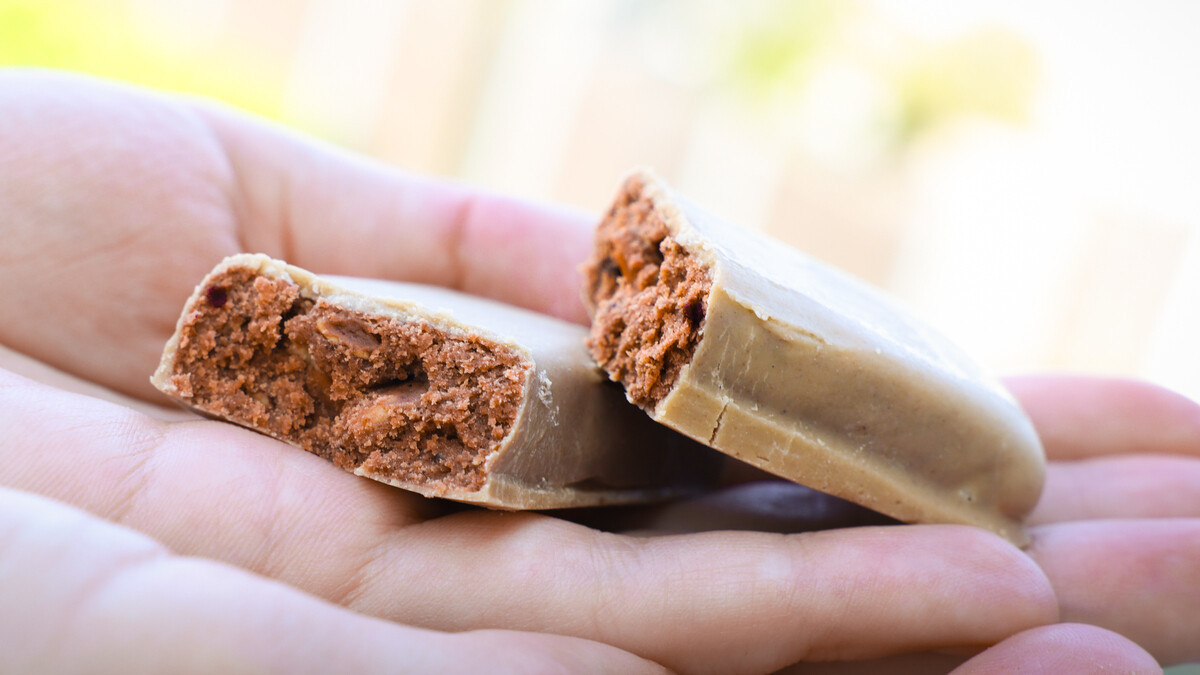
The Iron Bar is an iron-fortified snack designed primarily for women. Containing 15mg of iron, it was developed as a convenient food-based alternative for people looking to incorporate more iron into their diet. (Photo: Dominika Repcikova)
The idea began developing around 2020 or 2021, although Repcikova says she cannot pinpoint the exact year. By then, her studies had brought her from Slovakia to the Netherlands and then Luxembourg, where she moved to pursue her PhD. She turned to the University of Luxembourg Incubator and gradually immersed herself in the local startup ecosystem. The company itself was eventually incorporated in Luxembourg in March 2025.
Repcikova credits that environment with much of the project’s development. The relatively small ecosystem gave her access to other founders, feedback and people willing to share their experience, but she says it also changed how she viewed ambition. “I feel all around myself that you don’t have to apologise or over-explain your ambition. People get it.”
From academic rigour to the startup “Wild West”
Rather than seeing The Iron Bar as a break with her scientific career, Repcikova describes entrepreneurship as an extension of it. Years of academic training taught her how to interpret research, assess scientific evidence and conduct customer research. “I would say that I expanded my academic thinking to founder mode,” she says. “To me, it was not either-or, but rather: how do I integrate one package of knowledge into the other?”
What science had not prepared her for was the unpredictability of running a company. In research, she explains, methodologies provide a framework even when results contradict the initial hypothesis. Business proved different: months of preparation do not necessarily lead to the expected outcome. “You can get everything right on the formula and still land somewhere completely different,” she says.
I learned very quickly that ideas are pretty much worthless. It’s all about execution.

That experience also changed how she thinks about ideas themselves. “I learned very quickly that ideas are pretty much worthless. It’s all about execution.” She describes academia as rigorous, controlled and precise, while startup life is closer to the “Wild West”, where execution can determine whether even a promising product succeeds. One of her biggest adjustments was communication: after years of being trained to explain every methodological detail, she had to learn to tell customers simply what her product does, what problem it addresses and why it could be useful to them.
Finding time – and hearing “no”
For most of The Iron Bar’s development, Repcikova was also completing her PhD. Rather than finding large blocks of time for the company, she learned to divide the work into small, concrete tasks that could fit around her academic schedule: answering a few emails during a break, researching an ingredient in the evening or working on the website over a weekend. “I learned more than ever that time is a matter of priority,” she says. “Sometimes you show up for five minutes. Sometimes it’s lunch break. Sometimes it’s the weekend.”
You have to just receive enough no’s for the first yes to come.

Finding manufacturers brought another lesson. Repcikova says small production volumes and limited budgets meant The Iron Bar made little economic sense to many established producers, leading to a succession of refusals. Eventually, she found one willing to take a chance on the project. “I heard no’s for a long time until I found a manufacturer who genuinely believed in the vision,” she says. “I will never forget that.” The experience taught her to treat rejection as part of the process: “You have to just receive enough no’s for the first yes to come.”
The setbacks did not end there. At one point, orders began arriving while the company had no stock. Repcikova contacted customers individually to explain the situation and refund their purchases.
If you ask me if I’m a scientist or an entrepreneur, I’ll tell you I’m a builder.

Building beyond one bar
The Iron Bar remains at an early commercial stage. The team is also working on iron gummies, which she says offer better unit economics and could allow the company to reach more customers with a limited budget. Repcikova identifies women aged roughly 18 to their early 50s with active lifestyles as the company’s main target market.
For Repcikova herself, the next stage will again involve balancing two worlds. After several months focused exclusively on The Iron Bar following her PhD defence, she is starting a new full-time role in a science-adjacent field and plans to return to building the company during evenings and weekends. Within two years, she hopes to have one or two established products generating enough traction to break even. Further ahead, she wants The Iron Bar to develop into what she calls a “one-stop shop” for products focused on women’s iron and menstrual health.
The experience has not led Repcikova to choose between her identities as a scientist and entrepreneur. Instead, the shift happened gradually as women began telling her not simply that they liked the product, but that it addressed a struggle they recognised from their own lives. “I started seeing myself as a creator, as a builder,” she says. “I build something for women. And I started building for myself.”
“If you ask me if I’m a scientist or an entrepreneur, I’ll tell you I’m a builder.”