“Over the past 30 years on the International Space Station, researchers found something really unique: in microgravity, cell biology is accelerated,” says Kyle Acierno. “I thought: why hasn’t that been commercialised?”
That question became the starting point for Exobiosphere, the Luxembourg-based startup Acierno co-founded in 2024. The company develops autonomous orbital laboratories designed to accelerate preclinical drug discovery by allowing researchers to conduct experiments in microgravity.
Acierno believes the pharmaceutical industry faces a fundamental challenge. “The problem today is that 90% of all drugs fail,” he says. For drugs targeting neurodegenerative diseases such as Parkinson’s and Alzheimer’s, the failure rate is even higher. Exobiosphere’s ambition is to help researchers generate better insights earlier in the drug development process by taking experiments into an environment that cannot be recreated on Earth.
Given the scale of drug development, even a small improvement could translate into major benefits for patients and pharmaceutical companies. “If we can improve that success rate by just 1%, that’s already a pretty dramatic difference,” he says.
I feel like that might be where we’re heading – that some of the biggest challenges we’re facing as a species won’t be solved here on Earth, but will be solved in space.

Acierno also believes space will play an increasingly important role in addressing some of humanity’s biggest scientific challenges. “Imagine that, as a species, we couldn’t cure diseases until we were able to leave our own planet,” he says. “That’s pretty impressive, right? I feel like that might be where we’re heading – that some of the biggest challenges we’re facing as a species won’t be solved here on Earth, but will be solved in space.”
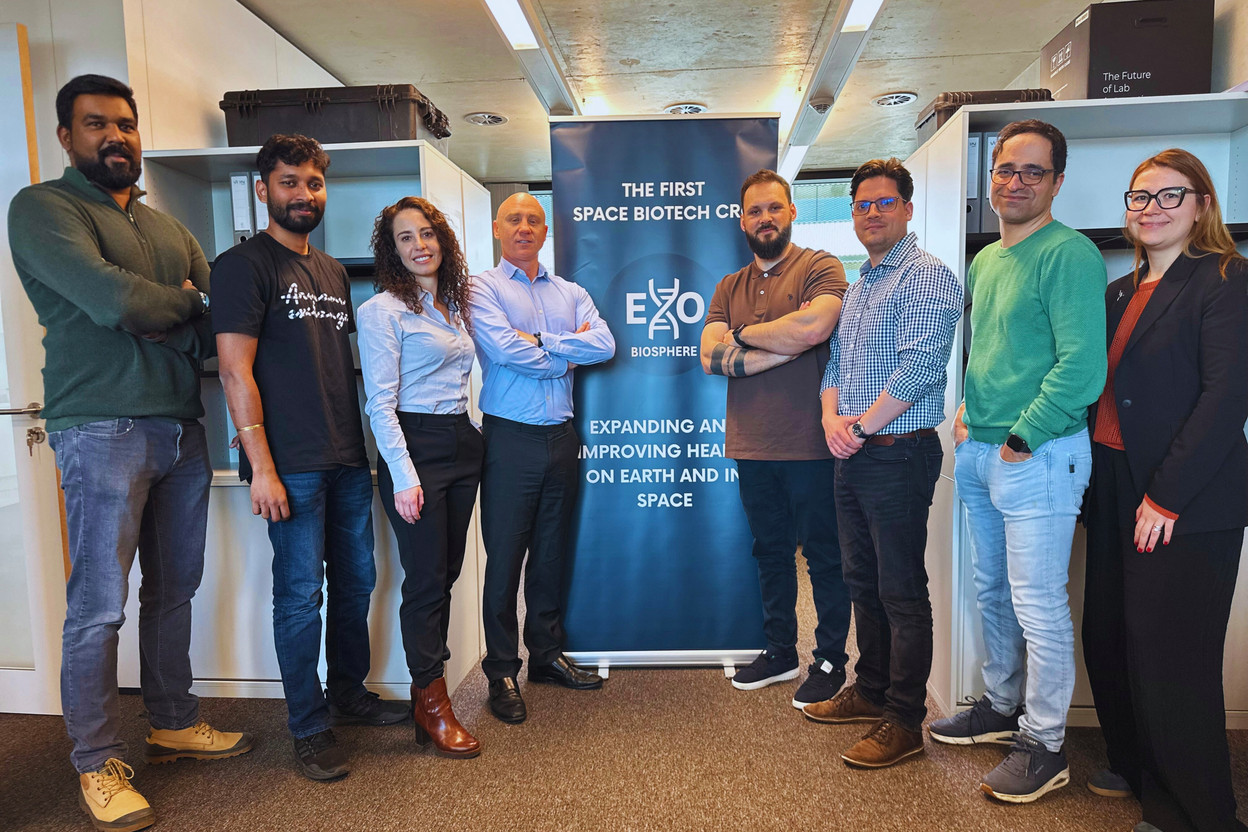
Less than two years after its creation, Exobiosphere employs 17 people and has secured five commercial missions before its first laboratory has even launched. The company’s next major milestone is scheduled for March 2027, when it plans to launch two autonomous laboratories: one aboard the International Space Station and another aboard Haven-1, the commercial space station being developed by US company Vast. Together, the missions will carry experiments on heart disease and ALS, a neurodegenerative disease for which there is currently no cure.
A co-founder driven by curiosity
Building a company was not Acierno’s original ambition. Raised in a small town in British Columbia, Canada, he spent almost a decade travelling after finishing high school, living in countries including China and Japan and visiting more than 100 countries before returning to university at the age of 25.
I wanted to save the world. I was an environmentalist at heart.

He enrolled in international security, driven by questions surrounding sustainability, economic development and the planet’s finite resources. The more he studied, the more convinced he became that humanity needed to rethink how it used Earth’s limited resources. “We’re living in a closed biosphere with limited resources,” he explains. “If we want to continue industrialising as a species without destroying the planet we live on, we have to think differently.”
That search for answers eventually led him to the International Space University in France, where he specialised in space studies before joining Japanese lunar exploration company iSpace as an intern. He became the company’s fourth employee and spent more than a decade helping it grow from an early-stage startup into an international business, opening its European office in Luxembourg before later becoming vice-president of sales in Tokyo and eventually CEO of iSpace US. After years spent helping build companies in the commercial space sector, Acierno began asking himself where the industry’s next major opportunity might lie.
Turning research into a business
His answer came from an area few entrepreneurs were paying attention to. For decades, researchers aboard the International Space Station had been publishing studies showing that biology behaves differently in microgravity. To Acierno, however, the surprising part was not the science itself but the absence of a business built around it.
“I thought, why hasn’t this part of the ecosystem grown? Maybe there’s a problem there that I can fix.”
He believes the missing piece was technology. “I think people realised the need, but the technology didn’t exist,” he says. “Over the past five years, there’s been revolutions in robotics and chips.” Advances in automation, miniaturisation and computing power meant laboratory systems that would once have been impossible to send into orbit could finally become commercially viable.
I was never really interested in doing space just for Earth, […] I wanted to create a company whose vision was for Earth and space.

Yet Acierno insists Exobiosphere was never intended to be just another space company. “I was never really interested in doing space just for Earth,” he says. “I wanted to create a company whose vision was for Earth and space.”
Rather than sending scientists into orbit, Exobiosphere sends autonomous laboratories. Its platform reproduces research workflows already used by pharmaceutical companies, hospitals and research institutes, allowing experiments to run automatically in microgravity. The goal is to improve preclinical drug discovery, where most potential treatments fail long before reaching patients. Acierno argues that microgravity offers researchers a unique environment to study diseases whose biological processes unfold over many years on Earth.
“Months equal years,” he says, describing how experiments can reveal biological responses more quickly in orbit.
Building momentum before launch
The company’s first customers arrived before its first launch. “I think the only way to know whether you’ve built something people want is if they’re willing to buy capacity,” says Acierno. That confidence is backed by demand. Exobiosphere has already sold five commercial missions to organisations including Cedars-Sinai in Los Angeles, one of the United States’ leading hospitals and research institutions, and has already reserved much of its launch capacity for 2027 and 2028.
Among all the milestones so far, one stands out for Acierno. Earlier this year, Dr Arun Sharma from Cedars-Sinai travelled to Luxembourg to carry out Exobiosphere’s scientific readiness review, successfully testing heart organoids on the company’s laboratory platform. “He tested it and gave us the thumbs up,” says Acierno. “That was probably the most exciting milestone for me and my team.” For him, it marked the moment the technology evolved from an idea into a platform that researchers could trust.
Looking beyond the first launch
The March 2027 missions are only the beginning. Acierno envisions increasingly sophisticated laboratories operating aboard commercial space stations, future lunar habitats and, eventually, missions to Mars. Yet despite operating at the frontier of space exploration, he insists the company’s purpose remains firmly grounded.
“Our vision is to improve life on Earth and in space.”
Ultimately, success will not be measured by the number of laboratories Exobiosphere launches, but by the impact those laboratories have on patients. “If our technology helps bring cures from space,” he says, “that’s our mission.”