In Mondorf-les-Bains, water is part of the landscape. Steven Scheuer, however, has turned it into a business. At the age of 28, the founder is developing a Luxembourg-based brand of reusable, customisable water bottles that is now looking to scale up. After two years of steady growth, he believes that 2026 will mark a real turning point.
His roots in Mondorf are no coincidence. He was born there, grew up there and still lives there. “We’re really immersed in this culture of water and wellbeing,” he notes. With Re-fill, he also wants to make the act of drinking more appealing. But at the start, there was neither a team nor hundreds of partners. Just a small engraving machine, a few colourful water bottles and a room belonging to his grandmother.
From a diplomatic dream to entrepreneurship
Having completed a master’s degree in international relations in Brussels, Steven Scheuer initially planned to become a diplomat and undertook a six-month placement at the ministry of foreign affairs in Luxembourg. He eventually turned his attention to the business world and joined the Luxembourg Confederation, where he worked in the retail sector and helped launch the Luxembourg Retail Federation.
His daily interactions with entrepreneurs made him want to switch sides. “I could see that they were constantly on the go, that they wanted to create things. That’s what motivated me to start a business.” He set up Re-fill whilst still working his day job, spending his evenings working in the family’s small premises.
If others have succeeded, that might be a good thing, because it shows there is a demand.

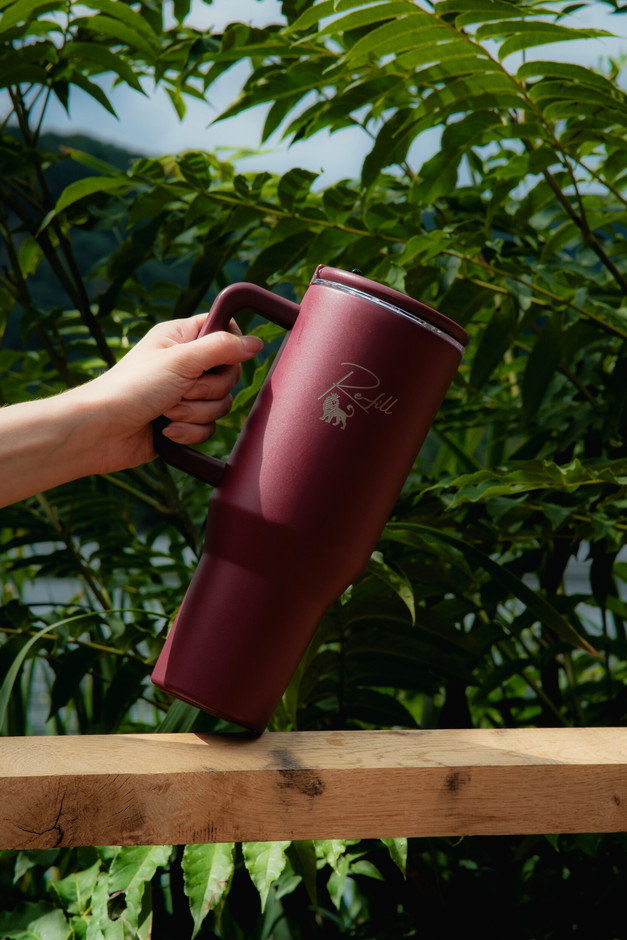
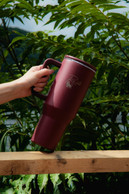
The idea first took shape in early 2023. At the time, the young entrepreneur was regularly buying bottles of water and, at the same time, noticed that water coolers were becoming increasingly common in offices and gyms. He wasn’t particularly impressed by the steel water bottles available on the market. “What bothered me about steel was the metallic grey flasks – they weren’t very attractive.”
So he ordered some colourful templates, bought a laser cutter and started engraving names for his friends and family. A network of after-school clubs soon took an interest in the idea, as a way for children to identify their own bottles. Further orders followed through word of mouth. “When I saw people’s reactions as they held the personalised product in their hands, I thought to myself: ‘We might be onto something.’”
At the same time, he noticed the rise of brands such as Stanley, Yeti and Owala in the United States. In his view, the water bottle is evolving from a simple functional item into a fashion accessory. A customer who ordered several to match her sports outfits confirmed this hunch. This development, however, presents a paradox: if the reusable water bottle becomes a collector’s item, it may ultimately run counter to the ecological rationale behind a reusable product. “Perhaps the aim isn’t to have 50 of them at home either. We need to find a balance.”
Re-fill: change of scale
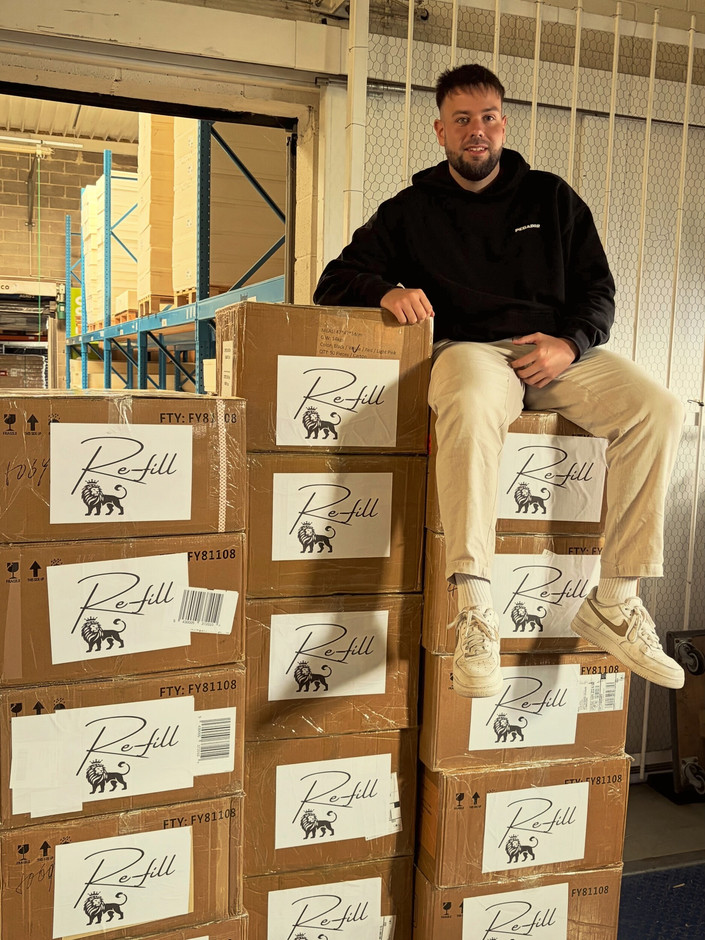
Re-fill was launched in 2024. This first year was mainly spent testing the concept and the products. In 2025, the business began to take shape with its first contracts. In 2026, the company reached a new milestone with its first employees, a growing number of partnerships with charities and businesses, and discussions with major retailers. “2024 was really a case of doing things by hand. In 2025, we started fulfilling contracts. But I think it’s this year that we can say we’ve got a proper business.”
The company now has three partners: Steven Scheuer, who remains its sole founder; Louis Sidot, who is in charge of the commercial side; and a third partner who acts as an investor and mentor. There are also two employees who work on logistics, engraving, packaging and dispatch. The small laser used in the early days has been replaced by four engraving machines. The water bottles are not manufactured in Luxembourg, but the personalisation, engraving, packaging and marketing are all carried out there.
Growth has so far been gradual, starting with the founder’s personal savings and then the revenue generated by the business. “The great thing is that we’ve managed each time to refinance the next batch of stock, right up to the point where we could fund our first employee,” he explains. However, the founder does not yet consider Re-fill to be profitable: for the time being, revenue is being reinvested in stock, machinery, infrastructure and staff. The brand receives an average of around ten online orders a day, in addition to bulk orders. For 2026, he is aiming to sell around 20,000 water bottles.
Charities at the heart of the model
The main driver of growth today lies with charitable organisations. Since early 2026, the start-up has forged partnerships with more than 125 charitable organisations and businesses in Luxembourg, as well as with around ten partners abroad. The concept is this: rather than asking a club to order several hundred identical water bottles, Re-fill creates a dedicated collection on its website. Each member can choose their own design and colour, and add their name or number. The company manages the stock, whilst the organisation receives a commission on sales. “A family can be part of the same club and choose four completely different water bottles. Each one will feature the club’s logo and personalised details.”
Local authorities, clubs and bulk orders now account for around 60% to 70% of the units sold by the company. The brand also works with local councils, government departments and other public sector organisations.
Carving out a place amongst the leading brands
When it comes to Stanley, Owala and Yeti, the Luxembourg-based brand is not seeking to compete solely on brand recognition. “If others have succeeded, that might actually be a good thing, because it shows there is a demand,” says Steven Scheuer.
Its strategy is based on three channels: direct online sales, partnerships and a network of retailers. Around 15 shops currently stock the products in Luxembourg, whilst one-off collaborations enable the brand to be featured in other retailers. For example, a water bottle designed around the Trounwiessel was sold at Ernster.
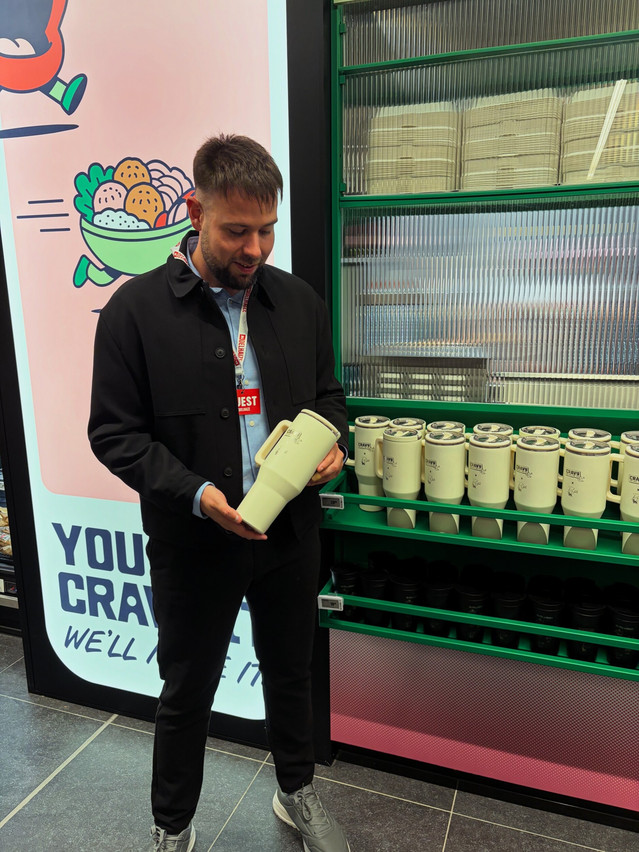
Re-fill has just launched a collaboration with Delhaize in Belval, as part of the new Cravy street food concept. (Photo: Steven Scheuer)
Since the interview, Re-fill has taken a further step forward in this distribution strategy. The brand has just launched a partnership with Delhaize, initially in Belval, as part of the launch of Cravy, the retailer’s new street food concept. For the start-up, this partnership marks its first foray into working with a player of this calibre, extending beyond its online business, B2B operations and collaborations with clubs and associations.
“We’re really trying to expand into the retail sector, including large-scale retail,” explains the founder. For 2026 and 2027, the aim is to expand the network of retailers and hydration partners. Regular online sales are currently concentrated in Luxembourg, France, Belgium and Germany. Incidentally, ‘Luxembourg’ was quickly dropped from the original name ‘Re-fill Luxembourg’ so as not to limit the brand’s international ambitions. The lion featured in the logo nevertheless retains its local roots.
Trade as a common thread
At the same time, Re-fill has had a strategic partnership with Stoll Maître Matelassier since 2025, particularly in the areas of infrastructure and logistics. Steven Scheuer himself joined Stoll’s management team in 2026, where he works on sales, marketing and e-commerce, whilst continuing to devote a significant portion of his time to Re-fill.
Looking ahead, he sees himself continuing to navigate between these two worlds and developing businesses capable of combining high-street retail with online sales. “I love high-street retail and I love online retail.” Having started out with a small engraving machine in Mondorf, Re-fill is now looking to prove that its business model can scale up.