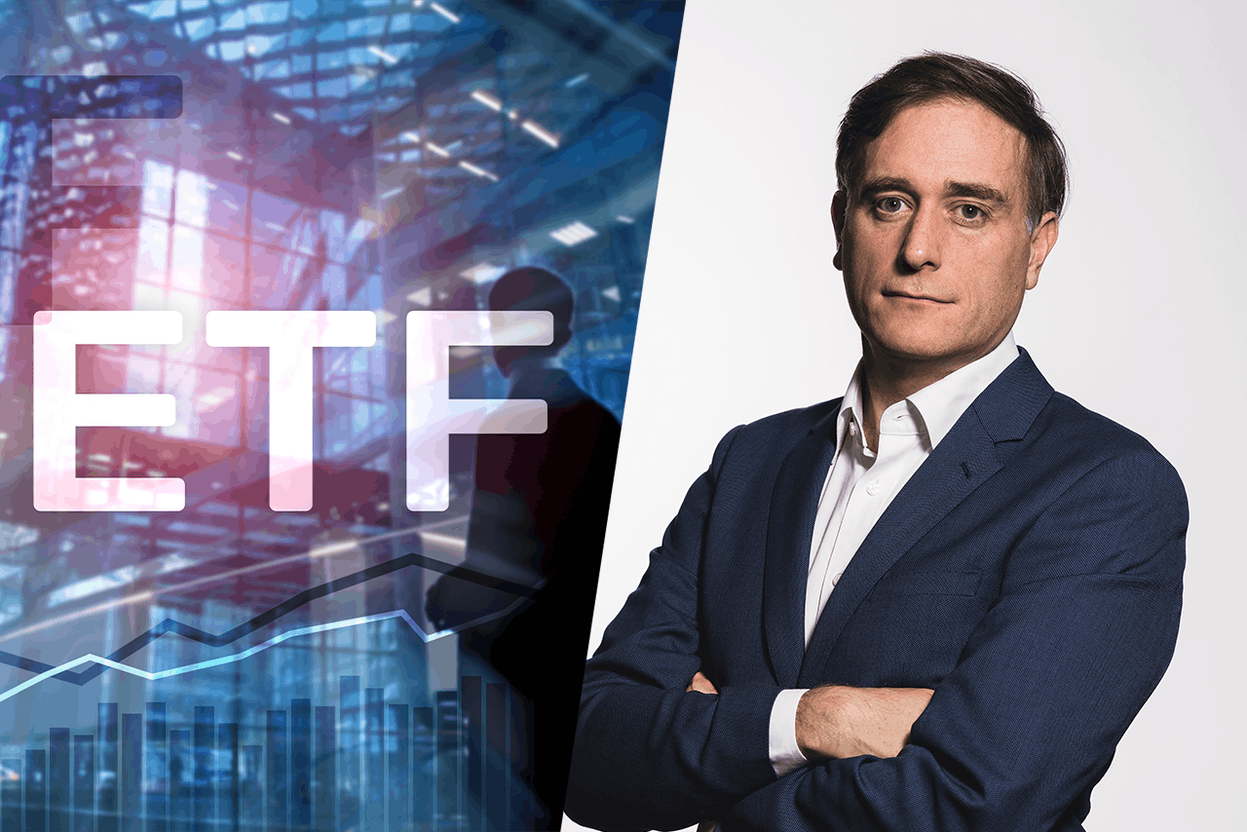
Fidelity is giving its active ETF managers greater scope to depart from their benchmarks while warning against extending the wrapper to assets unsuited to exchange trading.
Interviewed on the sidelines of Clearstream’s Global Fund Summit held on 29 October 2026, Stefan Kuhn, head of ETF at Fidelity, outlined the firm’s approach to active ETFs and cautioned against pursuing growth at the expense of underlying liquidity.
Once chiefly associated with passive index tracking, ETFs have become an increasingly important vehicle for active management. Fidelity’s approach combines research-driven stock selection with benchmark-relative risk controls, seeking outperformance while containing the extent to which portfolios diverge from their indices.
Beyond the benchmark, within bounds
Kuhn said Fidelity moved from research-based index strategies into active ETFs more than five years ago. Rather than focusing on unconstrained portfolios, the firm has developed “index-aware enhanced strategies” that give managers room to express investment views within defined risk parameters.
“Currently, active ETFs are meant to be index aware, but we are widening the rubber band around the index,” he said.
Tracking error measures the variability of a fund’s returns relative to its benchmark. Kuhn said Fidelity initially offered strategies with a tracking error of around 100 basis points, or one percentage point, before introducing products displaying tracking errors of 300–350 basis points in response to client demand for greater outperformance potential.
That wider scope allows managers to take more differentiated positions, although it also creates greater potential for underperformance.
Taming the performance killers of fees and size
In fund selection, two main structural forces erode investor returns: high fees and swelling fund size. Traditional active mutual funds often see performance dragged down by management costs or face execution friction when liquidating large positions.
Fidelity’s active ETF strategies with tracking error of around 100 basis points carry charges of 20–40 basis points, according to Kuhn. He argued that this pricing makes them competitive with traditional active mutual funds.
Passive ETFs remain a relevant comparison. For example, the iShares Core S&P 500 Ucits ETF has a total expense ratio of 0.07%, while the iShares Core MSCI World Ucits ETF charges 0.20%. The comparison highlights the additional cost that active strategies must overcome through performance.
On size, Fidelity leverages index-aware basket trading across broad, liquid constituents. Kuhn explained that when an investor executes a €100m redemption in a 250-holding active ETF, the manager sells a basket across “most positions” rather than dumping single stocks, mitigating market impact and preserving liquidity.
Proving liquidity during market stress
Kuhn also highlighted bond ETF trading during the Covid-19 market turmoil as an example of the wrapper’s usefulness when underlying markets become difficult to trade.
He recalled that executing individual corporate bond trades of $20m or $50m became extremely challenging. By contrast, market participants were able to execute a $100m bond ETF trade, providing exposure across 250 issuers.
The example illustrates how investors can use an ETF to trade diversified exposure in a single transaction. It does not mean that the liquidity of the underlying assets ceases to matter.
Starting an ETF business is hard,

The ETF creation and redemption mechanism supports arbitrage that can help keep share prices aligned with the value of portfolio holdings. However, premiums or discounts to reported net asset value can widen during market stress, particularly when underlying securities trade infrequently or their valuations become stale.
Indicative intraday net asset value, or iNAV, provides an estimated portfolio value during the trading day. It is a reference point rather than a guarantee of the price at which investors can trade.
Preparing for competition and wrapper integrity
As more traditional fund managers enter the European active ETF market, including through third-party platforms such as Waystone, Fidelity is relying on its track record and infrastructure to differentiate its offering.
“Starting an ETF business is hard,” Kuhn said.
Rather than chasing short-lived thematic fads in areas like artificial intelligence—which risks launching at market tops—Kuhn argued that Fidelity remains focused on broadening its core index-aware ranges.
Crucially, Kuhn cautions the industry against wrapping illiquid assets (private assets, illiquid high-yield bonds, emerging small-cap equities) into daily exchange-traded vehicles.
“Let’s just make sure as an industry that we put into an ETF what belongs in an ETF,” Kuhn said.