For years, the narrative of the global stock market has been dominated by a handful of American giants, the so-called “Magnificent Seven,” whose meteoric rise has both fascinated and terrified investors. However, as recent volatility and sudden drops in darlings like Nvidia demonstrate, tethering a portfolio to such a narrow mast can be an “incredibly risky” endeavour (see Chart 1).
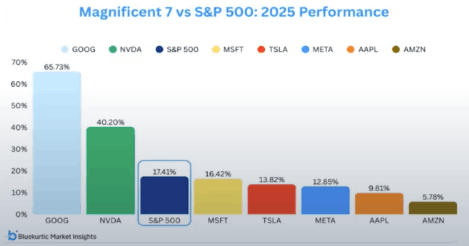
Chart 1: Mag 7 vs S&P 500 (in 2025) Source: Ginsglobal, as of 30 June 2026
While the Nasdaq-100 remains heavily concentrated—with more than half its value tied to just 8 megacap stocks (see Chart 2)—a different approach is gaining traction. In a webcast titled “Beyond the Mag 7: The Next Wave of Tech Disruption,” streamed on BrightTALK on 28 July 2026, Anthony Ginsberg, managing director of GinsGlobal Index Funds, rejected the idea that America has a “monopoly on brains” when it comes to technology.
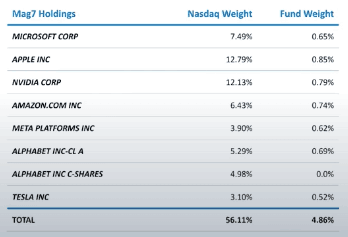
Chart 2: GinsGlobal ETFs are rebalanced semi-annually Source: Ginsglobal, HANeft. Nasdaq weigth as of 27 July 2026, ITEX weights as of 27 July 2026
Ginsberg argued that a globally diversified, equal-weighted strategy could reduce dependence on a small group of US megacaps. Equal weighting may reduce concentration, but it does not necessarily reduce volatility or losses.
Breaking the American tech monopoly
The current tech landscape is often viewed as a purely US-centric story, but the reality is increasingly global. While many standard indices such as the Nasdaq-100 are largely American-focused, Ginsberg said HAN-GINS Tech Megatrend Equal Weight UCITS ETF allocated approximately 60% to US companies, with contributions coming from Asia and Europe at around 20% and 13%, respectively.
This strategy acknowledges that global leaders in fields like robotics and cloud computing may also emerge from Japan, South Korea, or the Netherlands as they are from California.
By including emerging markets and Chinese “virtual monopolies” like Alibaba and Tencent, investors can access a much deeper ecosystem of tech beyond the usual US megatech.
The power of equal weighting
To mitigate the dangers of over-concentration, some fund managers are turning to equal-weighted indices that cap exposure to any single company or sector. In this model, even the most dominant “Mag 7” firms account for no more than about 10% of the top holdings, compared to the double-digit weightings for even single names seen in traditional indices.
The strategy helps investors “to avoid missing the boat” in specific securities or highly technological sectors prone to unexpected developments.
The firm’s Tech Megatrend Index is rebalanced every six months, with gains from high-flyers redistributed across the broader portfolio (see Chart 3). This ensures that investors are not “doubling down” on the same few names that already dominate their S&P 500 exposure, according to Ginsberg.
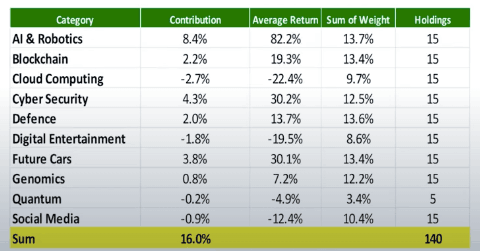
Chart 3: Tech Megatrend Index: 2026 YTD returns Source: Ginsglobal, as of 30 June 2026
Ginsberg did not address key features such as the cost impact related to the rebalancing of the weights, trading spreads, or the potential tax effects where applicable. Also, a greater exposure to smaller companies runs the risk of lagging during megacap-led rallies.
Ten megatrends shaping the future
True diversification in technology requires looking beyond software and social media to ten specific megatrends, including cybersecurity, AI, robotics, and gene editing. There is a growing “convergence” across these areas; for instance, cloud computing and cybersecurity are becoming “first cousins,” while AI is increasingly integrated into digital entertainment and defence technology.
Some of these sectors, such as quantum computing, are in their “early innings” but already show immense strategic importance, with countries like the UK, China, and Japan leading alongside the US.
The robotic surge and onshoring tailwinds
Political shifts and economic necessity are driving a major “onshoring tailwind” in the US, particularly in manufacturing. After years of cross-border supply chains developed under NAFTA and, since 2020, USMCA, Ginsberg argued that American firms are finally embracing automation and robotics to remain competitive with high-cost production hubs like Germany and Japan.
This trend, he believes, should accelerate, making robotics companies some of the primary beneficiaries of a more business-friendly environment. Rather than creating millions of manual jobs, increased technology expenditure is aimed at factory automation.
Why this is not another 2000 bubble
Sceptics often point to the dot-com crash as a warning, but the fundamentals today tell a different story, argued Ginsberg. During the 2000 bubble, he noted that price-to-earnings (PE) ratios on the S&P 500 IT index averaged above 50x, whereas an equal-weighted global approach currently sits at a more “moderate” 19.5 to 20x. However, that could be misleading as the comparison is not on a like-for-like basis.
Furthermore, the rise of subscription-based revenue models has created a much more sustainable and transparent earnings stream compared to the speculative advertising spends of 25 years ago. Ginsberg stressed that today’s tech giants are generating “annuitised” income that makes their operating models far more stable.
A core building block for portfolios
Ultimately, predicting which sub-theme will outperform is difficult. One year might see future cars lead the pack, while the next belongs to AI or blockchain. By utilising an equal-weighted global strategy as a “core building block,” Ginsberg argued that investors can avoid the stress of trying to time these rotations.
Ginsberg claimed their broad-based approach has already shown resilience, outperforming the concentrated “Mag 7” during recent periods of market turbulence while offering broader geography and themes into the technologies that will define the next decade.