1. To what extent will Luxembourg step up its defence efforts?
Defence: a planned increase until 2030. Luxembourg plans to increase its defence spending from 2.1% of gross national income in 2027 to 2.4% in 2030. This gradual increase paves the way for a greater commitment: to reach 5% by 2035, including related security expenditure.
Defence is firmly establishing itself as one of Luxembourg’s budgetary priorities. According to the draft 2027 budget and the multi-annual planning document, defence spending calculated in line with Nato criteria is set to reach €1.373bn next year, representing 2.1% of gross national income (GNI). It is set to rise to 2.2% in 2028, then to 2.3% in 2029.
For 2030, the government has provisionally set the figure at 2.4%, leaving it to the next government to decide on the trajectory beyond 2029. The figures will change in line with GNI forecasts, but the direction is set: an annual increase of 0.1 percentage points until 2029.
An initiative that will have an impact on future budgets. Compared with a scenario of no policy change, the new trajectory represents additional expenditure of €65.9m in 2027, €138.5m in 2028, €218.7m in 2029 and €306.3m in 2030.
Expenditure on equipment will follow a less linear pattern. Following a decline in 2027, expenditure from the Military Equipment Fund is expected to rise to €863.9m in 2030. The Belgian-Luxembourg battalion would then account for €340.6m, whilst air defence expenditure would rise from €100m in 2028 to €245m in 2030. In addition to these programmes, there are requirements for personnel, maintenance and infrastructure.
The 2035 target, however, sets a different benchmark: 3.5% of GNI for defence and 1.5% for related expenditure. The current planning does not yet set out the full path to achieving this. The debate will therefore focus on the pace of this build-up, its funding and the capabilities actually achieved.
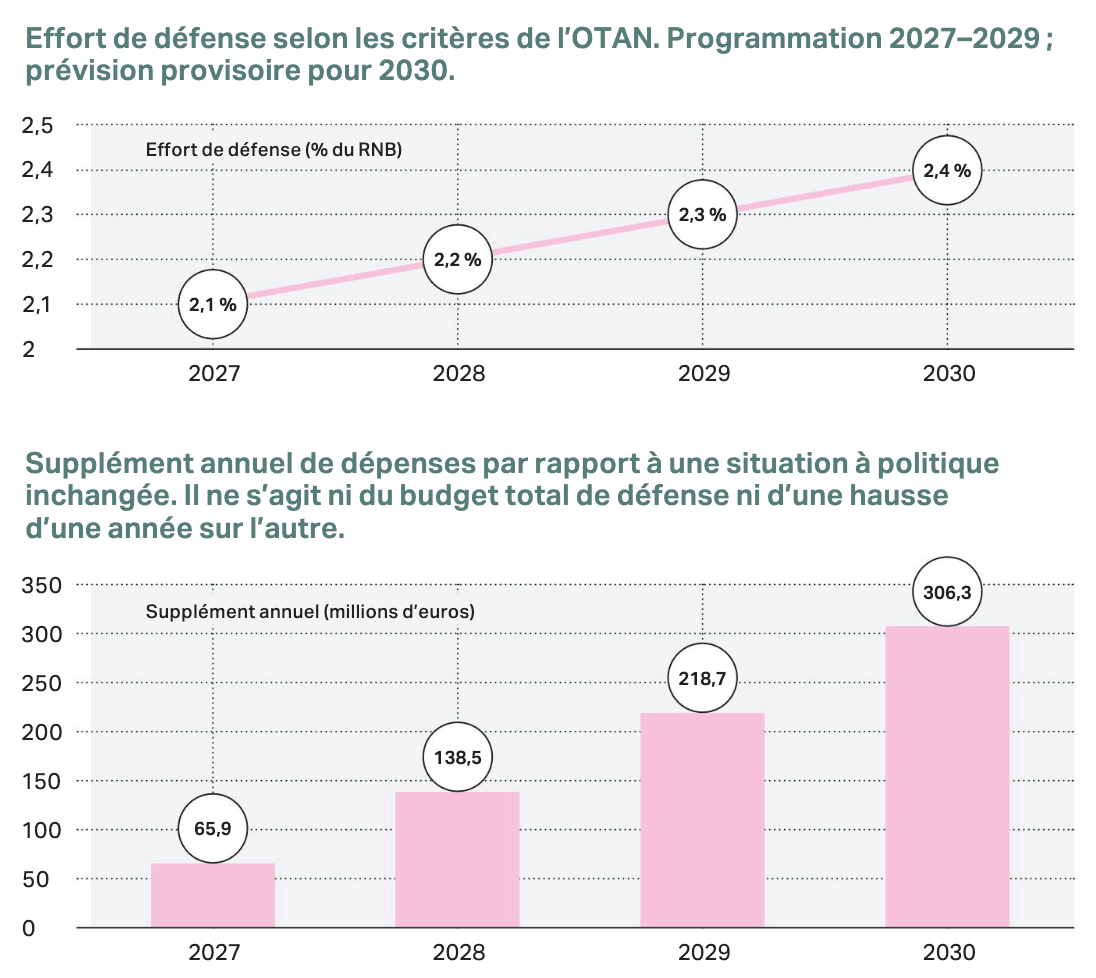
Defence expenditure according to Nato criteria and the annual increase in expenditure compared with a scenario where the political situation remains unchanged. (Sources: projet de budget 2027, dossier 8800, pp.34-35; programmation pluriannuelle 8801, annexe 9, p.535)
The key figure
+€306.3m. Projected annual increase in defence expenditure in 2030 compared with a scenario of no policy change. In 2027, it will reach €65.9m: the budget will therefore have increased 4.6-fold in three years.
2. Which programmes will absorb the increase in military spending?
Defence: infrastructure is being ramped up. Although structurally limited in terms of personnel, the strengthening of Luxembourg’s defence capabilities also depends on its equipment, including its buildings. The multi-annual planning programme allocates €32.6m in 2027 for the refurbishment of the Herrenberg barracks, the Bleesdall firing range and the Waldhof military camp. This compares with €21.8m in 2026, representing an increase of around 49%.
These three projects, funded by the Public and Administrative Investment Fund, amount to €156.2m over the period 2027–2030. This amount corresponds to expenditure planned over four years, and not to the total cost of the projects. This fund is intended to receive the sums allocated in the budget with a view to carrying out a construction programme which will be the subject of a special Act.
Waldhof picks up the pace; Bleesdall follows suit. Herrenberg remains the main project: its redevelopment and extension are expected to cost €20.7m in 2027 and €79.8m over four years. The government is prioritising the modernisation of the military centre, with the aim of also reducing the facilities’ energy footprint.
In Waldhof, the increase is marked. Expenditure on replacing and upgrading infrastructure is set to rise from €1m in 2026 to €10.3m in 2027. The cumulative budget is set to reach €42.6m by 2030. At Bleesdall, the increase is expected to occur mainly in 2028: after €1.6m in 2027, annual expenditure is set to exceed €10m. In total, €33.8m is earmarked over four years.
Other needs are emerging. The Military Equipment Fund has earmarked €20m for 2030 for barracks and ammunition storage facilities related to air defence. These timetables remain provisional: the administrative fund applies deductions to its overall expenditure to account for delays and unforeseen circumstances on site.
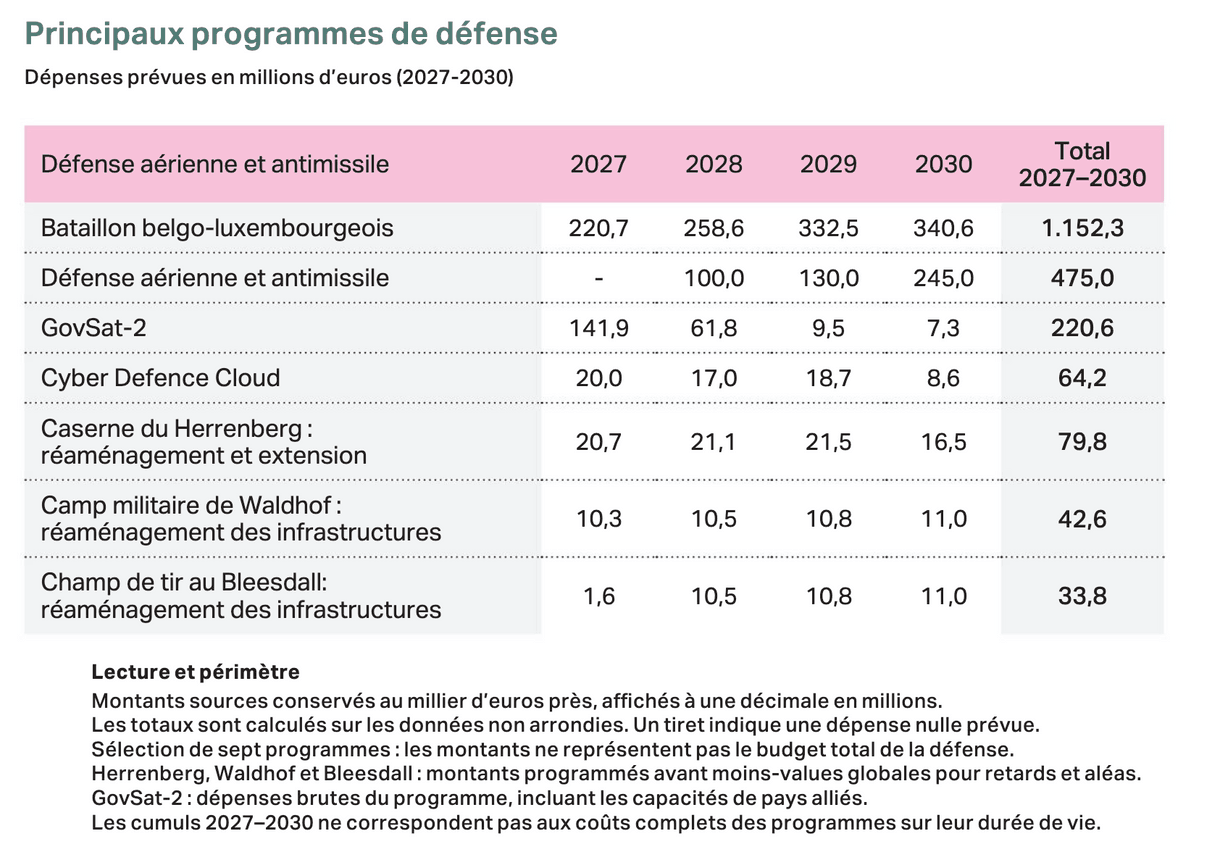
Key defence programmes. (Source: programmation pluriannuelle, pp. 394-396 et 448)
The key figure
€1.15bn. Such as the budget allocated to the Belgian-Luxembourg battalion between 2027 and 2030. This programme alone accounts for more expenditure than the other six projects presented combined, ranging from air defence to military infrastructure.
3. What is the opposition’s view?
Defence spending is set to rise from 2.1% of GNI in 2027 to 2.4% in 2030. Does this trajectory meet Luxembourg’s needs?


What policy choices does this trajectory entail? The 5% target includes defence-related expenditure.
M. H. – “In the current geopolitical climate and in view of our obligations, these budgets are necessary. Without peace in Europe, other important issues risk being sidelined. We find ourselves in a situation that has not been seen for decades. For a long time, we assumed that our neighbours and our Nato allies would take care of our defence. But preserving peace requires us to be prepared. This has been neglected in the past. We must change our attitude in the face of the new geopolitical reality and accept these budgets.
G. E. – “If I were in government, I would be rather sceptical about the 5% threshold. But I would commit to allocating more resources to defence than three years ago.
Is there a risk that this increase will be at the expense of social spending?
M. H. – “Despite the dramatic increase in defence spending provided for in the multi-annual budget, I do not see any cuts in the social sector. Next year’s budget also provides for measures in other areas. The increase in defence spending does not mean that social spending is being sacrificed.
G. E. – “I am relying on the government’s statements, particularly those of the Minister of Finance Chancellor of the Exchequer, that this effort will not be at the expense of social rights or social spending. As far as I am concerned, it is beyond dispute: we must find alternative sources of funding and, above all, must not make cuts in the social sector.
What economic benefits can be expected from these investments?
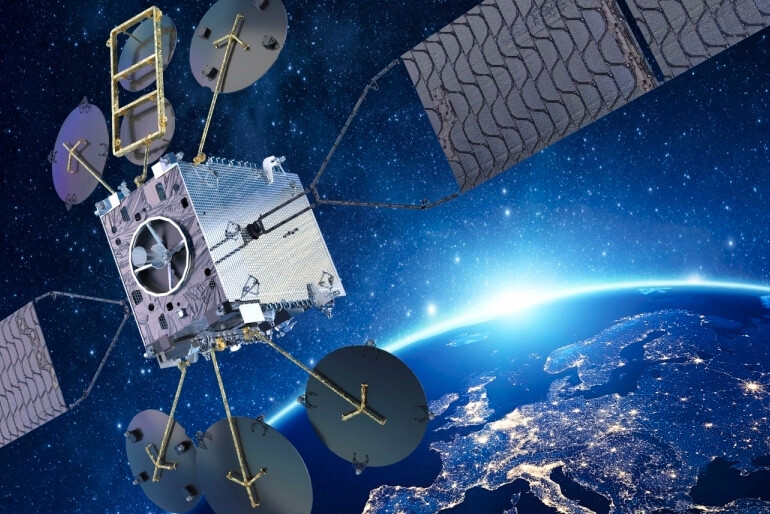
M. H. – “This is a strong argument and a new approach. The government has a strategy to generate these benefits. Our defence industry relies heavily on dual-use activities, both civilian and military. An entire sector is emerging. We already have expertise in space and satellites, with projects such as GovSat-2. These budgets can generate direct benefits and create jobs in Luxembourg.
In any case, we need to invest in this industry in Europe, of which Luxembourg is a part. Establishing an industrial supply chain may involve higher initial costs. However, it enables us to develop our European industry whilst ensuring that Luxembourg benefits. By joining forces with our European allies, these investments will pay off in the long run.
G. E. – “We already have strengths, particularly in the space sector and satellites, where Luxembourg is one of the pioneering countries. We can develop projects in these areas where investment would not be exclusively military. Future conflicts will not be fought solely on the conventional battlefield, with traditional weapons, but also in the cyber domain. Cybersecurity is one of Luxembourg’s strengths. We will need to develop this area further.
What outcome will enable us to judge whether this effort has been worthwhile by the end of the parliamentary term?
M. H. – “It is very difficult to measure. The main benefit is not economic: it is peace. Can we measure the extent to which taking our share of responsibility has helped to preserve it? I do not think so. Incursions and tensions show that this peace is under threat. The answer lies in investment and recruitment within the armed forces. But determining, at the end of a parliamentary term, whether peace has been preserved thanks to these specific efforts remains difficult. Yet dictatorships may ignore our efforts. If the other side decides to launch attacks, that does not mean we have not done our utmost. We are witnessing events that few people could have imagined a few years ago.
G. E. – “Our armed forces’ involvement in Nato’s efforts and in operations in the countries that need it most is essential. We could do more in this area. During a visit to Romania, I was able to see for myself the work being done by our soldiers, who are sharing our knowledge and expertise there. It would also be wise to invest in protection against drones. Being better able to detect them, identify their origin and determine their mission would represent a significant step forward.”
This article was written for the December 2026 issue of Paperjam magazine, published on 18 November. The content is produced exclusively for the magazine. It is published on the website to contribute to Paperjam’s comprehensive archive. Click on this link to subscribe to the magazine.
Is your company a member of the Paperjam Club? You can apply for a subscription in your name. Please let us know via club@paperjam.lu.