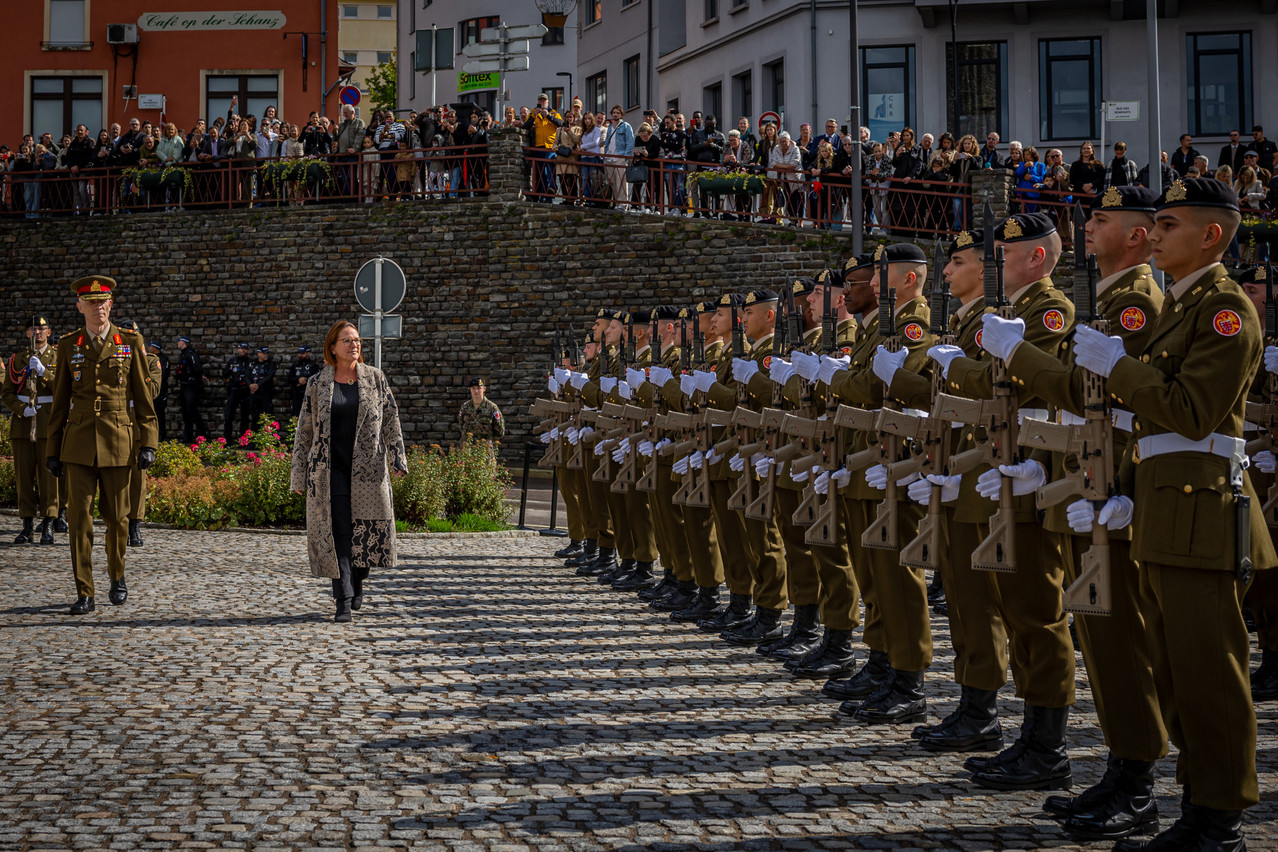
On 17 December, the Council of Government gave the green light to a package of measures entitled “Recruitment and attractiveness of the army”, presented by Defence Minister 
[T]he commitment to our security must be adequately rewarded.

“In view of the increasingly unstable geopolitical context and to meet Nato’s requirements in terms of military forces and capabilities, the need for qualified military personnel has never been more pressing,” stressed Yuriko Backes, adding that “collective security and national sovereignty today rely more than ever on the voluntary commitment of women and men who are ready to serve with commitment, uprightness and reliability”. The Minister insisted that “our personnel are at the centre of all our efforts - their commitment to our security must be adequately rewarded”.
Monthly bonus and free medical care
An initial bill, adopted by the government, aims to upgrade the pay of volunteer soldiers. It provides for an increase of 23 index points, i.e. a minimum of €530 per month, in basic gross pay, as well as an increase in the annual increase per year of service from 3.7 to 4 index points. The demobilisation bonus will also be increased over the entire period of service. In practical terms, the gross basic pay of a volunteer soldier in his first year would rise from €2,166.19 to €2,718.98, an increase of around 25%. In the fourth year of service, at the rank of first chief soldier, pay would rise to €3,732.83, compared with €3,170.83 at present.
To these amounts may be added, depending on the situation, a monthly “operational availability unit” bonus of 23.08 index points, i.e. 531.81 euros, a demobilisation bonus of up to €14,378.31 over 48 months of service, increases linked to peacekeeping operations, as well as the retention of non-monetary benefits, including free medical care.
Knowledge of Luxembourgish still compulsory
In a later phase, the government plans to make all volunteer soldiers deployable and systematically eligible for the operational bonus, while the initial active military phase would be extended from four to five years. The conditions for admission should also be adapted, in particular by opening up to non-resident European Union nationals and introducing exemptions in French or German, with knowledge of Luxembourgish remaining compulsory.
The package also includes a section devoted to career military personnel and experts. It provides for a reform of military commissioning in order to integrate civilian specialists according to their qualifications, an analysis of the conditions for admitting medical officers, the creation of temporary officer and non-commissioned officer careers, as well as a possible upgrading of salaries.
All of these measures are complementary to Bill 8068 on the army's operational compensation and indemnity scheme, currently in the legislative procedure, which also provides for increased indemnities for volunteer soldiers and regulars engaged in instruction and training activities.