
The European financial landscape is undergoing a structural transformation as private capital increasingly moves from the periphery to the core of corporate financing. While traditional banks have historically dominated the European market with a market share of 70%, a combination of regulatory pressure and the need for flexible capital is carving out a permanent space for private credit.
This evolution reflects a fundamental shift in how Europe’s medium-sized enterprises finance their growth, rather than a response to temporary market conditions, argued Douglass Welch, portfolio management conducting officer at Pemberton Asset Management, in an interview on 30 July 2026.
The resilient core of European lending
Despite broader macroeconomic headwinds, Pemberton views the core mid-market—companies with EBITDA of €15m to €75m—as fertile ground for private credit (see chart).
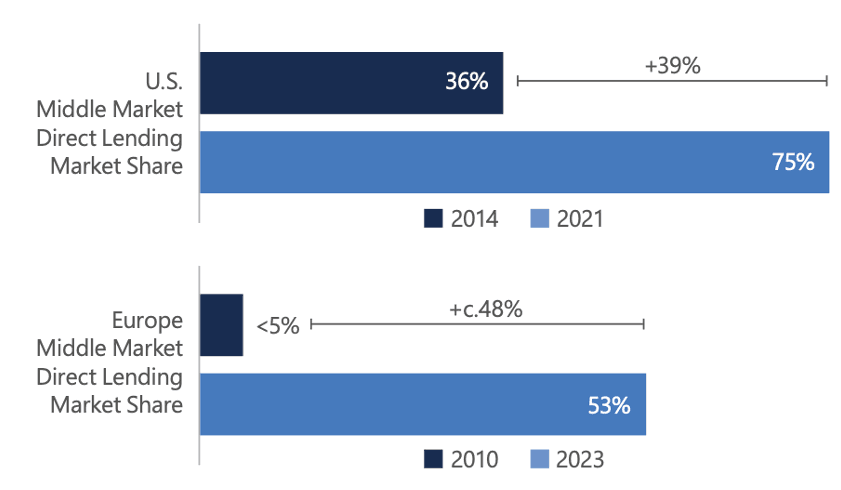
Chart: Middle market direct landing share Source: Pemperton, Morgan Stanley report 2025: European Private Credit: Why Now? August 2025.
Welch explained that Pemberton tends to follow private equity activities. For instance, many mid-market financing supports firms that were initially family-owned but now have private equity backers after a primary or a secondary LBO. This shift from being family-owned to professional ownership provides the governance, the business strategy, and the audit transparency, adding comfort to Pemberton while supporting credit due diligence.
The best opportunities currently lie in Western European markets that offer robust legal frameworks for workouts and restructuring, such as the UK, Germany, and France, argued Welch. Pemberton’s geographical expansion tends to mirror PE’s footprint in Western Europe, avoiding markets with complex legal frameworks such as in Austria.
Competition has increased, but the market has also expanded.

Niche strategies such as strategic risk transfer (SRT) are also gaining traction. Through SRT, Pemberton funds assume the first-loss risk on bank portfolios, helping banks reduce capital requirements while offering investors high-yield on short-maturity securities.
Adapting to a more crowded field
As competition intensifies, the market is bifurcating between the “covenant-light” large-cap space with stronger negotiation powers and the more disciplined mid-market. Increased competition is viewed as a natural byproduct of a maturing market that has grown to approximately €600bn in Europe.
“Competition has increased, but the market has also expanded,” said Welch. However, their competition remains pure-play European private credit asset managers such as ArcMont and HayFin. Despite documentation enabling them to invest 5% to 10% abroad, Welch noted that Business Development Companies (BDC) in the US “have other priorities to fix or address.”
To adapt, Pemberton is capitalising on its speed and flexibility, areas where it can outperform bank syndicates. While banks may take weeks to arrange a €200m syndicated loan, private credit providers can increasingly fund the full amount, offering borrowers a simpler, one-to-one relationship. "The Banque Internationale à Luxembourg can’t take the full amount.”
This structural advantage allows managers to maintain pricing power even as new investors or limited partners, particularly from the US, increase their focus on European assets. In addition, it is a market with covenants contrary to the covenant-light market in the US.
Luxembourg beyond the back office
To create a genuine competitive advantage that transcends its reputation for administration and domicile, Luxembourg must position itself as a centre for regulatory innovation. The Grand Duchy can differentiate itself by fostering a more sophisticated interaction between the industry and the regulator.
By leading the way in harmonising European rules, such as allowing fund vehicles to be the “lender of record” and supporting a framework for subline financing, or a subscription line of credit. Welsh noted that only a few banks have the origination facilities. Strengthening this ecosystem would provide private asset managers with better local tools for fund-level liquidity.
In contrast, Welch views negatively “ring-fenced” French Eltifs requiring local managers and investors for tax perks. He calls this a challenge to the European Savings and Investment Union and urges Luxembourg to “avoid the French example.”
Instead of investing “only in European government bonds,” Welsh argued that there is also a significant opportunity for Luxembourg to use its own Sovereign Wealth Fund more proactively, potentially seeding innovative infrastructure, defence, or venture capital funds to mirror the sophisticated strategies seen in hubs like Singapore or Abu Dhabi.
Building Europe's long-term capital base
Additionally, physical and social infrastructure remains a bottleneck; improving transport links to financial hubs like Frankfurt or Brussels and maintaining a high-quality, multilingual workforce is essential for long-term growth. The industry is also calling for a more harmonised approach to pension contributions across Europe to create a deeper, more liquid pool of long-term capital.
Europe emerges as private credit hub
The major trends reshaping the sector include a massive recycling of global investment capital and the “retailisation” of private assets. As institutional investors seek to diversify away from US-centric portfolios—which are currently plagued by “noise” and high exposure to volatile sectors like software—Europe is becoming a preferred destination due to its higher credit quality and prevalence of covenants.
Simultaneously, the industry is moving toward “evergreen” or open-ended funds to attract private wealth. To avoid the pitfalls seen in some US vehicles such as investing in illiquid seven-year loans while promising liquidity, managers must manage the liquidity mismatch carefully. “We've trained investors to invest in ETFs with daily liquidity,” he said.
Douglass Welch is a portfolio management conducting officer at Pemberton Asset Management S.A. and a member of its Investment Committee. He oversees asset allocation, investment restrictions, and regulatory responsibilities. With over 30 years in financial markets, he previously held senior roles at UniCredit and Citibank. He holds a BA in Economics and Political Science from the University of California, Berkeley.
This article was written for the Private Asset Supplement of Paperjam magazine’s October 2026 issue, published on 16 Septemberl. It is published on the site to contribute to the full Paperjam archive. Click this link to subscribe to the magazine. Is your company a member of the Paperjam Club? You can request a subscription in your name. Please let us know via club@paperjam.lu