Beyond the figures, the annual activity report reveals a doctrinal shift: the European Investment Bank (EIB) no longer presents itself solely as the bank for climate or cohesion, but as a central instrument of European sovereignty. It remains to be seen what the real impact of this repositioning will be.
Almost 60% of 2025 financing has been devoted to green projects. Energy, electricity networks, storage, interconnections and renewable energies dominate the agenda. But the tone is changing: the transition is no longer just about climate change, it is strategic. Energy security is presented as a pillar of European autonomy. Investments in electricity infrastructure or offshore wind power are described as direct responses to dependence on fossil fuels and geopolitical volatility.
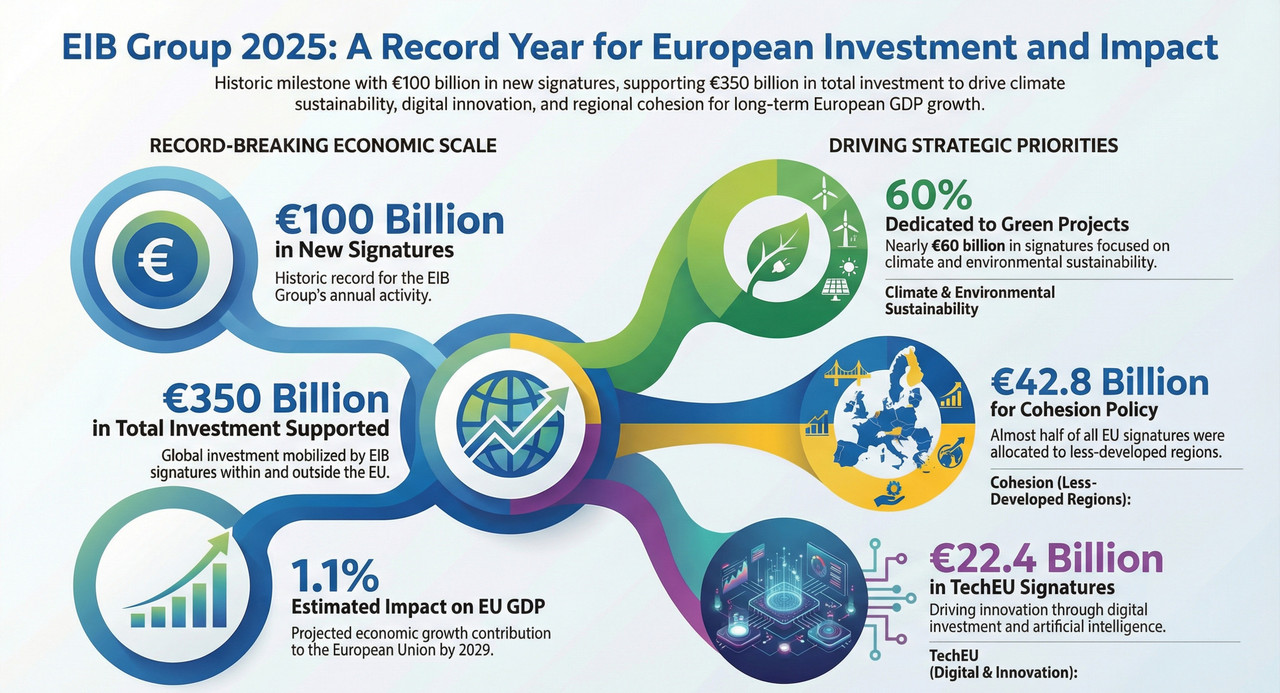
Key figures from the annual report. (Infography: Paperjam/Notebook LM)
This framework reflects the evolution of the European debate since 2022. The EIB is fully in line with this new political grammar. However, this shift is more narrative than structural: support for the climate was already at the heart of the Bank’s mandate. What is new is above all the way in which it is embedded in a rationale of sovereignty.
TechEU: Bridging the scale-up gap
The launch of TechEU, with a target of mobilising €250bn of investment by 2027, marks a symbolic turning point. The EIB intends to tackle one of the structural weaknesses of the European economy: the difficulty for technology companies to move from the innovation stage to industrialisation and global growth. Semiconductors, artificial intelligence, biotech, critical raw materials: the targeted sectors correspond to the Union’s strategic priorities. The European Tech Champions Initiative explicitly aims to prevent the exodus of scale-ups to the United States.
The ambition is clear. But execution remains to be demonstrated. The ability to mobilise massive amounts of private capital, to absorb the amounts announced and to sustainably change the European venture capital ecosystem will depend on factors that go beyond the EIB alone. The bank can act as a catalyst; it cannot on its own correct all the structural weaknesses of the European market.
Defence: a political rather than a budgetary turn
The most visible change concerns security and defence. In 2025, more than €4bn were committed to this sector, representing almost 5% of operations within the Union. Military bases, dual infrastructures, cyber security, financing the defence industry: the EIB is broadening its scope. Against a backdrop of war in Ukraine and European rearmament, this repositioning is politically significant.
In terms of volume, however, these amounts remain modest in relation to national defence budgets and the estimated needs to strengthen European capabilities. The turning point is real in symbolic and institutional terms; it is still limited in macroeconomic terms.
Cohesion and housing: stabilising the interior
Almost half of the funding within the EU has been directed towards less developed regions. Housing is also becoming a priority, with around €5bn available by 2025 and a target of one million affordable homes by 2030. Against a backdrop of social tensions linked to the cost of housing and territorial inequalities, the EIB explicitly links cohesion and democratic stability. Sovereignty is conceived here as internal as well as external resilience.
Here again, the scope must be put into perspective: faced with needs estimated at several hundred billion euros in the housing sector, the EIB’s contribution remains significant but partial.
With a balance sheet of €600bn and a strong presence on the green bond markets, the EIB insists on its financial robustness. This reminder is not insignificant. By increasing its exposure to disruptive innovation, defence and complex geopolitical environments, the institution is raising its risk profile. The report highlights the bank’s ability to maintain its cautious model while broadening its field of action. However, the question of balancing strategic ambition and financial discipline will remain central in the years ahead.
A gradual evolution rather than a rupture
The 2025 report marks a clear inflexion: the EIB is assuming an increasingly political role in the European economic architecture. It is positioning itself as a key instrument for the continent’s competitiveness, strategic autonomy and resilience. However, this is more a question of acceleration and repositioning than of a radical break. The historical pillars—climate, cohesion, infrastructure—remain. The novelty lies in their explicit integration into the discourse of sovereignty.
The EIB is not becoming a sovereign budgetary player in the state sense of the term. It remains a multilateral bank governed by its shareholders and its mandate. But it is now at the heart of European strategy in a fragmented world.
In this sense, 2025 is not just a record year. It also marks a gradual transformation: that of a financial institution which, without abandoning its banking prudence, is assuming a growing role in the strategic projection of the European Union.