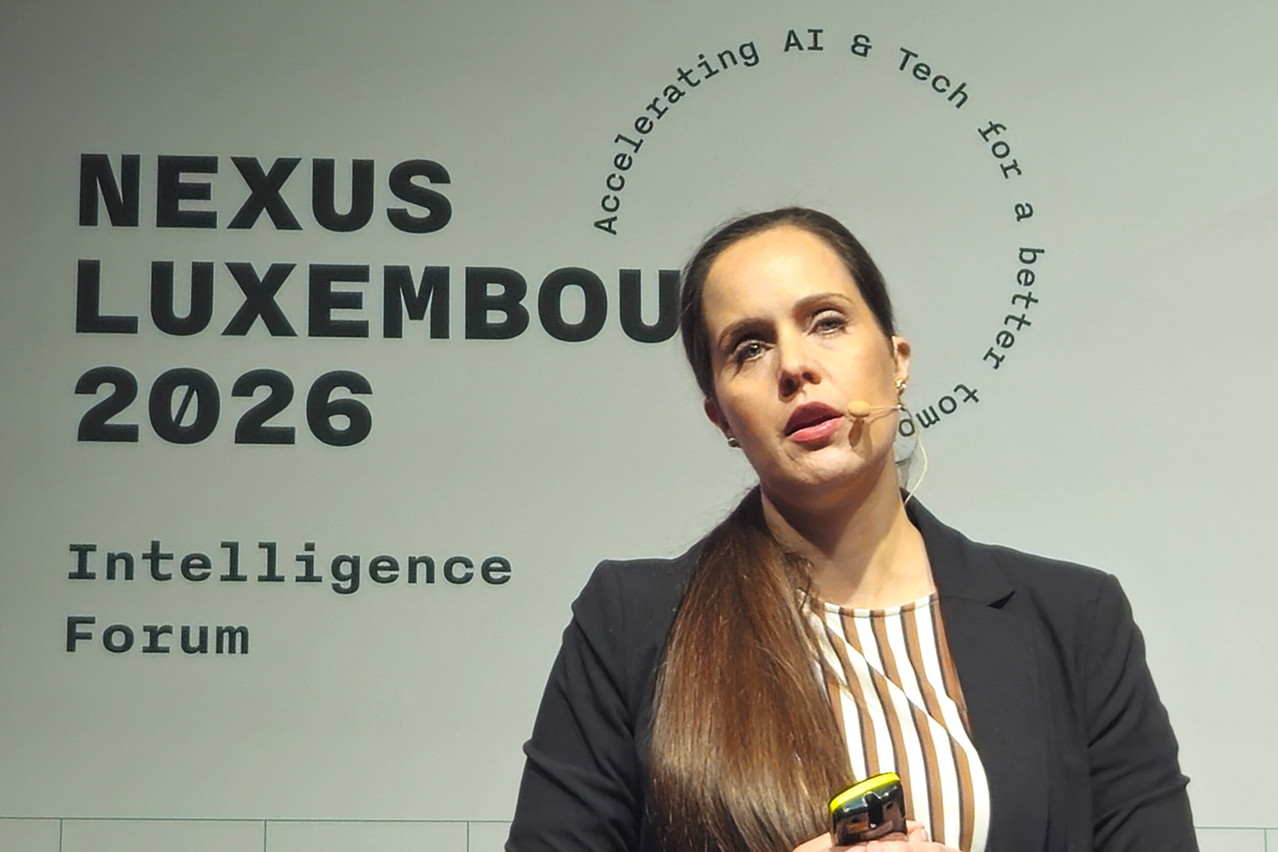
Natalie de Vries, Head of Data & AI Advisory Benelux at Atos, an IT services and consulting company, said sovereign AI must move beyond the data centre and focus on control across infrastructure, data, models and decision-making. Speaking at Nexus Luxembourg 2026, de Vries said the debate around digital sovereignty was “way more” than where data is stored.
“Yes, it’s very important where your data is stored when we’re talking about digital sovereignty or sovereign AI, but it’s way more than that,” she stated. “Regarding data, it’s also about data management, your technology, the entirety of your infrastructure, legal and the jurisdictional part of it, everything that encompasses doing your business and conducting your operations.”
Luxembourg’s digital government ambition
De Vries opened by referring to Luxembourg’s digital government ambitions, imagining the country by 2030 as “fully digital, fully conversational”.
“No more physical trips to the commune to arrange your public affairs. No more searching through websites or logging in to look for what you need to go for, but rather one interface that’s conversational, that speaks to you in your language,” she said.
She cited Luxembourg’s digitalisation minister, 
The sovereign AI paradox
De Vries described what she called a “sovereign AI paradox” facing large European organisations in both the public and private sectors. On one side, she said organisations want to “deliver better services faster”, “do more with fewer resources” and maintain control over policy decisions. On the other, pilots and proofs of concept may succeed while scaling often fails.
“Pilots or POCs succeed, but scaling it and really getting the value. That’s where projects usually fail,” she said. She warned that dependence on external platforms can increase as organisations build more AI systems.
“The greater the AI ambition you have as a country, organisation or institution, the greater the potential loss of control,” she argued. “That’s what sovereignty is about for me, not just a geopolitical debate, and not just where your data is located, but the control and the autonomy and the understanding of your entire AI and data stack.”
Control over the full stack
De Vries said sovereign AI required control across multiple layers, including infrastructure, data, models and decision-making. On infrastructure, she said organisations could use hybrid cloud, but systems had to be “modular” and “portable”. On data, she highlighted the importance of hidden biases, protection and knowing what models are trained on.
“Do you know what you’re training your models on, and what decisions you are then making?” she asked.
She added that organisations needed control over model training, fine-tuning, deployment and the full model lifecycle, rather than building a system once and leaving it unchanged. For decision-making, de Vries said the most important issue was where AI is used to make decisions or take actions affecting real people.
“You need to make sure that AI outcomes are aligned both with the legal side of things in the jurisdiction, but also very much more beyond that with your ethics and your moral values,” she said.
Public sector pressure
De Vries said pressure around sovereignty was increasing because of regulation, innovation, public sector expectations and geopolitics. She said AI regulation in Europe was “great” at a European level, but often “fragmented and vague and very difficult to implement, and very difficult to govern”.
She also noted that AI was moving beyond back-office pilots into “actual core business process”, making control more important. For the public sector, she said citizens expect governments to increase their autonomy and remain in control of citizen data. She added that by 2028, 65% of governments were estimated to take sovereignty measures.
A public sector AI assistant
De Vries gave the example of a European public sector institution that had a fragmented information space, with “1,200 plus websites” and “over 380 service information decks” that needed to be available in multiple languages. Atos worked on a digital citizen assistant as part of a wider solution, limited to approved information sources.
“We really ensure privacy, traceability and governance by design principles,” she said. “Importantly, to really make it human-centric and to really have that control, you need explainability and transparency by design to keep citizen interests at heart.”
The solution focused on three pilot use cases: tax office services, government subsidies and healthcare. De Vries said the system was currently based on generative AI chatbots but would become more agentic as it develops. She said strict business rules and guardrails were built into the system to limit the autonomy of the AI.
“We don’t want a government website giving the wrong information to a citizen,” she said.
Three pillars of sovereign AI
De Vries summarised the approach through three pillars: portable by design, explainable by default and trusted by people. Portable by design, she said, was about technical sovereignty, including modular, composable and cloud-agnostic systems. Explainable by default meant transparency, observability, monitoring and logging. Trusted by people required human governance and collaboration with subject matter experts.
“Be strict on the AI solution that you are letting do actions and give information to your customers or your citizens,” she said. She added that organisations should be transparent with users when they are interacting with AI.
“Tell your customers they’re talking with an AI agent that’s still being trained, that has only 92% accuracy on this question, but don’t worry, we’re working on the last 8% accuracy to improve our service to you,” she said.
De Vries concluded that, when designed properly, sovereignty could support rather than slow AI adoption. “Sovereignty stops being a decelerator and becomes an accelerator,” she said. “Less compliance friction means you can deploy quicker, more trust means it leads to higher adoption and getting the value and the impact quicker.”


