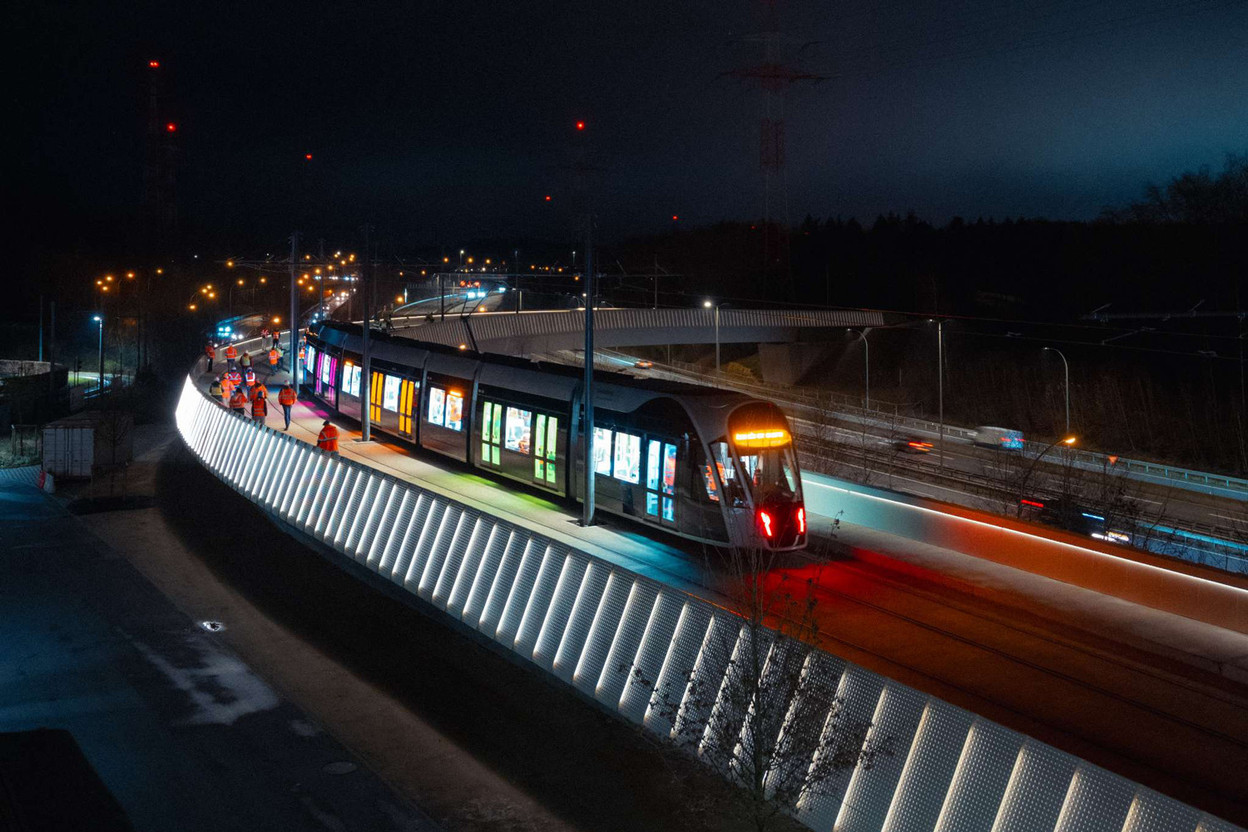
Yuriko Backes, minister of mobility and public works, has submitted a bill to Luxembourg’s parliament authorising the construction and financing of a new tramway section linking Place de l’Étoile (Stäreplaz) to a future Centre hospitalier de Luxembourg (CHL) mobility hub in Strassen. The extension would run along the Route d’Arlon, a long-established pressure point in the city’s western traffic network.
The bill would cap the government’s contribution at €114 million excluding VAT, indexed to construction prices. It would also declare the works to be in the public interest, enabling land acquisition and preparatory measures to proceed well before construction is due to begin.
The total project cost is estimated at €171 million, with the City of Luxembourg contributing €57 million.
Westward anchor
The planned extension would cover around 2.1 kilometres and include four stations. It would serve the Belair district, redevelopment sites around the former Josy Barthel stadium, and, for the first time, provide a direct high-capacity tram link to the CHL.
The CHL currently lacks a fixed, high-capacity public transport link. Under the proposal, it would become a western interchange node, linking the urban tram network with regional bus services.
The bill, however, stops at the CHL site in Strassen. Any extension beyond the hospital towards a future park-and-ride facility west of the city would require a separate funding law and parliamentary approval.
Cost and calendar
Construction is not expected to begin before spring 2029, reflecting dependencies on other major projects around Place de l’Étoile. Testing is scheduled for late 2032, with commercial service expected in the first quarter of 2033.
Annual operating costs attributable to the extension are estimated at €3.2 million for the government once the line is in service. The section would be operated as part of the existing Line 1, with a projected travel time of around five minutes between Stäreplaz and the CHL hub.
By seeking parliamentary approval at this stage, the government is aiming to secure the legal and financial framework years before works are due to start, even though construction remains several years away.
Planning lock-in
Declaring the works to be in the public interest would reduce legal uncertainty and allow early land acquisition along the Route d’Arlon. It would also effectively lock in the alignment before surrounding neighbourhoods are fully redeveloped.
In that sense, the tram is being used less as a response to growth than as a tool to organise it. The choice narrows future planning flexibility in favour of a tram-led urban model.
Delivered precedents
The Route d’Arlon bill comes after a series of tram projects that are already completed and in service.
The extension to Cloche d’Or and the stadium has been delivered, with trams now operating to Stadion as a terminus. Final platforms also entered service at Howald-Gare in January 2026, fully integrating the tram into the multimodal interchange.
Together, these projects have shifted travel patterns and reinforced the tram’s role as the backbone of urban mobility.
Network effects
Other investments are following the same logic. Preparatory works are under way for a further extension on Kirchberg, along Boulevard Konrad-Adenauer, linking the Pfaffenthal/Kirchberg interchange to the European School.
That section is scheduled for completion in September 2027.
On the rail side, the government approved a €138 million bill in November 2025 to transform Hollerich station into a major multimodal hub. The project includes an additional track between Hollerich and the central station and the separation of rail lines.
The aim is to establish Hollerich as the capital’s fourth peripheral station and relieve pressure on the central node.
Corporate pull
Improved tram connectivity is already influencing corporate location decisions.
State Street Bank International has confirmed plans to relocate its Luxembourg headquarters from Kirchberg to the ‘Stairs’ building in Cloche d’Or by mid-2026. Around 1,000 employees are expected to move into the 9,999 m² complex.
Access to the tram network was cited as one factor behind the relocation.
Market signal
Market data point in the same direction. A JLL study published in December 2025 found that 71% of office property transactions since 2020 took place within a ten-minute walk of public transport.
Office rents along tram and rail corridors were around 30% higher than in less connected areas. Districts such as Howald and Findel have gained in attractiveness as new connections have come online.
Friction
The tram’s expansion has also created tensions.
Since the line reached Findel–Luxembourg Airport in March 2025, taxi operators have warned of declining demand for airport journeys. Such trips are estimated to represent between 20% and 30% of business volume for some operators.
These concerns underline the uneven distribution of costs and benefits associated with modal shift.
Strategic choice
Taken together, the Route d’Arlon bill and the wider programme of tram and rail investments show how mobility policy has become inseparable from urban planning and economic positioning.
Parliament’s debate is therefore likely to test not the tram principle itself, but how far and how fast the government intends to push a model that increasingly uses transport infrastructure to shape the city.