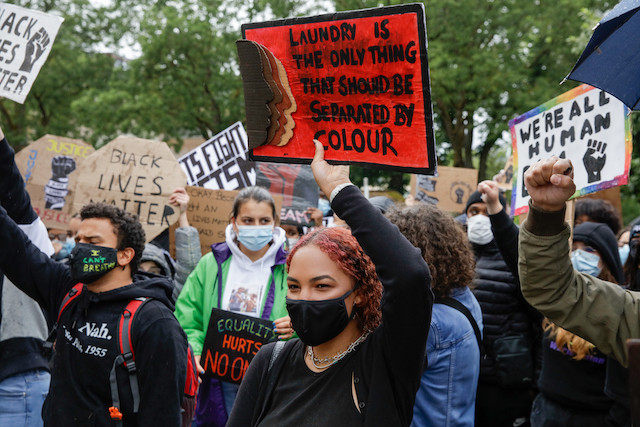
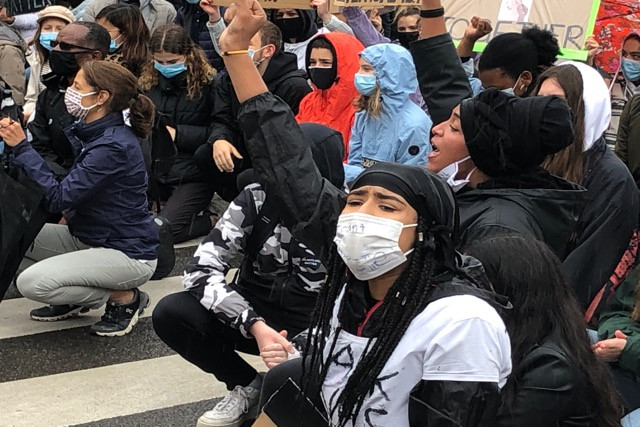
More than 1,500 people in Luxembourg joined a Black Lives Matter protest in June 2020 in the aftermath of the killing of George Floyd by a police officer in Minneapolis. The protest in solidarity with the US movement also called out racism and discrimination in the grand duchy.
A debate in parliament at the start of July 2020 concluded that the government must carry out a survey to better understand racism in the country and develop a national action plan against racism in all sectors of life--from education and the workplace to healthcare and political representation.
But what has happened since?
“Not much,” said Sven Clement (Pirate Party), who sponsored the motion to develop an action plan. A separate motion, proposed by Max Hahn (DP), called for a study on racism and lawmakers at the time decided that the research should serve as the basis for policy measures.
The family and integration committee provided input on the scope of the survey, Hahn explained, and signed off on the questions. The results should be presented by mid-March. “Expectations are high,” the MP said.
The survey wasn’t simply a box-ticking exercise, Hahn said. “It should be the foundation to start the work.” Without having seen the results, however, the MP did not want to comment on what the next steps will be or what headway should be made by the summer, when two years will have passed since the debate in parliament. “We must have the data first.”
A spokesperson for the Luxembourg Institute of Socio-Economic Research (Liser) said the institute would not discuss the study until it has been presented to lawmakers. Liser coordinated the project together with intercultural studies institute Cefis.
The slow progress has frustrated Clement. “If we wanted to tackle this problem, we could do a lot,” he told Delano. For example, anonymising CVs could help prevent race and gender discrimination in the hiring process.
If there’s a lack of awareness, how can there be an approach to a solution?

In healthcare, there are not only questions about access to services but also awareness and training of medical professionals. Medical study has largely been limited to white patients, men in particular. People of colour are more likely to be misdiagnosed because of bias but also as diseases can present differently.
Hate speech must consistently be prosecuted and penalised, Clement said, integration and inclusion promoted in schools and the workplace. “We need awareness at all levels,” said Clement. “If there’s a lack of awareness, how can there be an approach to a solution?”
Luxembourg’s “fairy tale” image of an international, multilingual country in which 47% of the population are foreigners from 170 nationalities isn’t helping. “It’s an excuse so that Luxembourg can keep living under the illusion that there’s no problem.”
It didn’t go unnoticed during the 2020 debate in the Chamber of Deputies that not a single elected representative in parliament is a person of colour.
In a 2018 report on “Being Black in the EU”, Luxembourg performed poorly, with 50% of survey respondents saying they felt they had been discriminated against in the last 12 months. An anti-discrimination body in Luxembourg--the Centre for Equal Treatment--said in its 2020 annual report that racism was the second most common cause of discrimination complaints, behind disability.
The family and integration ministry under Corinne Cahen (DP) is taking the lead to develop the racism action plan. The ministry previously published a national integration plan. But this doesn’t mention racism and includes no specific reference to black, Asian or Middle Eastern minorities.
Under Clement’s proposal, however, the plan should also involve the education, labour, health and other ministries, and the MP is sceptical that all the pieces will fall into place in any kind of meaningful way. “I’m really disappointed. We didn’t demand much and we’re getting even less in return.”
This article is the first in a series that Delano will be publishing throughout this week to mark the closing of US Black History Month.