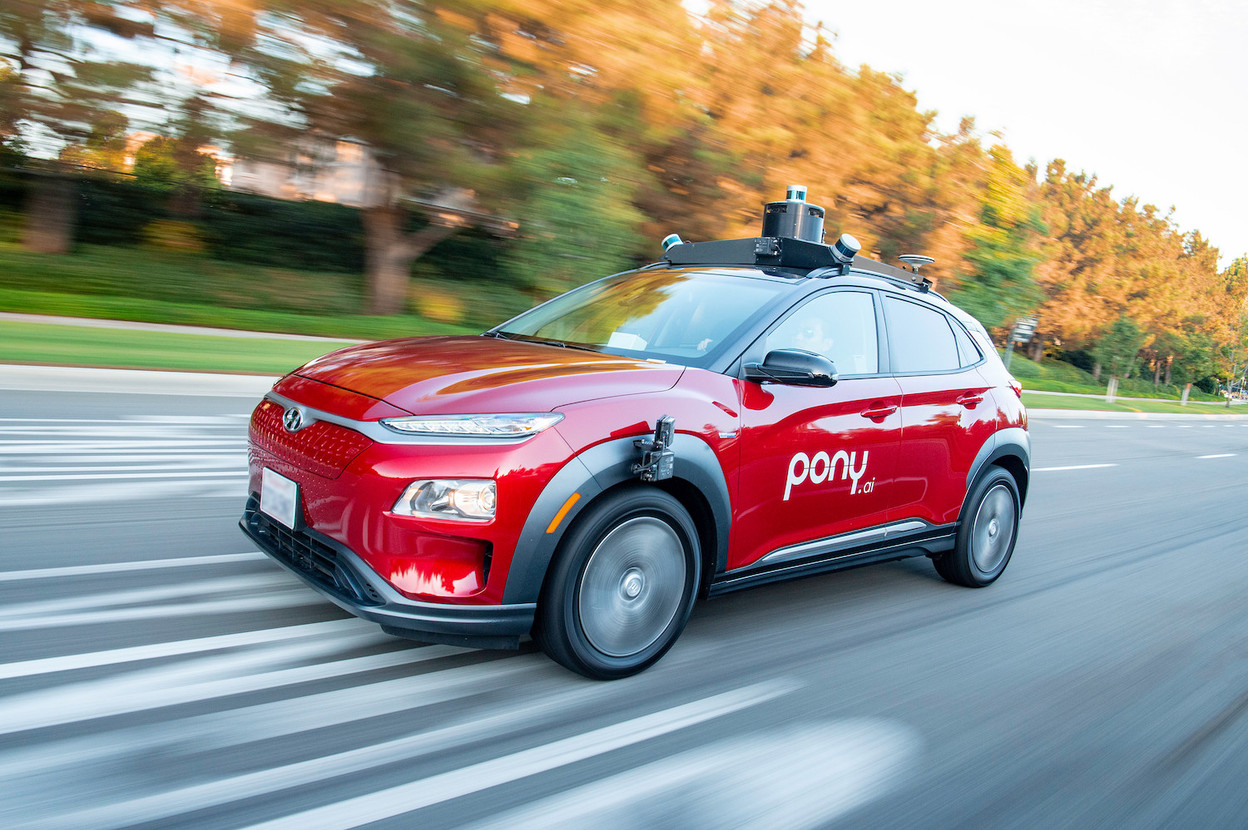
Where do we place the cursor for autonomous cars? If Luxembourg is too conservative, it runs the risk of not attracting entrepreneurs from the sector to Bissen, following in the footsteps of Pony.AI. If it is too progressive, it will expose itself to the wrath of insurers and public opinion at the slightest incident involving an autonomous vehicle on its roads. The decisions on the future regulatory framework--perhaps expected this year--are therefore complex, especially as the sector is in full swing.
The Consumer Electronics Show (CES) in Las Vegas illustrates a dual phenomenon: on the one hand, ‘traditional’ carmakers are stepping up the pace of autonomous driving technologies; on the other, new players in the mobility sector are stepping up the safety of their systems, which are now capable of doing without a driver altogether.
Toyota steps up its game with Nvidia
Toyota has announced the integration of Nvidia technology, with the Drive AGX Orin supercomputer, specifically designed for vehicles and capable of performing 275,000bn operations per second (Tops), compared with 150,000bn for the three neural networks of Tesla’s fourth-generation system. Elon Musk himself acknowledged at the end of 2024 that the fully autonomous driving mode was not yet living up to its promises, but announced a new version for 2026. Toyota thus hopes to catch up with and overtake the world leader in vehicle sales, which is facing two obstacles.
First, the National Highway Traffic Safety Administration (NHTSA) has opened an investigation into 2.6m Tesla drivers following reports of accidents involving a feature that allows the car to be controlled remotely.
Second, Chinese authorities are reluctant to authorise the installation of fully autonomous driving systems on models sold on the mainland.
Nvidia boosts workforce in China
In addition to Toyota, Uber has also announced a partnership with Nvidia to integrate artificial intelligence technologies into its robot taxi fleets. Nvidia is strengthening its presence in Asia by increasing its workforce in China (4,000 people) to develop autonomous driving solutions tailored to the local market, reflecting its global ambitions. The presentation of the “Cosmos” generative AI, capable of simulating photorealistic environments to train autonomous systems, marks a major advance in this field.
The number of operations per second is crucial, as it enables a system to envisage a multitude of scenarios and make the best decision in the event of the unexpected. It is precisely this issue of contingency management that players such as Waymo, a subsidiary of Alphabet, are trying to promote.
Waymo less dangerous than an ordinary driver
At the end of 2024, Waymo and Swiss Re published a study comparing conventional and autonomous vehicles. Over a total of 41m kilometres travelled, its autonomous system showed a clear superiority in terms of safety: an 88% reduction in material accidents and a 92% reduction in personal injury accidents compared with human drivers. The results are even better for cars registered between 2018 and 2021: an 86% reduction in material accidents and a 90% reduction in bodily injury accidents. The study also highlights the improved performance of drivers of recent vehicles, probably thanks to onboard technologies and a better driving experience.
However, some mobility and safety experts point out that billions of kilometres would have to be analysed to obtain sufficiently solid data to compare different technologies. Studies that focus on a specific player are often biased. This is why the National Highway Traffic Safety Administration has proposed a voluntary national transparency framework--a 265-page document that can still be amended--to establish reference standards for autonomous cars.
China as arbiter of the future
China could once again impose its rules on everyone. With its huge volume of data, dense ecosystem of vehicles and fierce competition between manufacturers, “2025 will be the year of the democratisation of the autonomous car in China,” said UBS analyst Paul Gong at the China Future Tech webinar organised by the South China Morning Post.
A new business model for insurers
Insurers will also have to rethink their business model: while technology may reduce the risk of accidents, it raises other issues, particularly in terms of reliability, cybersecurity and the management of personal data. This data, which drivers will almost inevitably have to share with manufacturers, represents a precious financial windfall for insurance companies. This could lead to a two-tier insurance system: lower premiums for drivers who obey the rules of the road, and more expensive policies for the ‘daredevils.’
Unless European regulators take up the issue to guarantee drivers control over their driving and consumption data.
This article was originally published in French.