The rapid expansion of exchange-traded funds is opening new opportunities for asset managers, but the industry's next frontier may prove more complicated than expected.
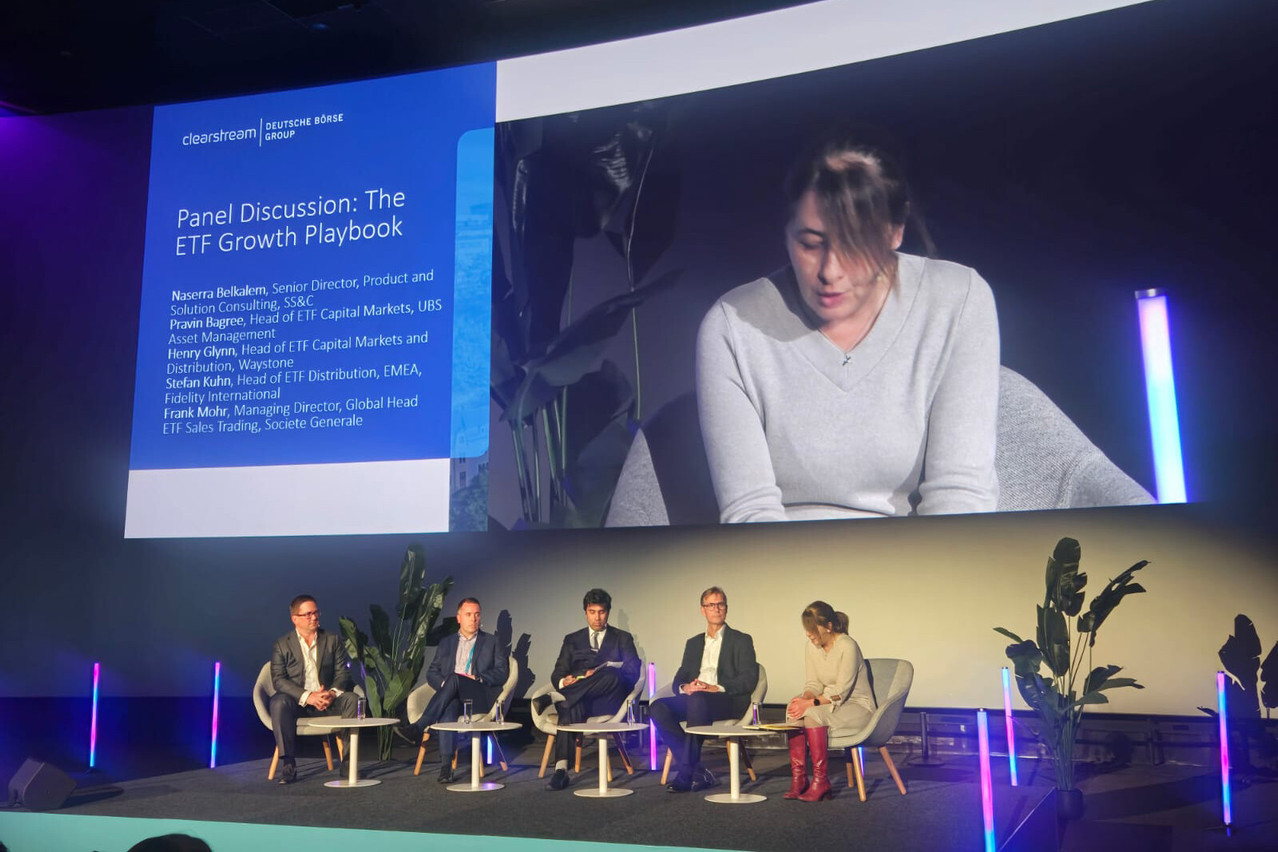
At the Global Fund Summit 2026, organised by Clearstream Luxembourg, representatives from UBS Asset Management, Fidelity International, Waystone and Société Générale discussed the growing sophistication of ETFs, the rise of active strategies and the operational challenges accompanying their expansion.
One issue emerged as particularly sensitive: whether the ETF structure can accommodate investments in private markets.
An ETF cannot create liquidity
Frank Mohr, representing Société Générale's market-making activities, delivered one of the panel's clearest warnings. ETFs may provide investors with intraday trading opportunities, but that does not automatically make their underlying investments liquid.
Market makers must be able to value the assets held in an ETF and manage the risks associated with providing continuous prices. As strategies become more complex, particularly those involving derivatives, options or less liquid securities, this process becomes increasingly challenging.
Frank Mohr stressed that market makers need sufficient transparency about portfolio composition to price ETFs reliably and maintain liquidity throughout the trading day. The challenge becomes particularly acute for private assets, which may be valued only periodically rather than continuously.
Pravin Bagree of UBS Asset Management reinforced the point, questioning how private market investments could be fairly valued within a structure designed for intraday trading.
For traditional private assets, he argued, the mismatch between infrequent valuations and daily market pricing makes the ETF format difficult to reconcile with the underlying investment strategy.
The discussion highlights a fundamental distinction: providing exchange trading for fund shares does not eliminate the liquidity constraints of the assets held within the fund.
Active ETFs drive the next wave
These concerns arise as the European ETF market undergoes a significant transformation. Historically associated with low-cost passive index tracking, ETFs are increasingly becoming a distribution format for active investment strategies.
Stefan Kuhn of Fidelity International argued that the ETF structure is evolving beyond its traditional role of delivering inexpensive market exposure. Active ETFs, he explained, can provide investors with systematic or actively managed strategies while retaining the accessibility, transparency and trading flexibility associated with exchange-traded products.
Although passive ETFs still dominate European assets under management, active strategies have been gaining market share and attracting growing investor interest.For Henry Glynn of Waystone, this shift is already visible among new market entrants.
He indicated that approximately 90% to 95% of the managers Waystone helps bring into the ETF market are launching active strategies. The trend is also challenging a long-standing assumption that ETFs must necessarily be inexpensive.
With more sophisticated strategies entering the market, the ETF is increasingly viewed as a distribution vehicle rather than a product category defined exclusively by low fees.
Distribution remains the decisive factor
Yet launching an ETF does not guarantee commercial success. According to Henri Glynn, one of the most common mistakes made by new issuers is attempting to target too many markets simultaneously.
The UCITS framework offers extensive cross-border distribution opportunities, including access to investors beyond Europe. But that geographical reach can become a distraction without a clearly defined commercial strategy.
Successful entrants, he argued, typically identify a limited number of priority markets and align their listing, currency and marketing strategies accordingly. Distribution is especially important in a market where established providers already benefit from significant scale advantages.
Bagree described passive ETF management as a business driven by scale, where the initial investment in portfolio management systems, trading capabilities and service-provider relationships can represent a substantial barrier for new entrants.
Once that infrastructure is established, however, additional assets can become increasingly profitable.
Market makers move to the centre of ETF innovation
As active ETFs become more complex, their success also depends on the wider operational ecosystem. Frank Mohr emphasised the importance of involving market makers early in product development, particularly when strategies include options, derivatives or other instruments requiring sophisticated hedging.
Unlike traditional passive ETFs, where underlying indices provide a relatively straightforward reference for pricing, actively managed portfolios may require more detailed information and specialised risk-management capabilities. Fund administrators also play a critical role.
The production of accurate net asset values and portfolio composition files is essential for market makers to provide reliable prices. These requirements are becoming increasingly significant as Europe prepares for the transition to T+1 settlement.
For Luxembourg's fund servicing industry, the expansion of active ETFs therefore creates opportunities beyond fund administration alone, extending to transfer agency, valuation, technology and capital markets services.
A growing market with structural limits
Despite increasing competition, the panelists saw considerable room for further ETF growth. Henri Glynn pointed to the relatively small number of UCITS ETFs compared with the broader European UCITS fund universe, suggesting that the market remains far from saturated.
The expansion of active strategies, institutional adoption and growing retail participation could all support further development. But the discussion also revealed a tension at the heart of ETF innovation.
As asset managers seek to bring more sophisticated and potentially less liquid strategies into an exchange-traded format, the need for robust pricing, operational infrastructure and market-making capabilities becomes increasingly important. For Luxembourg, a major centre for cross-border investment funds and alternative assets, the message is particularly relevant.
The ETF structure may continue to evolve, but its success ultimately depends on whether the underlying investments can support the liquidity and transparency investors expect. Innovation can expand the boundaries of the ETF market. It cannot remove the fundamental characteristics of the assets themselves.