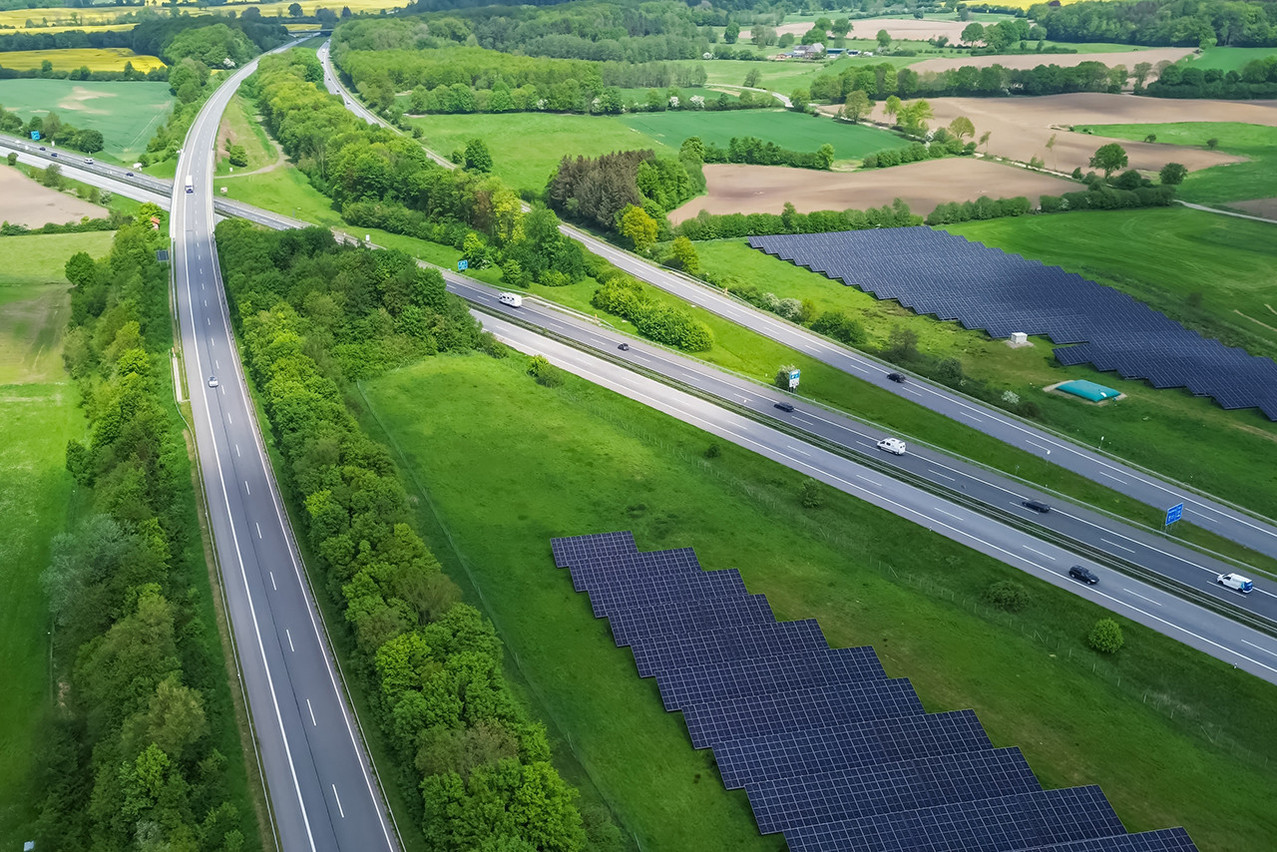
Although autonomous driving is developing and will one day invite vehicle passengers to look at the landscape, in Luxembourg it will not be blocked by an uninterrupted succession of solar panels. This Friday, the Council of Government approved the bill that will authorise the construction of photovoltaic installations in the non aedificandi zone, i.e. the 25-metre strip where all construction is prohibited and which is measured from the outer limit of the safety zone bordering motorways. In certain cases, this opening will also apply to bypasses of built-up areas and sections linking an interchange to the normal state road network, according to the official press release from the Ministry of State. The decision is part of the "Einfach - Séier - Erneierbar" package, presented in May by 

When presenting the 51 energy measures in May 2025, the Minister for the Economy, SMEs, Energy and Tourism, Lex Delles, highlighted the theoretical potential of around 1,500 MW along the A3, if the approaches to the motorway were equipped with photovoltaic panels, while specifying that the government did not wish to create a continuous solar corridor. The minister had stated that the figure was a technical estimate and not a development scenario, marking a desire to optimise rather than radically transform roadside landscapes.
The measures announced in the spring already established the current philosophy: maximising available space, pursuing Agri-PV, moving wind turbines closer to main roads and authorising the use of the 25 metres behind the motorway safety zone. At the time, Lex Delles indicated that the Ministry of Transport would be preparing a bill to allow the installation of panels in this strip, which is currently off-limits to construction. The adoption of this text by the Council of Government now paves the way for it to be tabled and examined by Parliament.
The State has no plans to operate these installations directly. As Lex Delles pointed out in May, the aim is to lease the land to private operators, via calls for tender, to enable them to develop photovoltaic power plants. The government wants to mobilise public land while relying on private investment, a model already used for several recent energy projects.
This approach is based on the feasibility study conducted by the Ministry of the Economy with the Ministry of Mobility, Public Works and the Roads and Bridges Administration, an initial part of which was presented in September 2024. The document mentioned several possible sites, including solar noise barriers, photovoltaic fences along the A3 widening site, ground-mounted power plants between the motorway and the new Luxembourg-Bettembourg railway line, as well as the use of public or private land up to 200 metres away.
Several European countries have already embarked on photovoltaic projects on the edges of motorways or directly on road infrastructure, with approaches at varying stages of development. In Germany, a pilot project will be installed from 2023 on the A81 in the form of a solar roof several dozen metres above the tracks, while North Rhine-Westphalia has launched photovoltaic power plant projects at the foot of the A44n, on embankments and in the immediate road right-of-way. Germany has also been testing photovoltaic noise barriers integrated into motorway infrastructure for several years. In the Netherlands, several provinces have equipped noise barriers with photovoltaic modules, notably in the regions of North Brabant and South Holland, while experiments have been carried out along provincial roads and solar-powered cycle paths, with direct integration into the infrastructure elements. In Sweden, a project along the E4 road involves the installation of photovoltaic panels at the foot of the roadside verges, producing several hundred megawatt hours per year according to data published by the operator. These systems reflect a European trend towards using the road right-of-way itself for solar installations, often in the area closest to traffic.
Luxembourg is taking a more cautious approach than that seen in Germany, the Netherlands or Sweden, where solar installations can be placed directly on noise barriers, at the foot of embankments or even above the tracks. This reflects a more conservative approach in terms of safety, public responsibility and landscape integration.
Friday's decision formalises a project that began in July 2024, when the government confirmed that the A3 - currently under construction and therefore suitable for rapid installation - was a priority site under consideration for the integration of solar panels, along with the future TGV line. The same framework included an analysis of the possibilities for siting wind turbines closer to motorways and business parks, with a mechanism for the municipalities and citizens concerned to participate in the developers' capital.
With the green light from the Council of Government, Luxembourg has taken an important legal step towards exploiting these linear spaces long considered unusable for energy projects. The text must now follow the classic legislative procedure, but it is part of a government programme geared towards accelerating renewable capacity, after a year 2024 marked by a record for additional photovoltaic installations of almost 160 MW, according to figures provided by Minister Serge Wilmes in May.