
The promise of easy exits from inherently illiquid investments presents a delicate balancing act that regulators and fund managers are struggling to master. As private-asset funds—once largely the preserve of institutional investors with long time horizons—increasingly open their doors to a broader range of investors, the mismatch between the liquidity offered and the illiquidity of the underlying assets has become a focal point of concern.
The fundamental question is this: how can a vehicle invest credibly in assets that take years to mature while allowing investors to withdraw capital at short notice and still generate strong returns? Without careful design, these funds risk falling into the classic “first-mover” trap, in which the quickest investors to exit leave those who remain to bear the brunt of fire sales and falling valuations.
The limit of liquidity transformation
At the heart of the issue is what Roberto Steri, associate professor of empirical finance at the University of Luxembourg, described in an interview on 13 August 2026 as “liquidity transformation.”
it is simply not credible to offer the same level of liquidity that a traditional bank provides.
While banks have long performed this role, private-asset funds operate under materially different constraints. When a fund originates loans to private firms, those assets may be difficult to sell quickly without accepting a substantial discount.
If a fund manager promises frequent redemptions, it creates a mismatch between the liquidity offered to investors and that of the underlying assets. As Steri noted, "It is simply not credible to offer the same level of liquidity that a traditional bank provides.”
In the US, non-traded business development companies (BDCs) have attempted to manage this mismatch. Although some argue that these vehicles work as intended for patient investors, their limited redemption arrangements can frustrate those who need immediate access to their capital.
In February 2026, Blue Owl Capital Corp II (OBDC II), the management decided to permanently restrict redemptions from its private retail debt fund. Instead, the firm informed its investors that it will return capital. Although this approach avoids favouring investors who submit redemption requests first, shareholders may have to wait several years to recover all their capital. Such constraints can produce an outcome in which “no one is really happy,” Steri said.
The dangerous game of the first mover
In game-theory terms, the principal risk for these funds is the “first-mover advantage.” If investors sense trouble, early redeemers may receive a price based on the latest reported net asset value before the full cost of generating liquidity has been reflected.
That advantage is not automatic: the amount investors receive depends on the fund’s redemption gates, pricing adjustments and repurchase terms. It arises when the redemption price does not capture the full liquidity costs that an investor’s exit imposes on the portfolio, leaving those who remain to absorb a disproportionate share.
Forced sales can also create spillovers that affect fundamentally sound funds with similar holdings (see Chart 1). A distressed fund’s asset sales may depress observable market prices, affect valuations across comparable portfolios and trigger withdrawals from similar vehicles.
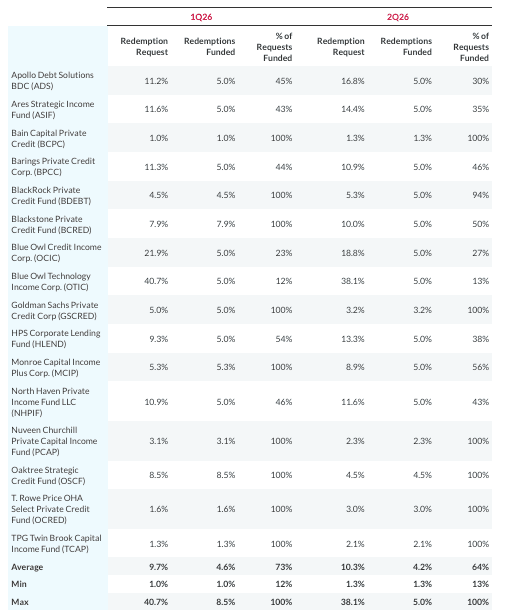
Chart 1: Redemptions as a % of prior quarter shares outstanding. Note: During 1Q26, Oaktree Strategic Credit Fund funded 6.8% with Brookfield purchasing an additional 1.7% from an investor. Blackstone Private Credit Fund funded 7% with Blackstone and employees contributing capital for the additional 0.9%. Source: Fitch Ratings, company filings
Long-term investors can therefore suffer because of other investors’ rush to exit, with unrealised losses mounting as forced sales place further pressure on market valuations.
A regulatory toolkit for the illiquid age
Europe is strengthening its framework for managing liquidity risk in open-ended funds, including alternative investment funds that originate loans. The revised Alternative Investment Fund Managers Directive, commonly known as AIFMD II, establishes a harmonised set of liquidity-management tools intended to reduce dilution and discourage destabilising runs.
These tools include quantitative measures, such as redemption gates and extended notice periods, and anti-dilution tools, such as redemption fees, swing pricing, dual pricing and anti-dilution levies. Steri said these measures are intended to protect patient investors, strengthen funds’ resilience and limit potential risks to financial stability as the sector grows.
Swing pricing adjusts a fund’s dealing price to reflect the estimated transaction and market-impact costs generated by subscriptions or redemptions, Steri explained. When net outflows trigger an adjustment, redeeming investors receive a lower price, helping to prevent those costs from falling disproportionately on investors who remain in the fund. In effect, investors seeking liquidity bear more of the cost of providing it.
However, swing pricing is not equally suitable for every portfolio. Guidelines from the European Securities and Markets Authority indicate that it is most appropriate when the underlying assets are actively traded and current information about transaction costs is available. For private assets with limited pricing data, redemption fees, notice periods or gates may be easier to apply credibly.
AIFMD II, formally Directive (EU) 2024/927, was adopted in March 2024. EU member states were required to transpose most of its provisions into national law by 16 April 2026, although the timing and details of implementation may differ between jurisdictions.
Historically used by some UK and US corporate bond funds, the swing pricing mechanism has reportedly been employed in Luxembourg for more than 25 years. Steri said swing pricing is unevenly used across European funds, though common in some key market segments. Although attractive in principle, he said it can deter impatient investors because of the potentially prohibitive impact on the redemption price.
Why patience is the only real solution
Ultimately, fund design cannot eliminate the inherent characteristics of the assets these vehicles hold. Successful private-asset investment requires patience. A house may be valuable, but converting it into cash takes time—and a seller who must transact immediately may have to accept a discount.
For the retail investor, the message is clear: if you are not prepared to be patient, these vehicles—no matter how they are designed—may not be the right place for your capital.