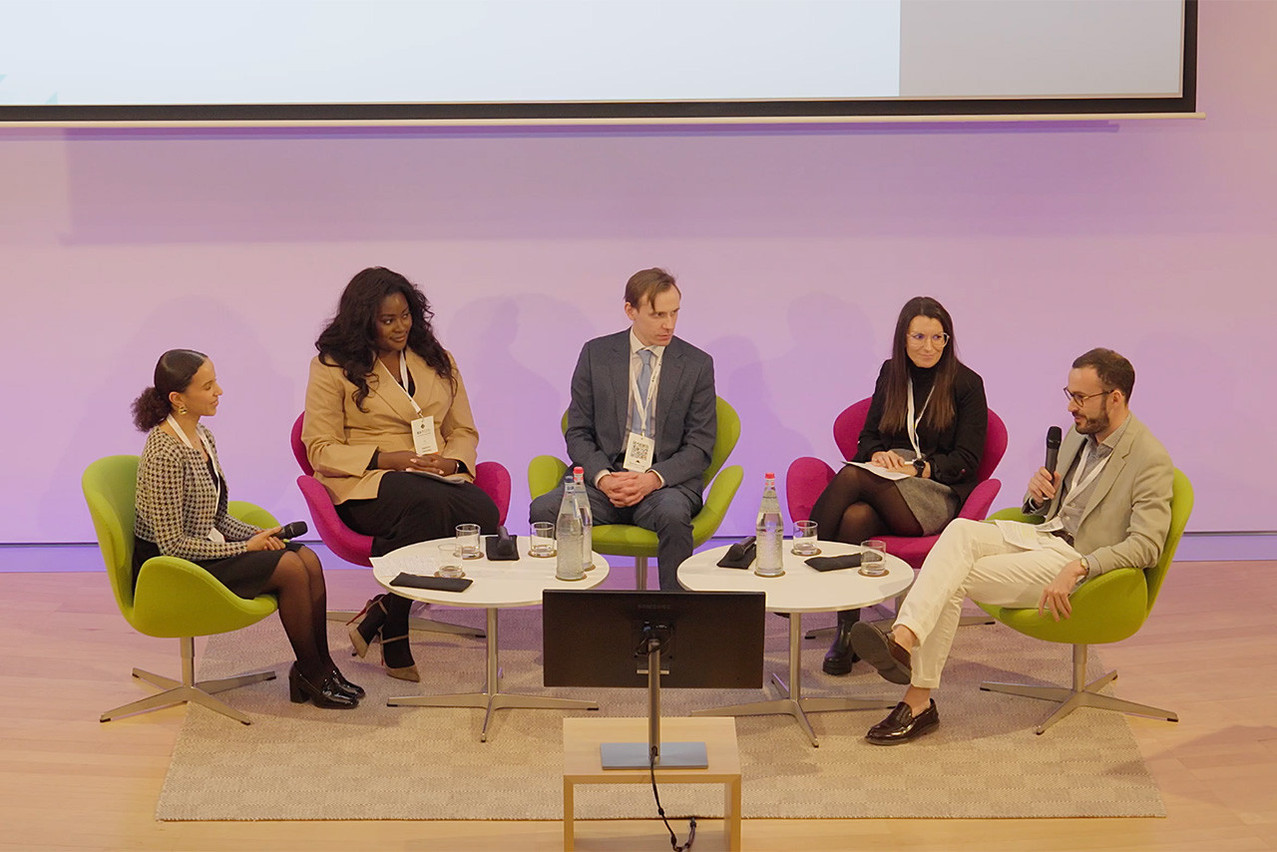
“If I was going to sum it up in one word, it’s agility,” said Sara Huda, managing director and global head of investment services at EQT. “Agility in the way we think, how we produce output and how we communicate.” According to Huda, the next generation of professionals is key to driving that agile mindset in Luxembourg, having built their careers in an environment of constant transformation.
This message was delivered during the “NXTGEN Luxembourg Fund Industry 2025” discussion hosted on March 5 by Aztec and Banque de Luxembourg. Moderated by Sofia Souici, business developer at Banque de Luxembourg, the panel debated what Luxembourg should keep, stop and start if it wants to remain successful by 2035.
Huda recalled arriving in Luxembourg in 2012, when the financial centre was adapting to the implementation of the Alternative Investment Fund Managers Directive (AIFMD). At the time, global private equity firms were looking for ways to continue raising capital in Europe under the new framework. Luxembourg responded by introducing the SCSp partnership structure in 2013. “It looked and functioned similarly to a Cayman LP, which most global PE players were familiar with,” Huda said. “No other EU jurisdiction had anything close to being that simple.” The structure helped Luxembourg’s development as a hub for alternative investment funds. But as the sector has grown, the regulatory environment has become more complex.
“The frameworks we operate in now are multi-layered and complex,” she said, raising costs for both investors and fund managers. “As complexity accelerates, agility naturally decreases.”
What Luxembourg should keep
Panellists first highlighted the elements of Luxembourg’s model that continue to work. Sabrina Ziegler-Feld, global head of service provider management at Partners Group, highlighted the country’s longstanding openness to international talent. “I think the first thing is that Luxembourg did really well in integrating international people,” she said. “And that is not just yesterday, that is since decades the case.”
From a legal perspective, Stéphanie Tshilumba, associate at A&O, stressed the strength of the regulatory framework and the ecosystem built around it. Regulators are widely respected by investors and asset managers, she said, while Luxembourg benefits from a high concentration of experienced service providers in the funds industry.
Conor Babington, legal and compliance professional at SwanCap, highlighted another advantage: the country’s scale. “As a small country ultimately its role globally is always going to be as a facilitator bringing different financial interests and cultures together,” he said. Luxembourg’s size also allows it to move quickly. “The fact that it’s small means it can be agile and get things done.”
What Luxembourg should stop
At the same time, panellists warned that the regulatory environment has become heavier. “The biggest risk is over-regulation,” Ziegler-Feld said. Referring to developments such as the EU’s Digital Operational Resilience Act (Dora), she argued that certain requirements had been implemented “stricter than in other countries.”
Tshilumba pointed to the cumulative effect of regulation. “We have more and more substance requirements,” she said. “We also have more and more regulation, and then it’s the layering of regulation.” That layering increases reporting obligations and costs, particularly for smaller or mid-sized managers.
You don’t want to be the last person adopting that tech, you want to make sure you’re somewhere close to the front.

Babington pointed to the factors shaping location decisions today. “Speed to market, regulation, and of course talent,” he said. In practice, he added, that increasingly depends on how quickly firms can obtain approvals from the CSSF. Compared with seven or eight years ago, he noted, setting up an AIFM now takes significantly more time and costs more.
Operational habits were another concern. Ziegler-Feld noted that much work in asset servicing is still done “totally manually with manual workarounds,” while Babington said many processes in Europe’s fund administration industry remain more labour-intensive than in the US. “You don’t want to be the last person adopting that tech,” Babington said. “You want to make sure you’re somewhere close to the front.”
Avellino also pointed to the operational pressure created by technological change. “It’s not only technology,” he said. “It’s the ability of the workforce of people to adapt to the new technology.”
What Luxembourg should start
Rather than calling for radical reinvention, the panel focused on targeted improvements.
Huda cited a practical example from her own team: a NextGen employee automated a hedging instruction process that had previously required two full-time employees and around 1.5 business days per month. Using ChatGPT and Excel automation, the task now takes around 40 minutes a month and includes automated checks. More broadly, she argued, younger professionals will play a key role in driving that change.
Ziegler-Feld said similar efforts are already underway within her organisation, where automation tools are reducing the time spent on repetitive tasks by up to 70% or 90%. She also suggested Luxembourg could develop shared infrastructure, such as a “digital hub” allowing firms to share certain due diligence information on service providers.
Avellino pointed to broader structural opportunities. Luxembourg, he said, needs stronger national data infrastructure so companies can share information securely across the market. Another differentiator will be the ability to regulate emerging assets in an agile way, citing developments such as the EU’s Markets in Crypto-Assets regulation and Luxembourg’s blockchain legislation enabling the tokenisation of funds. Talent retention will also remain a challenge, he added, as professionals often leave the country after several years due to structural issues such as housing.
Avellino also argued that the role of service providers is evolving. “We’re not anymore simple administrators,” he said. “We’re becoming more and more tech partners.” That shift will require a more cross-disciplinary workforce able to connect operations, artificial intelligence, finance and ESG reporting.
We are not just passive observers of the change. We are right in the middle of it.

The panel also explored what younger professionals expect from the industry. Ziegler-Feld said many want to understand the broader impact of their work, while Babington pointed to earlier responsibility and greater flexibility, including remote work arrangements. Tshilumba framed the issue as one of responsibility. “We have a duty to actually challenge assumptions,” she said.
Looking ahead, panellists were asked what they hoped the industry would no longer be debating in ten years’ time. For Ziegler-Feld, the answer was technology adoption itself. “I hope that we are not discussing to implement technology,” she said. “I hope that we are actually only optimising it.” Tshilumba focused on execution. “I hope you will not be speaking about time to market, quickness of approval and so on,” she said. “Agility shouldn’t be aspirational. It should be invisible, it should be what we do every day and aim to improve.”
The discussion ended with a call for the next generation to play a more active role in shaping the sector’s future. “We are not just passive observers of the change,” said Vania Milan, business development manager at Aztec. “We are right in the middle of it.”