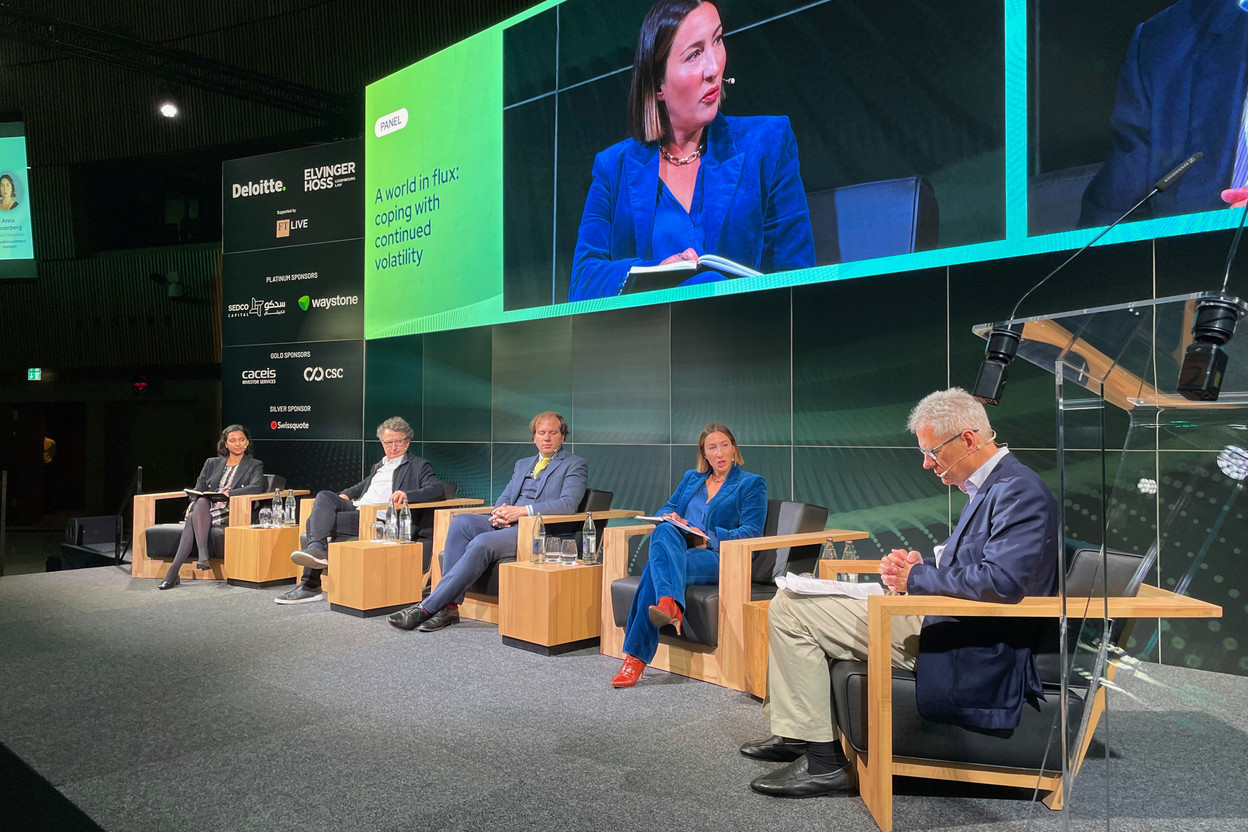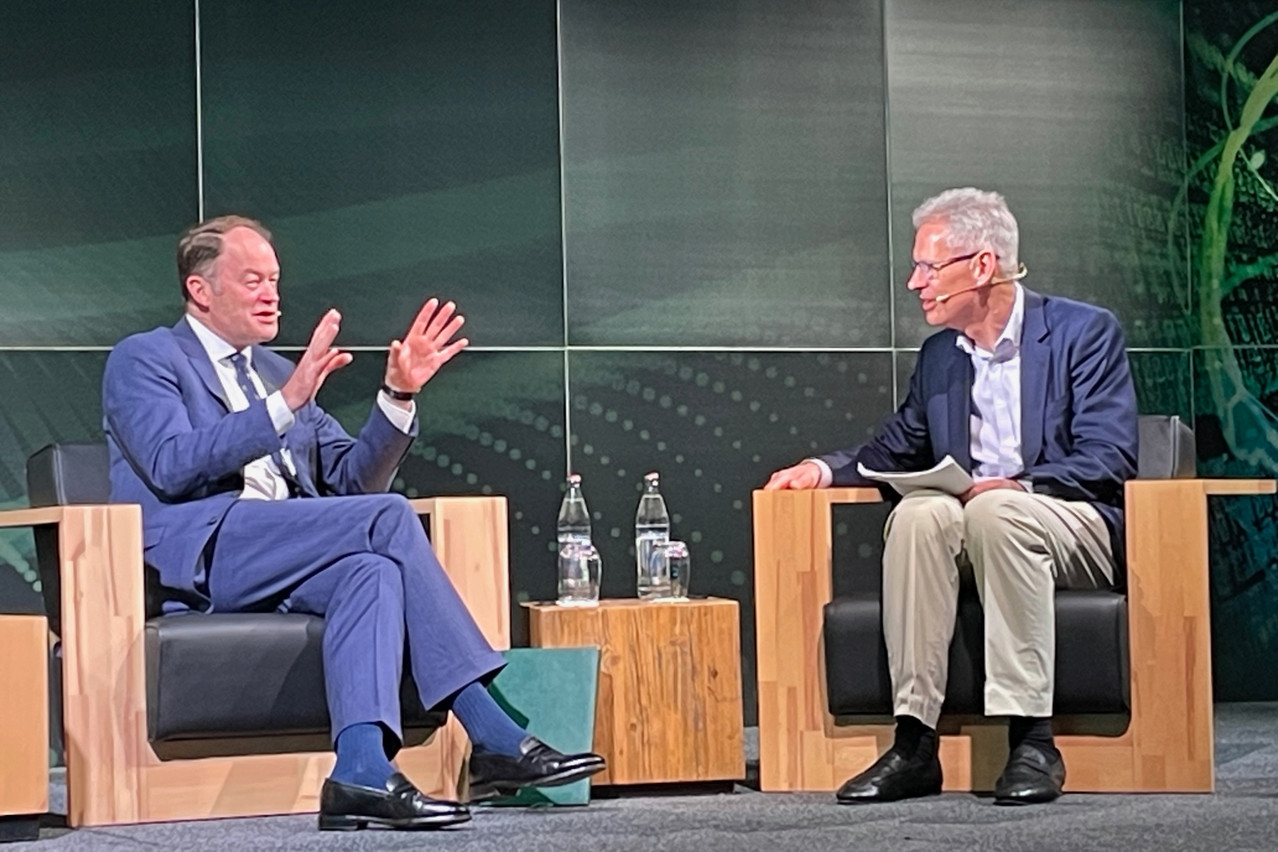
“I did have a crush on Charlotte of Luxembourg, who was the Grand Duke [Jean]’s niece, when I was about 14. It never went anywhere,” sighed a smiling General Sir Patrick Sanders, a former UK army chief, during the cross-border distribution conference, organised by Deloitte and Elvinger Hoss Prussen with the support of FT Live on 13 May 2025.
Trump’s security achievements in his first 100 days
Sanders argued that JD Vance, the US vice president, had a “catalytic effect” when he spoke at the Munich Security Conference. He thinks that his speech sent “shock waves” through Europe as he made it ”very clear that what had been a trend from the first Trump administration had now become a hard reality.”
Sanders thinks that a key theme over that period is the perceived US withdrawal from its role as the “leviathan” or guarantor of the post-Wall international order, viewing the cost of maintaining this “empire” as too high, a trend that arguably started under Obama and has most evidently hardened under Trump. “Russia was running out of time, and what Trump’s done is to throw it a lifeline… [the UK] withdrew from Eastern Suez [in 1956] because we counted the cost of maintaining that empire… but not the benefits from it.”
This US shift represents a significant strategic, economic and geopolitical shock for Europe. While acknowledging Jean Monnet’s view that Europe responds well to shocks such as the GFC, Sanders expressed scepticism about Europe’s political and economic capacity to fully capitalise on this moment. He cited Europe’s poor record on political action, particularly since Russia’s 2014 actions in Crimea, an event that was an “early sign.”
Can Europe really unite?
European security is deemed inseparable from Ukrainian security, which emphasises the need to both rearm Europe and continue supporting Ukraine. Sanders suggested a larger crisis may be needed for Europe to truly unify as collective European action on defence remains challenging.
It is best illustrated by a modest defence pact being stalled by issues like fishing rights. “It’s not an encouraging sign of Europe acting coherently and collectively against what is a much more serious threat than a fishing crisis.”
Is sharing intelligence with the US to be reconsidered?
“Most of the intelligence flows the other way,” Sanders said. He argued that maintaining a bridge to the US is vital due to significant benefits like intelligence sharing through the Five Eyes Alliance and Nato.
“De Gaulle was right. You cannot trust the US over the long term,” stated Sanders. Consequently, the rationale for European strategic autonomy ”makes sense,” but Russian deterrence requires a coherent and collective implementation beyond individual national efforts on defence.
Investment in defence may turn Europe into an industrial defence superpower
“There is an enormous opportunity, because all it requires is the political will to act.” Sanders argued that Europe possesses solid foundations and scaling capability. Beyond naming some well-known defence companies such as Leonardo, Rheinmetall and British Aerospace, he thinks that the greatest opportunity lies in a "second defence sector" centred on technology, driven by speed and adaptation and being software-driven rather than hardware-driven. These are the lessons learned from Ukraine.
The private sector, particularly with venture capital, is better suited for this innovation due to commercial freedom and a future orientation compared to governments that struggle with risk and failure. “[Governments] try to mitigate all risk because it's public money.” Sanders attributed some of Ukraine's innovation success to the lack of stifling regulation during wartime. “Thinking much more creatively about regulation… will be a good start.”
Two wars in Ukraine: technology and WWI-style
The war in Ukraine highlights warfare’s enduring nature (human, violent, visceral, political) and its evolving character (how it’s conducted). “Some elements of that will be absolutely transferable to other theatres, and some won’t.”
Sanders commented that wars are ultimately decided on land, controlling resources, people and territory which means that “defence has the advantage over offence.” Stalled movement leads to attrition. Technology is used to break stasis, but warfare is fundamentally about adaptation, not finding a permanent “silver bullet” technology. “Whilst the FPV drone, the fibre optic drones and long-range strike drones are undoubtedly preeminent and dominant now, it will not take long before protection against those begins to reassert itself.” Wars are generally protracted, requiring deep stockpiles, a sustainable industrial base, a population prepared for war and an agile industry that ideally utilises dual-use technologies.
Should ESG account for military technology or weapons?
“When is it not moral to defend yourself from attacks… it’s immoral not to invest in the defence of your population, your children and the following generations,” said Sanders. He observed that the ESG pendulum is swinging back towards defence due to both market opportunity and belief in the cause by VCs, among others. ”So, if you’re out of step, I’d be looking in the mirror as a dedicated ESG investor and questioning myself about my morals.”
Questioned by the audience on nuclear deterrence and the pact between Poland and France, Sanders commented that Nato members are under the UK/France nuclear umbrella. However, he is concerned that a potential US reduction in “extended deterrence” could lead to proliferation in the Middle East and the Far East. While fewer than Russia’s (1700), the UK/France’s strategic warheads (400) provide a significant deterrent. “Russia is going to lose Moscow.”
Frozen Russian financial assets should be at work
“It will be unfair to leave Brussels to bear the full wrath of Russia unsupported,” argued Sanders. He thinks that the Russian assets valued at nearly $300bn should support rearming Ukraine and/or funding its reconstruction and/or reparations.
Who else will play a role in the reconstruction?
“I am deeply pessimistic about the prospects for any kind of enduring, peaceful, stable, secure settlement in Ukraine because of the [completely irreconcilable] objectives,” admitted Sanders. He believes that Ukraine will “never cede” sovereignty/territory apart from “possibly Crimea.” Sanders argued that Putin’s aims extend to Ukraine’s sovereignty, not only territory but also challenging Nato and the EU to restore an imperial Russia. To that aim, Russia is rearming for potential conflicts with Nato as per the Russian defence minister’s speech on Victory Day in Moscow.
Questioned by Paperjam on the stresses on the Russian supply chains, Sanders noted that Russia is regenerating combat power with support from China, North Korea and Iran, but also indirectly from Europe through energy sales. Ukraine’s disruption efforts are insufficient. “Ukraine is successfully disrupting some of that production. But it’s not enough to defeat it.” Yet Putin’s bigger challenge may be manpower due to high attrition. Further mobilisation is likely in late 2025 or early 2026, potentially bringing the war home to Moscow and St Petersburg. In the meantime, “deathonomics” (high pay/death benefits) provides economic incentive for service in poorer regions but strains Russian expenditure.
To survive an existential threat in WWI, Sanders commented that France, with a population like Ukraine at the time, mobilised some 10-12m people. “So far, Ukraine has mobilised just over a million.” He acknowledged that Ukraine has “plenty more capacity.” He noted that the state chose not to mobilise those people for political reasons, but also because it is “hoping to preserve the next generation who are coming up with all the technology and the innovation.” One should also account for the young people serving Ukraine without being in uniform.
Sanders expects Ukraine’s reconstruction costs ($1tn+) to largely fall on Europe. The US plan on minerals to benefit reconstruction remains to be seen. Yet he thinks that the effort also presents opportunities, and Europeans can draw lessons from Ukraine’s resilient power grid defence. “Most of us assumed or thought that Ukraine’s power grid would collapse this winter… [but] Russia was never really able to damage it.” The recent blackout in Spain and Portugal showed how vulnerable European critical infrastructures are.
Guerilla warfare may result upon an unjust armistice
“Guerrilla warfare is just another form of warfare.” Sanders described the former as an asymmetric method used when symmetric strength is lacking. “The moral component, the will to fight and whether Ukrainians are exhausted--they are undiminished.” He thinks that systemic resistance post-armistice would only likely occur if an unjust peace were imposed, undermining Ukraine’s sovereignty, independence and integrity. “Most of the preparation that we were giving the Ukrainians [pre-war], the training, was to conduct resistance operations,” he added.