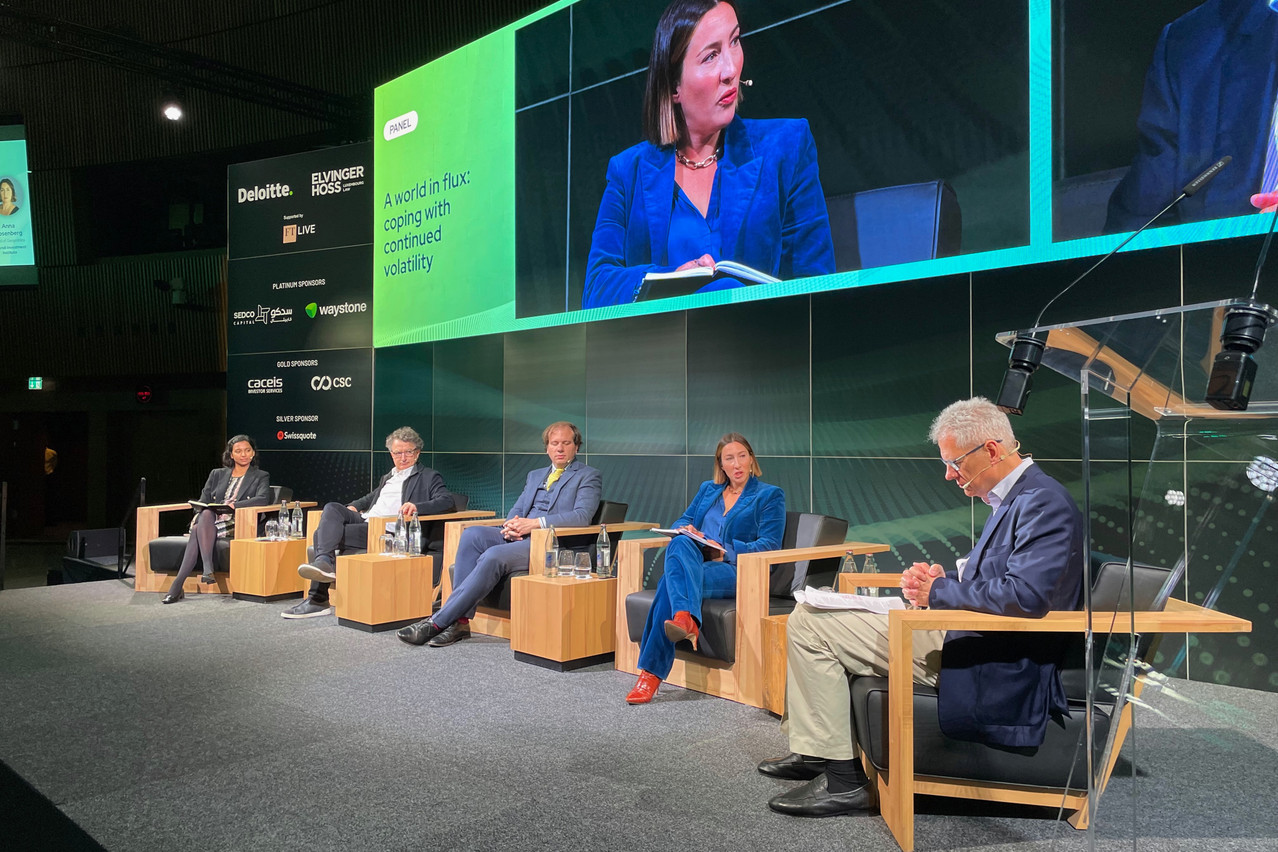
“Trump is an additional disruptor, but he’s not a game changer,” stated Anna Rosenberg, head of geopolitics at Amundi Investment Institute Advisory, during the Cross-Border Distribution Conference, organised by Deloitte and Elvinger Hoss Prussen with the support of FT Live on 13 May 2025. She argued that Trump continues an ongoing trend that is messy, riskier and involves more friction. This trend is driven by factors like increased economic warfare, including export controls, sanctions, protectionism and tariffs. The US-China relationship is a key aspect, marked by great power competition and the US attempting to contain China economically.
She also noted that the US is also embracing mercantilism, a historical approach focused on national economic gain, sometimes through territorial expansion, which has often led to conflict. “We need to take seriously comments around Greenland,” said Rosenberg.
Other contributing factors include climate change opening Arctic shipping routes, new arms and space races, deteriorating bilateral relations, and a rise in global conflicts, with patterns from the 1930s re-emerging.
A series of experiments or a clear-cut strategy
Whilst some perceive Trump’s actions as sporadic, there is an argument for a method to the madness. Rosenberg thinks that Trump’s policies appear guided by principles like improving US national wealth and achieving greater economic self-sufficiency or independence to become less vulnerable. She commented that one of Trump’s economic advisors, Stephen Miran, had suggested “a 10% tariff for everyone and minimum retaliation… let’s put the China episode aside… he’s gotten this.” She added, “I think there is strategy to the chaos.”
Anunita Chandrasekar, a fellow at Centre for European Reform, thinks that this represents a shift from a principle-based global order to a more transactional--possibly extortionist--framework. “A lot of new alliances are popping up that are based on interests, not values.” Consequently, she expects Europe and China “could and should team up,” as she sees economic logic in going in that direction.
Chandrasekar stressed that EU-China relations are complex. Despite some shared economic interests, divergent interests towards the US exist. Europe depends on US security guarantees, whilst China challenges the existing order. China’s ties with Russia and its diplomatic style are creating tension. “Chinese soldiers were found in Ukraine. China is supplying these dual-use goods to Russia.” She noted that the European Council concluded back in 2019 that China is seen as a partner, a competitor and a systemic rival. “Both sides might have shared interests; they’re very far from having shared values.” As such, a full teaming up is improbable.
Global recession of democracy
In the last 20 years, “democracy has receded everywhere, mostly in China, in Russia, in Turkey… but also in Europe, in the US, and everywhere,” stated Yves Choueifaty, president and CIO at Tobam.
Many Western companies face high exposure to this autocracy risk factor. Despite this trend, Choueifaty still considers the US amongst the most solid democracies, ranking in the first quintile based on data. Surprisingly, he noted that data has not shown an accelerated recession of democracy in the US recently, and calling the US an autocracy is deemed completely wrong. Rosenberg stressed that the events of the last six months are not yet in the data, implying that one’s conclusion may change.
What does it mean for investors?
“A great diversification is underway across assets, trade relationships and supply chains… pointing to upward pressure on inflation… somehow offset from disinflation from China,” stated Rosenberg. She thinks that governments face huge fiscal pressure due to necessary increases in defence spending. Navigating this requires staying differentiating between information and noise, building scenarios, hedging and preparing portfolios through diversification.
The message for asset managers is that “autocracy does not work from an economic point of view,” claimed Choueifaty, “according to abundant research from academia.”
He commented that “running a business without the rule of law is mission impossible.“ He also stated that “the West and Western companies thought wrongfully that they could attract China and Russia and those countries towards the rule of law by investing in those countries. They were completely wrong.”
Anecdotally, Choueifaty outlined the experience of Goldman Sachs with its own joint venture in China with a Chinese investment bank for 20 years. “Every single year they have lost money in the JV,” whereas the Chinese partner made money “every single year.” Despite continuous attempts over the last five years, unbundling the JV has proven impossible.” Tensions between the US and China are here to stay.
Why has the decline in US equities has not been followed by a flight to safety into US fixed income?
“The US can sustain a debt level of 200, 300 or 400% of GDP,” said Maximilian Hess, founder of Ementena. He explained that the US dollar system’s strength partly derives from its use for US taxes, and--importantly--the reach of US economic institutions enabling sanctions. He is concerned, however, that people such as Trump’s economic advisor Miran are too smart and risk blowing up the system. Global trust in the US dollar is key.
“What were the first asks that Putin made in the recent hints at ceasefire negotiations? The lifting of sanctions on Russian banks.” Hess commented that Vladimir Putin talks about the dollar system “all the time, far more often than he talks about Nato.”
Alternatives to the dollar
Elsewhere, Hess thinks that challenges from Brics currencies (Brazil, Russia, India, China and South Africa) are seen as unlikely (“nonsense”) soon due to capital controls. “They can’t track trade and trust with each other.” Europe’s response is viewed as pivotal in determining the future impact of the Trump shock on the global order.
“It is Europe that has the potential to be the economic power rival and growing area of the future and to take some of that away from the United States,” said Hess.
Chandrasekar commented that Europe seeks to maintain globalisation, but still relies on US security guarantees despite the Trump administration’s attempts to reduce that reliance. The existential threat from Russia necessitates significantly increased defence spending. This pressure could drive integration, potentially leading to a capital markets union and making the euro a more attractive alternative to the dollar. Europe is a middle power, balancing relationships with the US and China.