For a decade, income-seeking investors navigated near-zero interest rates, often accepting greater risk for modest returns. By 2026, however, a structural reset in global yields had transformed the investment landscape.
[the new macroeconomic regime] is a world of scarcity.
This appears to be more than a temporary shift. “Income is back,” said Natalie Gill, senior portfolio strategist at the Blackrock Investment Institute. More than 80% of the global bond universe now yields above 4%, compared with roughly 20% during the 2010s, according to Blackrock data (see Chart 1). Investors consequently have access to more income—but must navigate greater complexity.
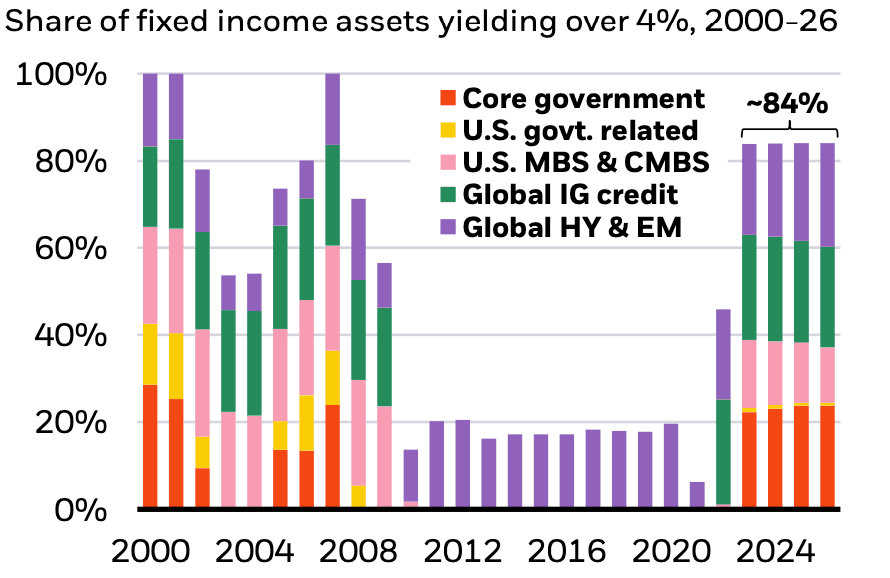
Chart 1: Income back on the table Sources: Blackrock Investment Institute, with data from LSEG Datastream as of July 31, 2026. Notes: The bars show market capitalization weights of assets with an average annual yield over 4% in a select universe that represents about 70% of the Bloomberg Multiverse Bond Index. Core government comprises U.S. Treasuries and euro core government bonds; U.S. government-related comprises agencies and municipals; U.S. MBS & CMBS comprises both securitized sectors; Global HY & EM also includes euro periphery government bonds.
A tectonic shift in global bond yields
The transition marks the end of the post-financial-crisis era. Global government-bond yields have risen to 15-year highs, while yields on long-dated Japanese government bonds have touched a 30-year peak (see Chart 2).
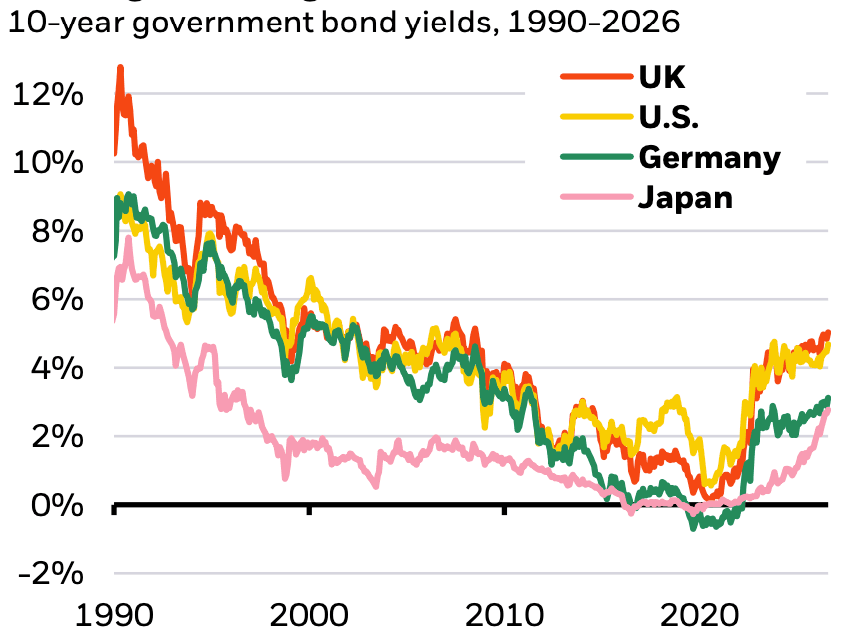
Chart 2: The big reset higher Source: Blackrock Investment Institute, with data from LSEG Datastream, August 2026. Note: The chart shows benchmark 10-year government bond yields.
Blackrock views the change as part of a new macroeconomic regime shaped by supply constraints, rising debt, and intensifying competition for capital. Its researchers described this as a “world of scarcity,” in which the delicate balance among debt, interest rates, and inflation leaves bonds increasingly sensitive to changes in market sentiment.
The forces driving capital competition
Two powerful forces are intensifying this competition, according to Vivek Paul, global head of portfolio research at the Blackrock Investment Institute.
The first is the artificial intelligence buildout, representing the fastest capital expenditure cycle in history, according to Gill. In the first half of 2026, projections for AI-related capital spending rose by 30%.
“It requires significant resources such as energy, skilled labour, materials, and minerals,” Gill said. She added: “And it requires a huge amount of funding too.”
As their investment requirements grow, hyperscalers are drawing on cash reserves and turning to corporate bond markets, equity issuance, and private-market financing.
The second force is geopolitical fragmentation. Governments and companies are investing more heavily in resilience, including defense, energy security, and more robust supply chains. This growing demand for resources and funding may place persistent upward pressure on interest rates, Gill said.
Dethroning the traditional portfolio ballast
The new regime has challenged long-held assumptions, particularly the role of long-dated government bonds as portfolio ballast. Historically, these securities often cushioned portfolios during equity sell-offs. Supply-driven inflation and heavier government borrowing have made that protection less dependable.
Blackrock’s analysts are therefore rethinking strategic allocations and favouring short- and medium-term debt. US Treasuries with maturities of one to five years currently offer substantially more yield per unit of risk than their long-dated counterparts (see Chart 3).
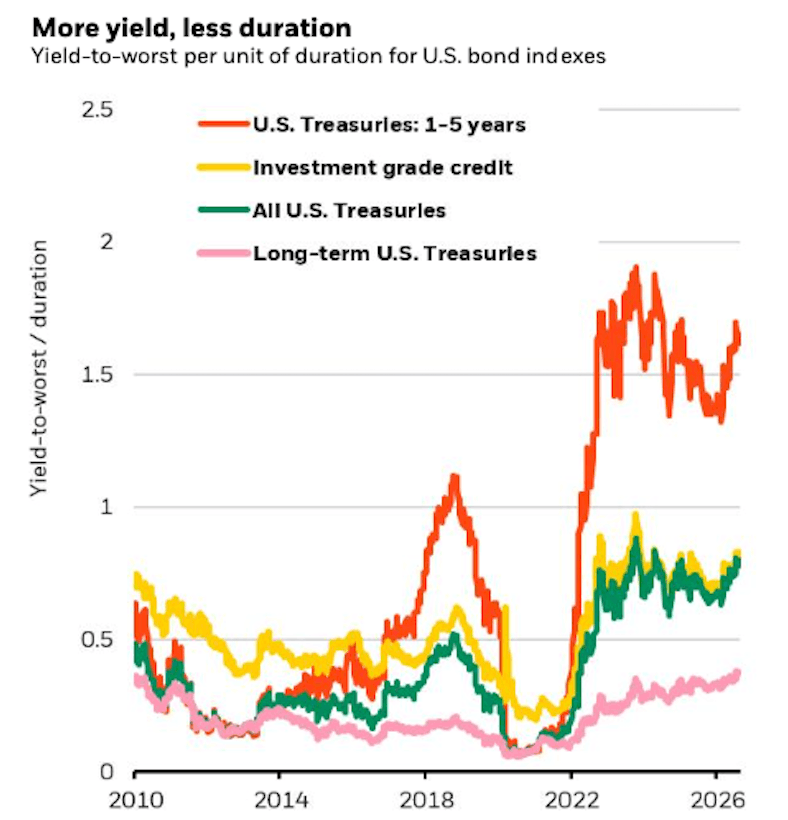
Chart 3: More yield, less duration Source: Blackrock Investment Institute, with data from LSEG Datastream, August 2026. Notes: Yield-to-duration is calculated as index yield-to-worst divided by modified duration. Yield-to-worst is a measure of a bond's expected yield, while modified duration measures its sensitivity to interest-rate changes. The ratio measures how much yield investors receive for each unit of interest-rate risk. A higher ratio indicates more yield per unit of interest-rate sensitivity. The measure does not account for other risks, including credit, liquidity or default risk.
Navigating a highly selective market
When yield is abundant, selectivity becomes paramount, Gill said. Identical headline yields can conceal markedly different duration, liquidity, and default risks. Investors must look beyond asset-class labels and examine the underlying borrowers, protections, and cash flows.
Broad credit indices appear expensive because spreads are tight, but dispersion may create opportunities for active managers, particularly in higher-rated European high-yield debt.
Blackrock’s strategic portfolios also favour income-oriented private-market assets over growth-focused private equity. Private credit may offer an attractive entry point following the adjustment in interest rates, while infrastructure can provide durable, often contracted or regulated cash flows. It also offers exposure to two major investment themes: the AI buildout and the development of more resilient energy systems.
Gill and Paul also see opportunities in options markets. With implied equity volatility priced above pre-COVID levels, investors may be able to generate additional premium through covered-call strategies. Such strategies require careful implementation, however, because they can limit participation in rising markets.
Income investing demands an active hand
The era of “set it and forget it” portfolio construction has passed, Paul said. Although income is once again widely available, capturing it in this more volatile regime requires active decisions about duration, credit quality, liquidity, and implementation.