If a mum was crossing with a pushchair and her baby from the left-hand side to the right of a road and an old man had started crossing from the right-hand side to the left, who should an autonomous car "sacrifice" if it was unable to stop in time? For years, the ethics laboratory at the prestigious MIT has been questioning these ultra-sensitive choices, which have held back the development of autonomous cars because it is impossible to justify the slightest incident or accident involving a technology that is often less dangerous than human driving. Asking the question at a Christmas dinner was the occasion for endless animated discussions depending on one's religious, ethical or cultural convictions.
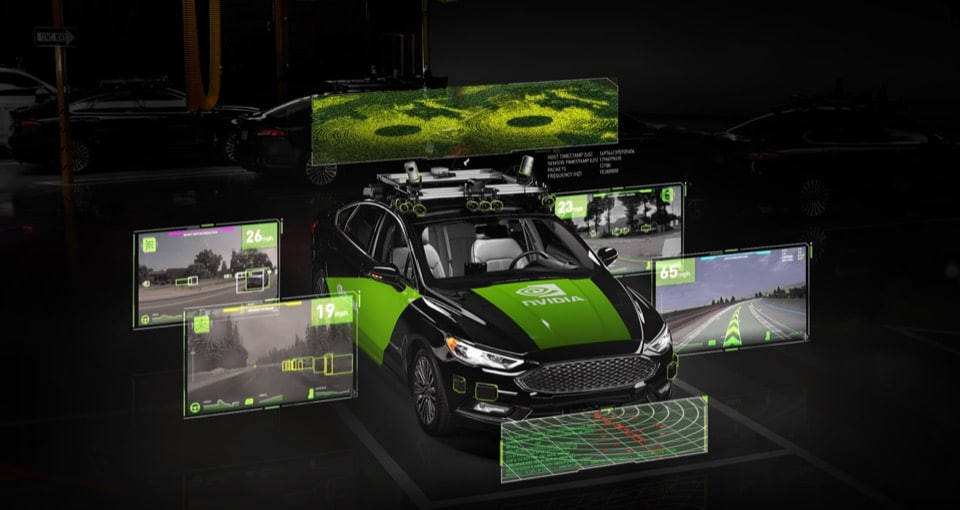
"Was", because with the technology presented by Nvidia before the opening of the Consumer Electronics Show in Las Vegas, Alpamayo, vehicles could soon be equipped with the first VLA - for "vision-language-action" - model of open reasoning. What does this mean? Instead of the vehicle reacting according to recorded "photos" of different situations and finding itself helpless because it is impossible to predict everything - and even experienced drivers know this - it would adapt in real time, without being connected to a cloud, to what it sees, what it understands and what it can do.
The Alpamayo project, put forward by Nvidia, is based on vast sets of real-world driving data collected from around the world. These also include sequences recorded in Luxembourg - a marginal territory on the group's global scale, but indicative of the way in which these technologies are constructed: through the aggregation of ordinary road situations, far from ideal laboratory demonstrations.
The "Physical AI - Autonomous Vehicles" dataset put forward by Nvidia gives a measure of the effort involved. It includes 1,727 hours of driving, or 310,895 20-second clips, collected in 25 countries and more than 2,500 cities. Around 50% of the data comes from the United States, the other half from 24 European countries.
Each clip combines feeds from multiple cameras and LiDAR sensors, and more than half also incorporate radar data. The aim is not so much to accumulate kilometres as to multiply situations: dense or fluid traffic, variable weather, unforeseen obstacles, ambiguous behaviour by pedestrians or drivers.
In this context, Luxembourg appears for what it is: a tiny fraction of the overall volume, but a real environment among others, with its own constraints - cross-border traffic, multilingual signalling, coexistence of old and recent infrastructures. So many concrete cases that often escape overly clean scenarios.
This is the observation that Nvidia is now formalising with its concept of "physical AI" and its VLA models. It is no longer just a question of seeing, but of reasoning about a situation, understanding its context and then acting in a coherent way. In a VLA model, visual perception feeds into a more abstract representation of the scene. Language" is not a capacity for dialogue, but an internal reasoning tool that structures the situation: a hesitant pedestrian, an unusually behaving vehicle, a temporarily suspended rule. Action then follows from this reasoning, and not from a simple trigger. This so-called open reasoning logic accepts the unexpected as a normal given, not as an anomaly to be corrected.
It is this ability to adapt that Nvidia is highlighting to justify the ambition of level 4 autonomy on a scale that has five: vehicles capable of driving without an active driver, in defined areas and conditions, without depending on constant human supervision.
Why local execution becomes central
Another key element highlighted by Nvidia: these decisions must be made locally, on board the vehicle. On the open road, waiting for a response from the cloud is not an option. A few tens of milliseconds of latency can be enough to turn a hesitation into an incident.
In environments like those in Luxembourg - tunnels, dense urban areas, variations in connectivity - this on-board execution is not a technological refinement, but a minimum requirement for credibility. The cloud retains a central role for training and improving models, but no longer for instantaneous decision-making.
The accessible metadata show that the sequences collected in Luxembourg are spread over several months and different time slots. They show voluntary exposure to a variety of conditions, which is essential for testing the robustness of the models. However, it is not possible to identify the routes precisely, or to isolate videos or LiDAR data that are specifically from Luxembourg. Nvidia also states that it has temporarily withdrawn half of the clips from the public set pending an internal review, which explains the discrepancies between some of the figures announced and the volumes currently available for consultation. This data is therefore not proof of deployment, but training and validation material.
When technology meets the political framework
This technological movement is not taking place in a political vacuum. Several years ago, Luxembourg formalised a specific approach to automated driving, structured around the national strategy "Automatiséiert Fueren 2028". The stated aim is not to promise a rapid arrival of autonomous cars for the general public, but to create a framework for testing, evaluating and supervising these technologies on open roads, prior to any commercial deployment.
In practical terms, this strategy has laid the foundations for a system of administrative authorisations for trials of automated vehicles, with precise requirements in terms of safety, human supervision, liability and data protection. The approach is progressive: first tests with a safety driver, then remote supervision scenarios, depending on the level of autonomy and the context of use. It is this framework that helps explain why some industrial players are choosing Luxembourg for their first European tests. In October 2025, Stellantis and Pony.ai announced that their trials of SAE level 4 robotaxis would begin in Luxembourg, before gradual deployment in other European cities from 2026.
In this context, the presence of Luxembourg data in the training sets put forward by Nvidia takes on a more coherent meaning. It does not make the country a central player in the American group's strategy, but places it in a continuous chain: collection of real data, development of models capable of open reasoning, supervised tests on open roads, then regulatory validation.
The "physical AI" presented by Nvidia at CES only gains credibility when it fits into this type of trajectory. Not as an abstract promise, but as a technology that will have to operate within specific legal frameworks, under the scrutiny of the authorities and the public.
Nothing guarantees that Luxembourg will be the first European country to see large-scale autonomous vehicles on the road. But it is one of the few countries to have already aligned an explicit public strategy, an operational legal framework and concrete industrial projects around this prospect. In a European landscape that is still fragmented, this ability to articulate technology and regulation could well carry as much weight as volumes of data or computing power. It is perhaps here, more discreetly, that one of the next stages of autonomous mobility in Europe is being played out.

