Thierry Labro: Let’s start with your personal mission. You’ve often spoken passionately about sustainability: was there a specific turning point in your life that sparked this passion?
Fredrika Klarén: I have a few of them, but one very important one was when I was just finishing university. I studied environmental systems analysis and I was pregnant with my first child. My husband and I went to the cinema to see “An Inconvenient Truth,” the film that Al Gore put out in 2006 or 2007.
I just remember sitting in the cinema and having such an “ah ha!” moment. I had studied environmental science for nearly five years at that point and, of course, had really gained insight into all the challenges and how daunting the situation was for the world. But what Al did was take this science and turn it into clear graphs and data that we could use. I felt so empowered by that. I felt that if we can put data on this and start to measure it, then we can manage it as well. That was one of the pivotal moments in my life where I felt: I have to work with this, and I have to work with climate.
In your current position and previous roles, I guess the dynamic between idealistic vision and operational reality is much sharper. How do you work with that?
I think I want to be in both worlds. I don’t want to pick one. To me, it’s really important to use the energy between those two states, to be very practical in one part of your everyday life, to be constructive and find compromises and just move forward, while also getting energy from the fact that we have a bigger mission. We are at a pivotal time in humanity’s history where we know that we’re not doing enough, but we need to get there somehow. And even though it feels vague, impossible and uncharted, I get a lot of energy from that. I need both perspectives.
Today, you’re a respected and experienced leader. Is it difficult to share your vision with operational teams? Do you have tricks for embedding people in your climate-neutral vision?
I’ve worked on this for more than 15 years now, and the situation has changed so much within business. Entire organisations are now pro-sustainability, so my tactics have had to change.
The great thing about working at Polestar now is that I feel I’ve come to a place where people put more demands on me than I put on them. They really want to drive sustainability throughout the organisation--they just want to know how. And I think there’s a great understanding that it’s business-critical, as an automotive company, to fully embrace and go for sustainability. So what I’m doing now is talking to the operations teams about how exactly we go about this, how to navigate it in a smart way but also in an impactful way.
It’s all about serving up data.

It’s all about serving up data. We have a really robust process to ensure we collect data, so we can measure our impact and communicate sustainability clearly, whether internally at Polestar or externally to our customers. For example, we have lifecycle assessments for all of our cars, where we measure the climate impact throughout the car’s entire value chain and lifecycle. We can use this to have a trustworthy and engaging dialogue with our customers, but also with all the internal teams at Polestar who are working to cut emissions.
So, data is a key point there. Could you go deeper into your strategy for us?
As a young company--we’re still only seven or eight years old--we were founded in a time when we already know a lot. We know that we’re facing a rampant climate crisis.
We have three core strengths at Polestar that we want to cultivate as we build high-performance cars: design, innovation and sustainability. That’s a very important strategic triad for us.
Within this, we focus on four key areas: climate neutrality, circularity, transparency and inclusion. These four areas are at the core of our sustainability strategy, and we apply them throughout our core programs, our operations, our workplaces and beyond. And within these four focus areas, we’ve defined clear objectives. For example, when it comes to climate, we’re a pure EV player, so we already represent a powerful climate solution. If a consumer chooses an electric car over a fossil-fuelled one, they can already cut their carbon footprint by more than half, and that benefit will only grow as energy grids become greener and as brands like ours reduce emissions from production.
But we also know that electrification is just the beginning. At Polestar, we focus much of our climate effort on the production of the cars. We know that most emissions come from the batteries, steel and aluminium. So we work specifically to reduce emissions from those materials. For example, with Polestar 2--the car we first launched in 2020--we’ve managed to reduce the carbon footprint by three tons since launch. It has gone down from around 26 tons of CO2 when it left the factory gate in 2020 to about 23 tons today.
This is a key part of our strategy: reducing emissions now, during production, to ensure that as we scale--and we do need to scale, to replace fossil-fuelled cars with electric ones--we decouple our growth from environmental impact. Polestar 2 is a great testament to the fact that this is possible.
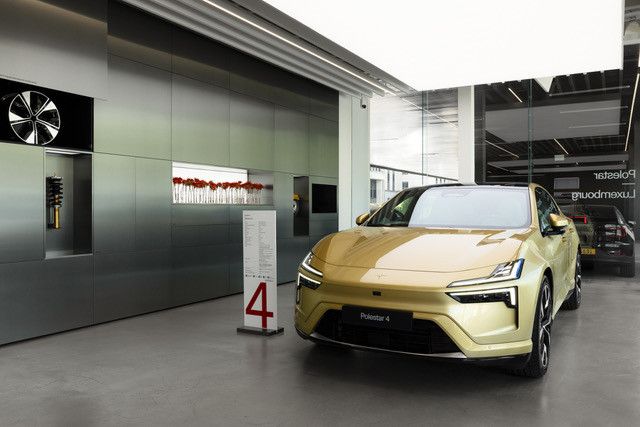
Just one final point on climate: we work with carbon budgets for each of our cars. For example, with Polestar 4, we achieved the lowest carbon footprint of any Polestar car to date: below 20 tons for the long-range single-motor version, the smallest one. We’ve seen a really positive effect from all this on our company’s greenhouse gas emissions. We’ve stayed below our reduction curve and cut emissions per car for three consecutive years, which is a fantastic result, I think.
You’re a very innovative company. One point I find particularly interesting, especially because I think Luxembourg will try to play a key role in blockchain development in Europe, is that you’ve launched an initiative to track the materials you use through blockchain.
Yes, this falls under our focus area of transparency. Materials traceability is a key initiative within that, and it starts with identifying our risk materials. When we put batteries in cars, we also use more risk materials, specifically minerals like cobalt, lithium, nickel, mica and others. These materials come with risks such as human rights violations, environmental pollution and even child labour.
We believe that the first step we must take is to secure full traceability in these supply chains. But the automotive industry, and especially the mineral supply chain, is not accustomed to traceability and transparency. For instance, if you buy an organic cotton t-shirt, you can get a certification that traces it through the supply chain. No such ready certifications exist for minerals today. So, back in 2019, when we were developing Polestar 2 together with Volvo Cars, we launched a pilot project on blockchain traceability for cobalt. We partnered with an exciting company called Circulor, and the pilot was so successful that, when Polestar 2 launched in 2020, it became the first car in the world where we could claim blockchain traceability on cobalt.
Whether it’s a consumer who wants a high-performance, innovative car with a high degree of autonomous driving, or a single mother who needs an affordable car that works for her daily life--these are the people the automotive industry must support.
Since then, we’ve expanded our work in this area. Blockchain is not the only solution. You can also use other methods to map and trace supply chains. Today, we have traceability on cobalt, mica, nickel and lithium in our cars, and we’re pushing to expand even further because we know there are many more risk materials that need to be tracked. Once you’ve established traceability, then you can really start working. Once you know where something comes from, you can assess the situation at the source--whether it’s a factory or a mine--and determine what corrective actions are needed. Traceability is the foundation of all sustainability work in supply chains today.
In operational terms, if your traceability tool shows that something is wrong, what’s your strategy? Do you start a dialogue with the supplier, or do you decide to switch to a different lithium producer, for example?
Exactly like that. If we get a flag that a material is coming from an unknown source, we can pinpoint where in the supply chain it occurs. Then we can make sure that the processing plant--or whichever actor is involved--is contacted, and that we initiate a dialogue about any corrective actions needed.
The market is changing very fast today. Car manufacturers are launching new vehicles more often, and we’re starting to see a new generation of EVs with ranges up to 1,000 kilometres. This has major implications for charging infrastructure, consumer adoption, pricing and more. What’s your vision for the near future? Because even though you’re a young company, the market is evolving rapidly. Also, this plays a role on the secondary market, since the third generation of electric vehicles will soon enter that space. So how do you plan to deal with the circular economy around these developments?
What we envision is a future where more electric cars cater to a broader variety of needs. Right now, a lot of people feel left out of the transition. They can’t afford a car, or they feel that the available options don’t meet their needs. So whether it’s a consumer who wants a high-performance, innovative car with a high degree of autonomous driving, or a single mother who needs an affordable car that works for her daily life--these are the people the automotive industry must support.
At Polestar, we want to push the agenda forward in terms of innovation. We’re very clear about our focus: we create great performance cars. That’s what we love and what we do best. So we want to take responsibility for advancing that segment.
That’s the beautiful thing about cars: they can last a very long time. And even at end of life, they are highly recyclable.
But I’m also excited about where the industry is headed right now. Here in the mid-2020s, we’re seeing policies that help lower the entry barrier for many customers. The automotive industry is also at a point where many OEMs [original equipment manufacturers] are producing smaller, more affordable cars, which is a really encouraging development.
Will you create a smaller car for people who have less money for an electric car? Or will you remain focused on the more premium segment?
I can’t say anything about the sizes of our future cars. What I can say is that, if you want a performance car, you can come to Polestar. If you want to feel something exciting when you press the accelerator, that’s where we are--and the cars will be designed and built around that experience.
A word, maybe, on the secondary market. What will happen with the first generation of Polestar vehicles?
It’s a very exciting space. We’re learning more about these products now that they’ve been on the roads for several years. Battery lifespan, for example, is looking really good. And the overall quality of our cars is strong. We’re very focused on growing the market for pre-owned electric vehicles. You can already see them in our spaces, and each year we offer more of them. This allows us to meet different customer needs whilst extending the lifespan of the vehicles.
That’s the beautiful thing about cars: they can last a very long time. And even at end of life, they are highly recyclable. You can recycle more than 95% of a car battery, for instance. Today’s vehicles are constructed in such a way that, if we reshape the infrastructure accordingly, we can extract these materials and reuse them. The potential is huge.
Biography
Fredrika Klarén is the head of sustainability at Polestar, a Swedish electric performance car brand. She joined Polestar in April 2020, bringing over a decade of experience in sustainability roles within the fashion and retail industries, including positions at Ikea and as head of sustainability at Kappahl. Klarén holds a degree in civil engineering with a focus on environmental systems analysis from Chalmers University of Technology in Gothenburg, Sweden.
At Polestar, she leads the company’s sustainability strategy, emphasising climate neutrality, circularity, transparency and inclusion. Under her leadership, Polestar has achieved significant milestones, such as a 9% reduction in greenhouse gas emissions per car sold between 2022 and 2023.
Klarén is also the chair of the board for Agenda 2030 West, an organisation that fosters partnerships that cross between and amongst academia, business, civil society and the public sector to advance the United Nations’ sustainable development goals.
This article was written for the May 2025 issue of Paperjam magazine, published on 24 April. The content is produced exclusively for the magazine. It is published on the site to contribute to the full Paperjam archive. Click on this link to subscribe to the magazine.
Is your company a member of Paperjam Club? You can request a subscription in your name. Let us know via club@paperjam.lu