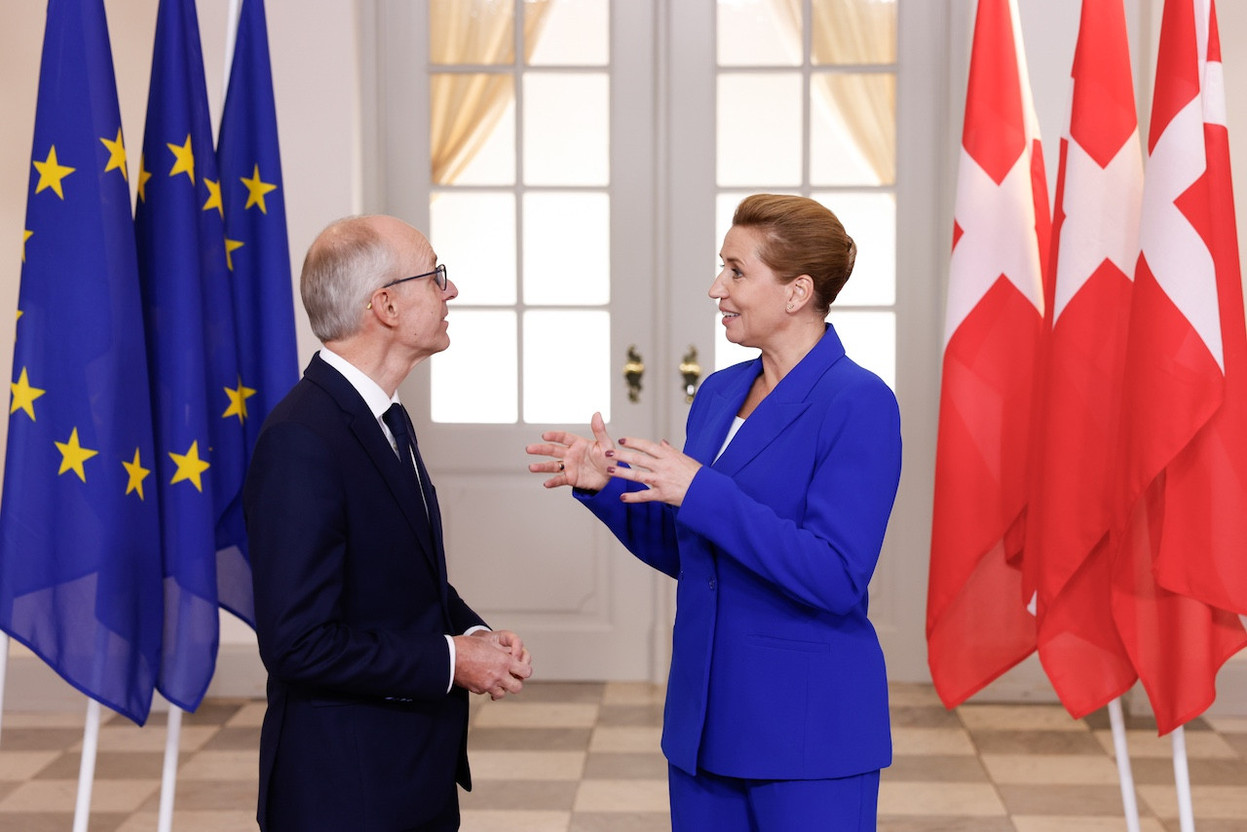
Although the agenda of the European Council meeting on October 22–23 promises to be particularly full, one of the main topics will be the use of frozen Russian assets to finance support for Ukraine—a matter on which Luxembourg is seeking guarantees. The European Commission is expected to present concrete proposals on this issue.
In her State of the Union address, Commission President Ursula von der Leyen proposed financing Ukraine’s war effort using immobilized Russian assets. These assets would not be confiscated but would instead serve as the basis for a “reparations loan” to Ukraine, drawing on the cash balances associated with the frozen funds. Repayment would only occur once Russia had paid reparations for the damage inflicted on Kyiv.
However, the proposal did not meet with unanimous approval within the European Council. Luxembourg, through its Prime Minister, 
Luc Frieden was, however, less categorical when it came to the use of revenues generated by these assets—under certain conditions. Asked about his position on the Commission’s proposal, he replied to a parliamentary question that “it remains essential to clarify the legal and technical modalities of the proposed mechanism, as well as to analyze its budgetary and legal implications for the Member States. Luxembourg supports a legally sound and carefully considered approach, ensuring that unintended repercussions are avoided. An assessment by the European Central Bank of the implications for financial stability would be appropriate.”
Belgium—for its part, home to Euroclear and thus at the heart of the asset-freezing mechanism—demanded firm guarantees that it would not be left to bear alone any potential legal costs arising from Russian litigation.
A zero-interest loan mechanism
The European Commission is expected to use the Council meeting to clarify its stance on the roughly €210 billion in frozen assets resulting from successive rounds of sanctions imposed on Moscow. There is no question, however, of seizing them outright. This cautious approach is intended to limit potential harm to the reputation of the European financial system and the euro, as well as to avoid possible legal challenges—reassuring both Luxembourg and Brussels.
Instead, the Commission intends to use the cash balance generated by these frozen assets, estimated at around €140 billion. The EU executive plans to replace the matured Russian assets with zero-coupon short-term bonds issued by the EU. These new assets would be transferred to Ukraine in the form of interest-free “reparations loans”, conditional on the implementation of reforms, and would only be repaid if Russia ended the war and compensated Ukraine for the damage caused. If Russia failed to do so, the loans would be converted into grants.
The Commission also proposes inviting international partners that have likewise frozen Russian assets to take part in this loan mechanism.
A push for qualified majority voting
Given the constraints facing Member States—shrinking fiscal space amid a prolonged war and growing Ukrainian needs—a solution will have to be found. The Commission, moreover, wants to make it easier to renew the freezing of Russian assets by introducing qualified majority voting instead of the unanimity currently required, in order to avoid potential vetoes that could derail the program.
Another Luxembourg priority: competitiveness
Competitiveness will also be on the agenda, with discussions structured around three pillars: simplification, green transition, and digital transition. Participants will aim to agree on accelerating administrative simplification and reducing “bureaucratic” burdens, as the European Parliament is set on October 22 to clarify its own stance on the matter.
They will also debate how to reconcile climate goals with the need to strengthen Europe’s competitiveness.