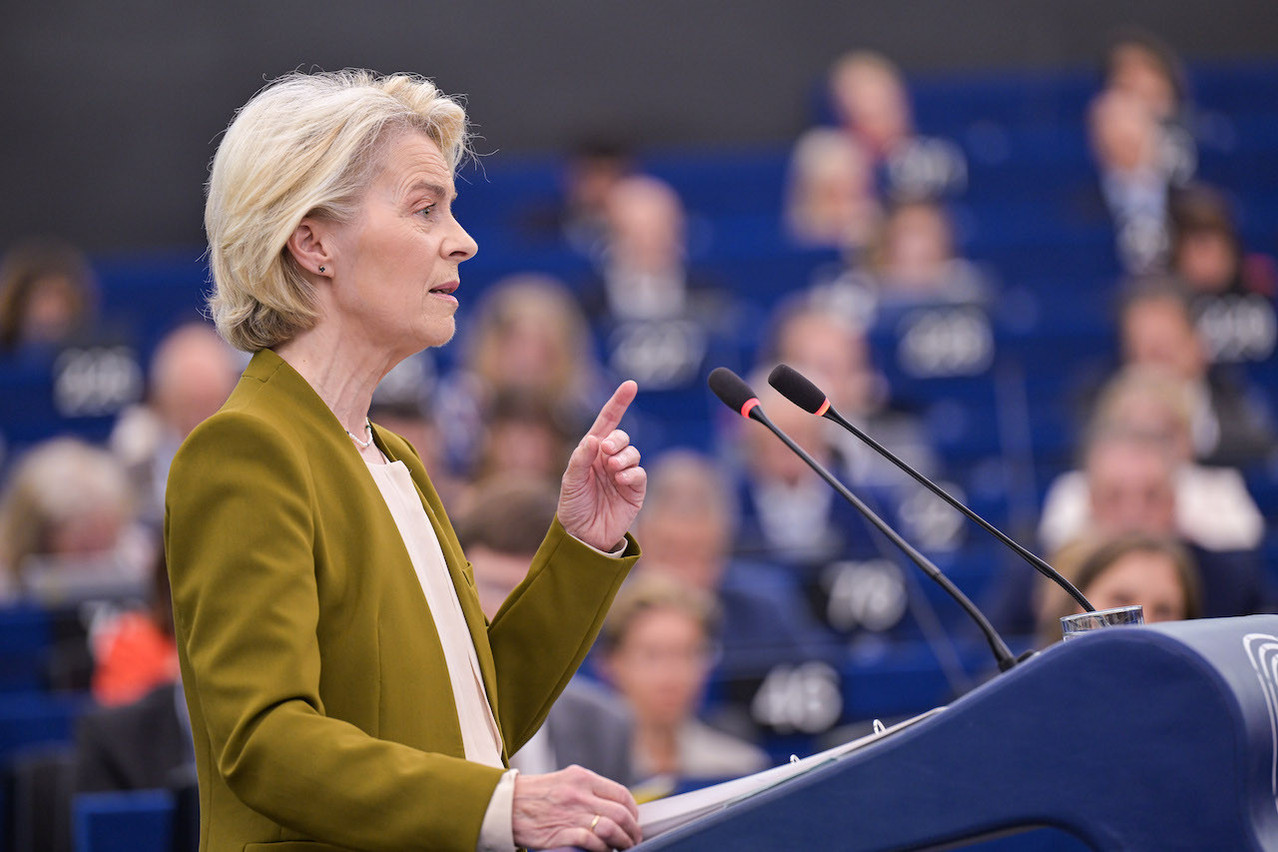
This year's State of the European Union address comes as Ursula von der Leyen faces growing opposition from MEPs. While the trade agreement with the United States has set the world alight, opposition has been fuelled by the turbulence surrounding the Green Deal, which has been undermined by the policy of administrative simplification championed by the European People's Party (EPP), and by criticism of Europe's powerlessness in the Gaza Strip. In her annual address, the President of the Commission, anxious to reassert her leadership, insisted that Europe is fighting for peace, independence, democratic values and the right to self-determination, particularly in the Ukrainian and Gazan contexts. She called for unity to strengthen the Union's defence, security, technological and energy sovereignty, as well as its competitiveness. Declarations of principle matched by announcements of concrete measures.
Reaffirmed support for Ukraine
On the Ukrainian front, the President of the European Commission reaffirmed the EU's support and announced new measures to help Kiev. She began by mentioning the organisation, with Ukraine and several partners, of a summit of the international coalition for the return of Ukrainian children, recalling that "every child abducted must be returned".
She then presented a mechanism for financing the war effort through immobilised Russian assets: not confiscation, but a "reparations loan" using the cash balances generated by these assets, which would only be repaid once Russia was forced to pay for the destruction committed. Finally, the Commission will launch a new military programme, called Qualitative Military Edge, designed to support investment in the capabilities of the Ukrainian armed forces, particularly in the field of drones. This programme will be endowed with six billion euros.
Israeli ministers and settlers punished
On the Gaza front, Ursula von der Leyen reaffirmed that "famine must never be a weapon of war" and that "there can be no room for Hamas, now or in the future". With the Islamist movement already sanctioned, she announced several measures aimed at Israel to support a two-state diplomatic solution. Faced with the deadlock over the suspension of the association agreement with Israel, the Commission is putting forward other options: suspension of bilateral aid, sanctions against settlers and certain extremist ministers in the Israeli government, and working with the Member States to achieve a partial suspension of the agreement on its trade section.
"I am aware that it will be difficult to obtain a majority, and I know that any measure will seem excessive to some and insufficient to others", admitted Ursula von der Leyen. She added that the Commission would work across the board to promote the use of qualified majority voting, particularly in key areas such as foreign policy. In addition, from October, the Commission will set up a donors' group for Palestine, tasked with contributing to a financial instrument dedicated to the reconstruction of Gaza. "This will be an international initiative led with regional partners, building on the momentum created by the New York conference organised by France and Saudi Arabia."
Massive investments in digital
On the competitiveness front, the President of the Commission has announced "massive" investments in digital technology and clean technologies. These will be financed by the Future Competitiveness Fund and by doubling the Horizon research and innovation programme. The Commission will also join forces with private investors to develop the ScaleUp Europe fund, designed to support fast-growing start-ups in critical technology sectors.
"Massive investments will be made to support innovative AI start-ups, to enable them to form, develop and deploy their models," she stressed. Ursula von der Leyen also announced "urgent measures" to maintain Europe's clean technology sector, including a €1.8bn package to boost battery production.
Criticised for the bureaucratic nature of European integration, she said that new proposals would aim to reduce red tape, overlaps and the complexity of the rules, with the aim of cutting administrative costs for businesses by eight billion euros. Finally, a new roadmap will be presented to strengthen the single market: 'Made in Europe' criteria will be introduced in public procurement and incentives put in place to encourage EU partners to buy European.
Strengthening social cohesion
On the social front, the Commission is highlighting three projects. Firstly, a Quality Job Act designed to "ensure that modern employment keeps pace with the modern economy". Secondly, a plan to eradicate poverty by 2050, supported by a strengthened "child guarantee" and a programme for affordable housing. "A first European plan for affordable housing will be presented this year to make housing more accessible, sustainable and of better quality. It will include a review of state aid rules and a legislative initiative on short-term rentals," said the Commission President.
She also insisted on the protection of fundamental freedoms, the strengthening of democracy in the face of disinformation, and the need to provide answers to social challenges such as poverty or the safety of children online. A commission of experts will be mandated to advise the EU on the best approach to children's access to social networks, based on the Australian model. Finally, a new programme to support independent journalism and media literacy will be launched, "with a significant increase in media funding in the next budget".
This article was originally published in French.