
Luxembourg’s economic recovery is slow in coming. In its autumn 2026 economic forecasts, the European Commission has revised down the Grand Duchy’s growth to 1.3% this year and 1.8% in 2027, compared with 1.6% and 2% forecast in the spring. This revision contrasts with that of the European Union, for which the growth forecast for 2026 has been raised to 1.4%.
In Luxembourg, following a 0.3% increase in the first quarter, GDP fell by 0.9% in the second quarter. Private consumption and investment declined, against a backdrop of rising energy prices and tighter financing conditions. Public consumption is expected to be the main driver of growth in 2026. On the household front, the June wage indexation and government measures to support disposable income are expected to boost spending in the second half of the year.
Households expected at the transit centre
Brussels is forecasting a gradual pick-up in economic activity, with growth reaching 2% by 2028. Private consumption is expected to benefit from new wage indexation schemes and an expansionary fiscal policy. Private investment in satellites and aircraft would also contribute to the recovery. In the construction sector, confidence is improving, but the cost of finance is expected to continue to hold back the recovery.
This recovery would not immediately reduce unemployment. Despite a 1.6% increase in domestic employment in 2026, the unemployment rate amongst residents is projected to reach 6.9%, compared with 6.5% in 2025. The Commission notes, in particular, the growing role of cross-border workers in job creation. Unemployment would then fall to 6.7% in 2027 and to 6.3% in 2028.
Harmonised inflation is expected to reach 3.7% this year, driven by energy prices, before slowing to 2.5% in 2027 and 1.9% in 2028.
A provisional improvement in the budget
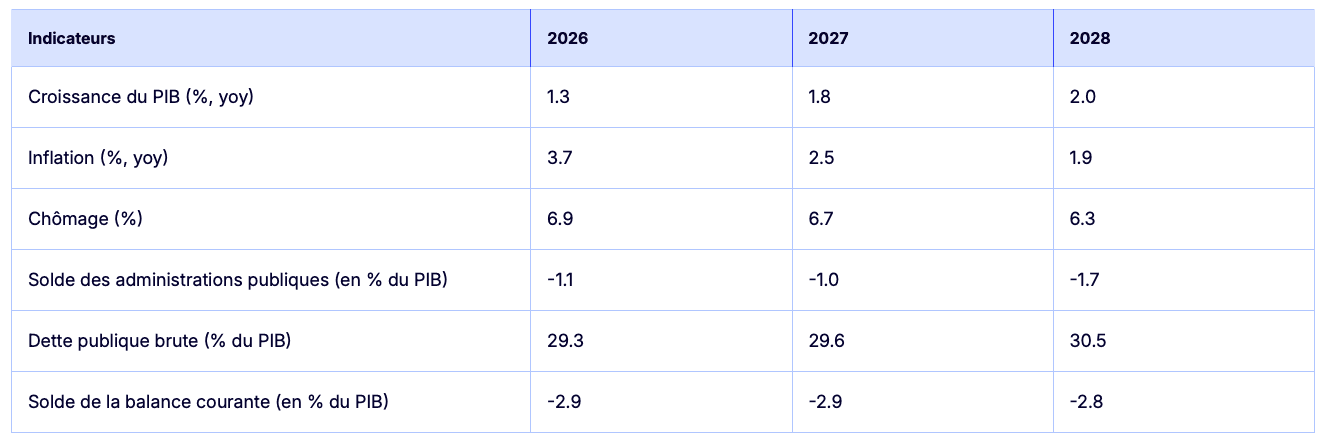
Luxembourg’s economic scoreboard, as compiled by the European Commission. (Source: Commission européenne)
The general government deficit is expected to fall to 1.1% of GDP in 2026, and then to 1% in 2027. Revenue is expected to be boosted in particular by income tax, an increase in social security contribution rates and one-off inheritance taxes.
However, the improvement would be temporary. In 2028, the income tax reform would reduce revenue by around 0.8% of GDP, helping to bring the deficit down to 1.7%. Public debt would continue to rise, increasing from 26% of GDP in 2025 to 30.5% in 2028.