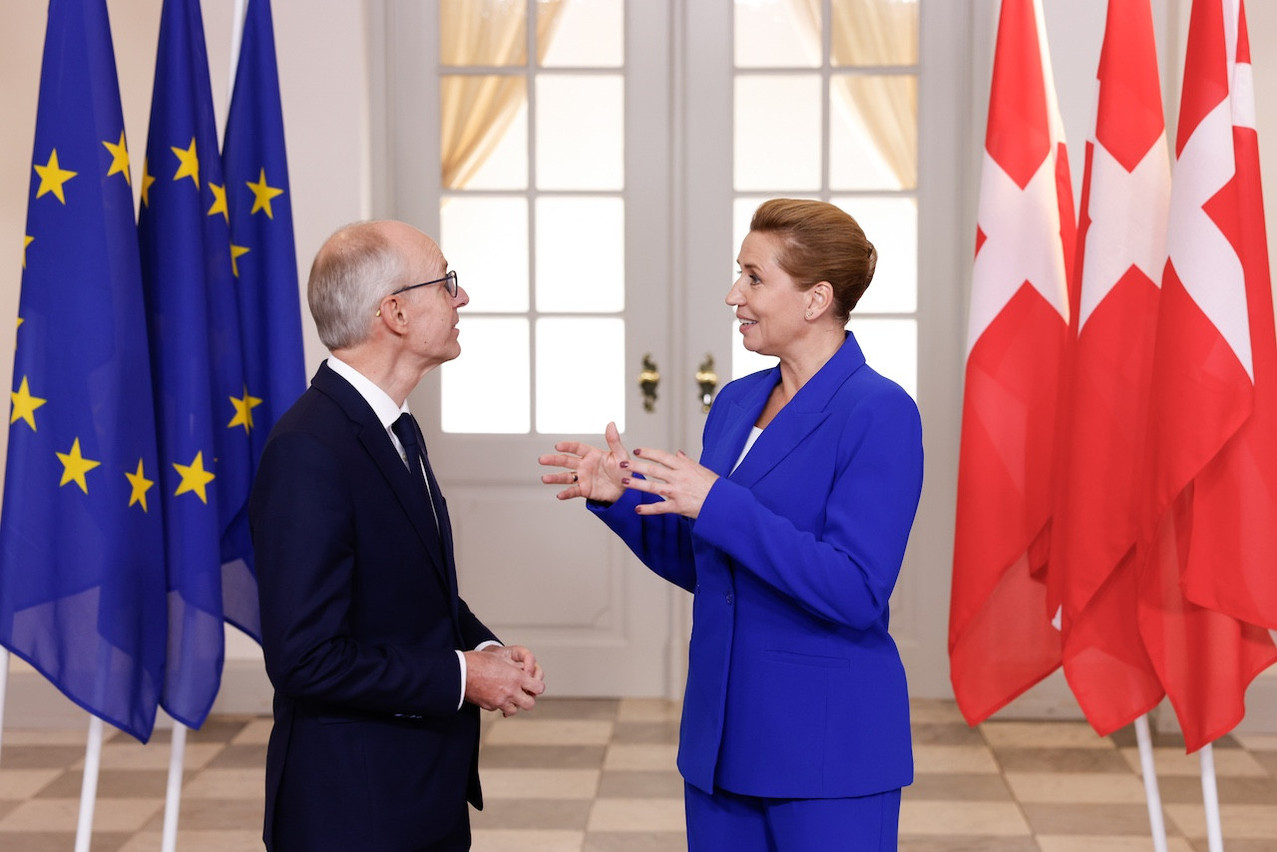
Luc Frieden welcomed by Danish Prime Minister, Mette Frederiksen, at the informal meeting of heads of state and government in Copenhagen. (Photo: Council of the European Union)

Luc Frieden welcomed by Danish Prime Minister, Mette Frederiksen, at the informal meeting of heads of state and government in Copenhagen. (Photo: Council of the European Union)

Gathered in Copenhagen, the heads of state and government discussed the fate of Russian assets frozen by the EU, in particular their possible use, through a loan mechanism, to finance Ukraine’s war effort. A project that raises concerns in Luxembourg. No decision was made, except to continue the discussions.

"What should be done with the Russian assets frozen by the European Union since Moscow's aggression against Ukraine? This question is at the heart of the two-day informal meeting of heads of state and government in Copenhagen, devoted to greater European cooperation and effectiveness in defence and aid to Ukraine. In this context, Commission President Ursula von der Leyen's proposal to use the €200 billion in Russian assets frozen as a result of EU sanctions is a major sticking point.

During her State of the Union speech on September 10, she suggested mobilising these funds to launch a "reparations loan" to Ukraine, secured by the associated cash balances. These assets would only be repaid once Russia was forced to pay reparations for the damage inflicted on Kiev.

Legal obstacles for Luc Frieden

A proposal already supported by Finland and Sweden. A proposal that will require unanimous support in the Council. A "welcome proposal, but one that raises a whole series of complex legal issues" for Prime Minister Luc FriedenLuc Frieden (CSV). Questions to which he is waiting for clarification before agreeing. These include how Ukraine would repay such a loan, what the implications would be if Russia did not have to repay reparations following a peace agreement, and who would bear the responsibility for such a loan. A final question that refers back to the arbitration procedure triggered by Mikhail Fridman following the freezing of his assets, the Russian oligarch has turned against Luxembourg on the basis of a treaty signed between the Belgian-Luxembourg Union and Ukraine in order to obtain compensation for a loss he estimates at €14.5 billion. Assets which the European Commission has maintained frozen.

The thorny issue of confiscating Russian assets

"These hesitations have caught the attention of Déi Gréng MP Sam TansonSam Tanson who has tabled an urgent question to the Prime Minister and the Minister of Foreign Affairs, Xavier BettelXavier Bettel (DP). She asked them if they were prepared to sign up to the Brussels proposal, which she deemed "responsible". Speaking to Paperjam, she said, "Resorting to frozen Russian assets via a loan is a responsible solution: it supports Ukraine, is less attackable from a legal point of view and avoids burdening European citizens."

The MEP also asked ministers to clarify Luxembourg's position on "supporting the widest possible use of these assets, as proposed by some Member States" - in other words, going as far as confiscation. Even though the Commission President is not calling for such outright confiscation, Luc Frieden reiterated Luxembourg's position of principle: for him, confiscating or seizing assets belonging to another state is simply not an option.

As a reminder, Luxembourg currently holds between €6 billion and €6.2 billion of Russian assets in escrow, according to the Ministry of Finance.