
“We’ve moved from a low-interest-rate environment to a higher one and could be heading back toward lower rates again in the next six to 12 months,” said Matt Jones, a 20-year Fidelity veteran and portfolio manager, during a presentation in Luxembourg on 4 December 2025.
Jones explained that their absolute return fund ($1.2bn in assets under management) has a long-short equity market neutral strategy positioned to navigate dynamic market shifts. It includes the volatile interest rates and significant rotations between value and growth stocks observed over the last five years.
Managing down “volatile volatility”
Jones remarked that their fund, “a non-weather solution,” is engineered to provide absolute performance across all market cycles. It targets returns of cash + 3% to 5% with low volatility, specifically around 5% to 7% (about one-third of the equity market).
Since inception (09/2020), the fund generated an annual performance of 8.6% with a volatility of 5.5% vs. 3.1% for the Secured Overnight Financing Rate index (SOFR). Not surprisingly, the fund is “completely unconstrained by the benchmark,” he said. Of note, Jones stated that the biggest drawdown since inception reached around 5%.
All about the stock-picking ability of Fidelity’s analysts
The fund's portfolio is intentionally constructed to be beta zero—meaning no sensitivity to market direction (see chart 1)—and deliberately eliminates all systematic risk exposures, such as those related to country, sector, style, value/growth, size, or market timing. By eliminating these biases, Jones claimed that 85% to 90% of both risk and alpha generation are concentrated purely in stock picking.
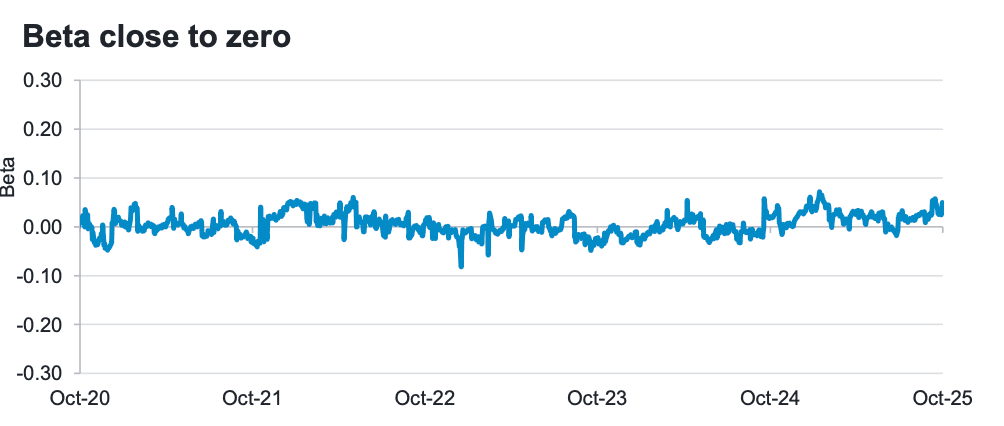
Near absence of market risk Fidelity International
This strict market neutrality has resulted in the fund exhibiting a low to negative correlation to virtually all other asset classes (see chart 2) including its direct peer indices, the Eureka Equity Market Neutral Index (-0.12) and the HFR Equity Market Neutral Index (0.07).
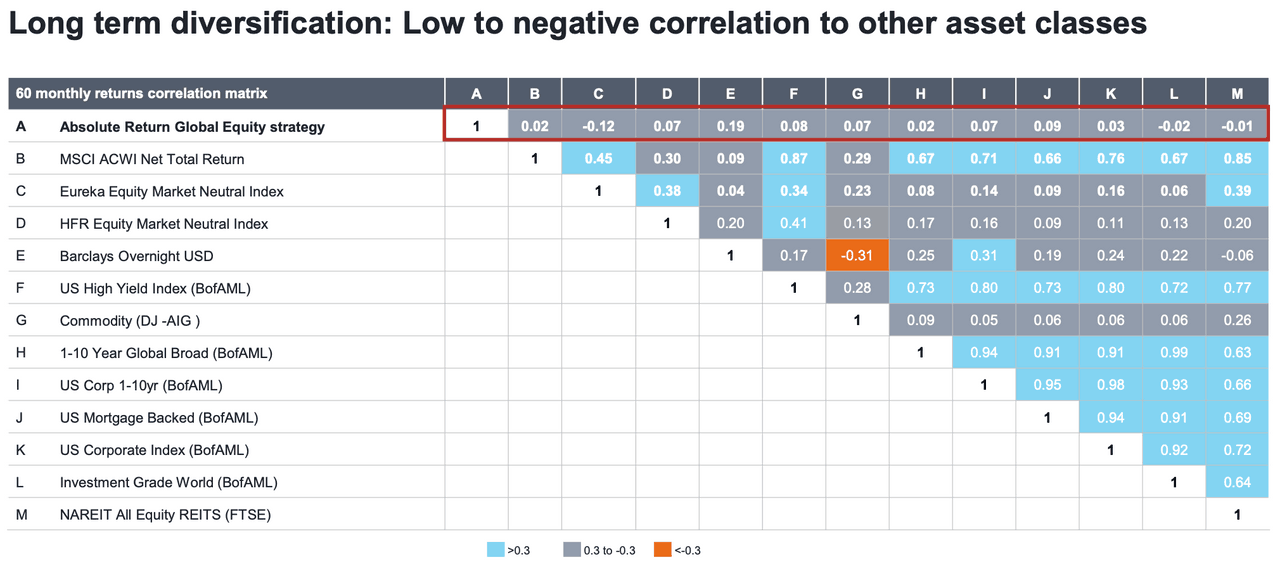
Negligible correlation Fidelity International
Paired book: alpha generation & risk control
The portfolio typically holds about 80 names long and 80 names short while the fund operates with relatively low leverage. “Shorts generate absolute alpha but mainly offset the risk of the long book,” said Jones. Besides, he noted that gearing settings can be adjusted (e.g., raising leverage if dispersion drops) to maintain the target return and volatility profile.
Jones stressed that the short positions are critical not only for generating absolute alpha but, crucially, for offsetting all risk of the long book to ensure market neutrality.
Looking for conviction trades
The strategy's core strength is its focus on proprietary, idiosyncratic alpha “that is unique and cannot be replicated outside of Fidelity.” This alpha is sourced exclusively from the fundamental research conducted by Fidelity's global equity research team, which includes approximately 125 analysts. The research team’s buy ratings generally outperform the market, while sell ratings tend to underperform, creating a widening spread the fund seeks to capture (see chart 3).
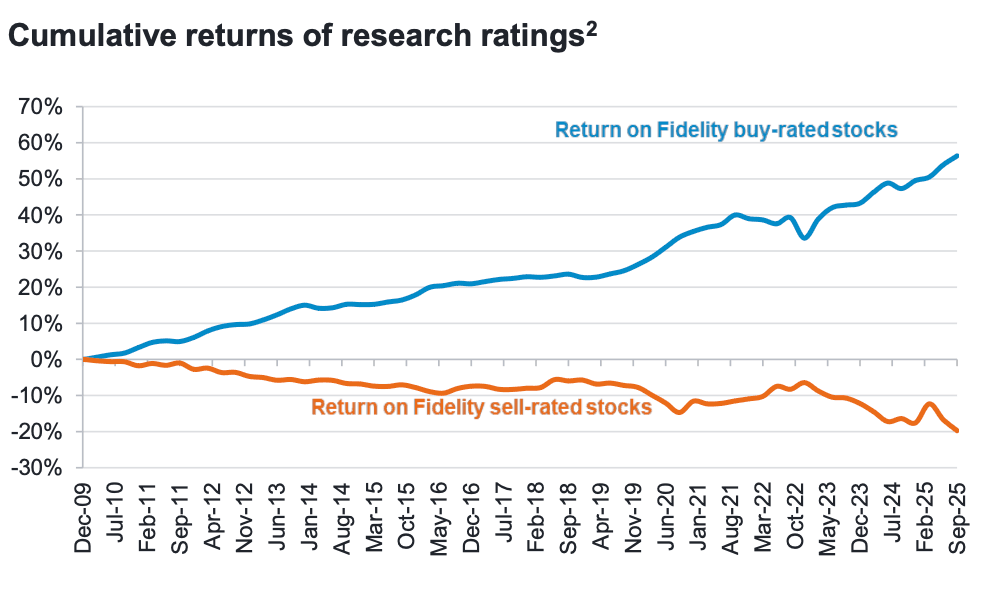
Buy ratings outperformed sell ratings Fidelity International
The investment process systematically filters Fidelity's roughly 2,500 active research ratings down to a high-conviction list. This filtering relies on seven key signals. The first four signals are derived directly from the fundamental research analysts (such as rating conviction, recent research notes, and rating change) and constitute 60% to 70% of the scoring system. The other key signals come from external data (rating upgrade/downgrade), with valuations being the most important external factor.
Process “actively slowed down”
Although the process is systematic, portfolio managers maintain qualitative oversight before “pulling the trigger and sending the trade order.” He argued that the process is reinforced by reviewing investment theses and by checking for qualitative risks (e.g., potential takeover targets in short positions). Jones said the process is intentionally paced to ensure thoughtful decision-making rather than rapid, model-driven turnover.
The process is “stable and repeatable,” utilising “low turnover,” averaging 120% to 130% annually, which is “very low compared to a quantitative process.” Major rebalancing is performed quarterly, aligning with when analysts update their research post-reporting season, ensuring trading activity matches the slow, long-dated pace of the alpha signal.
Jones noted that the fund typically
struggles mainly during periods dominated by macro shocks or intense retail flows, overriding fundamental analysis (e.g., “broad macro shocks” or “meme-stock-style retail surges”). Even so, he emphasised that the fund is highly liquid, with the entire fund (both long and short book) capable of being liquidated in under three days.