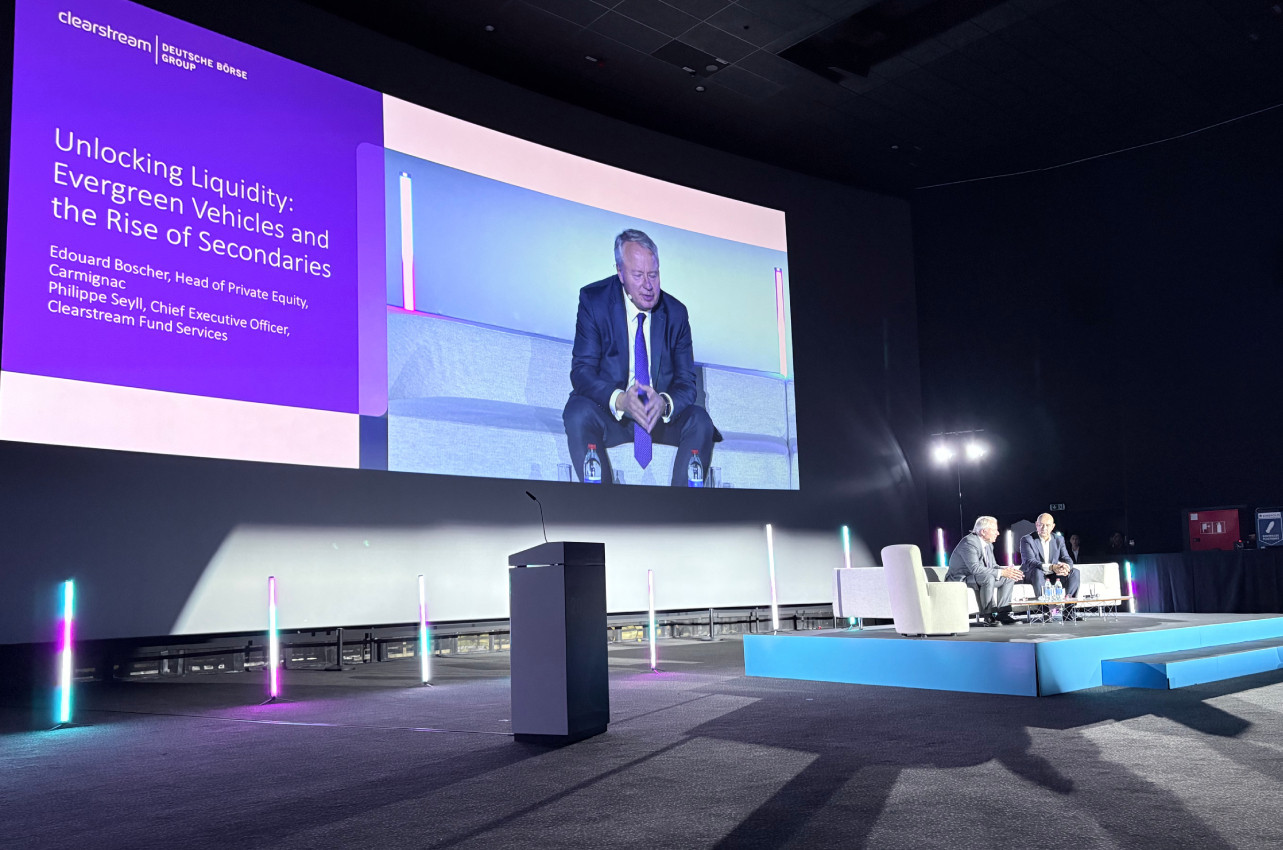
The trend is clear: "Evergreen funds are going to develop massively", assured Edouard Boscher, who heads up Carmignac's private equity business, in a dialogue closely watched by 450 professionals with the CEO of Clearstream Fund Services, 
Historically, private equity has been reserved for large institutional investors - sovereign wealth funds, pension funds, insurance companies - capable of allocating up to 50% of their portfolios to this asset class. But for wealthy individuals, and even more so for retail investors, exposure remained marginal: "Between 0 and 3%", observes Mr Boscher. The reason was that "private equity was perceived as too complex and, above all, too illiquid"
Traditional closed-end funds, with their staggered capital calls and deferred distributions, are not suitable for investors who have neither the resources nor the time to manage ten-year commitments. Evergreen structures, on the other hand, are a game-changer. These open-ended vehicles allow regular subscriptions and redemptions - within certain limits - while investing in unlisted assets. "We're talking about semi-liquidity, not total liquidity," adds Carmignac's head of private equity. "The horizon remains long-term, at least five years."
The secondary market follows the primary market
Liquidity is necessary in any industry, even in long-term investing, whether to pay insurance claims or to deal with a "denominator effect" that forces a pension fund to reduce its allocation. The secondary market represents around "2%" of total private equity assets under management. Private equity accounts for around $8 trillion of the $20 trillion in private assets. Last year, secondary transactions amounted to around $160 billion, or 2% of the $8 trillion market. Historically, even in 2019, with $8 trillion in private equity, there were $80 billion of transactions, or "still 2%". The secondary market therefore follows the primary market and will continue to grow with the growth of private equity. It is a good asset class, particularly for evergreen vehicles.
Recourse to the secondary market offers several advantages: it allows mature portfolios to be acquired at a discount, thereby reducing the notorious "J curve" - the initial period when a fund's performance is negative before rising again. It also provides immediate diversification: "By buying a portfolio of 20 funds, each containing ten companies, you are investing in more than 200 companies in one go," explains Mr Boscher. Above all, the distribution flows generated from the first few quarters make it easier for investors to manage redemptions.
There are two types of secondary transactions: LP-led (limited partner) transactions and GP-led (managing partner) transactions. LP deals consist of a "mature portfolio of existing assets", whereas GP deals are often "single assets" promoted via continuation funds.
When considering LP transactions, buying an existing portfolio offers several advantages: firstly, the purchase is made at a discount, which "avoids the J-curve". The J-curve is a "big problem" for retail investors, because even if they are promised high IRRs (15%, 16%, 18%), they experience "negative performance for a year or two", which is complex to manage. Thanks to secondaries, we gain access to "immediate performance", which reduces the impact of the J-curve.
Diversification in essence
Secondly, diversification is an important element. For retail investors, you need "less risk". Buying a portfolio of 20 funds with 10 underlying companies means buying "more than 200 companies" in a single transaction, ensuring diversification from day one. The evergreen structure, allowing monthly subscriptions, is "very valuable" for accessing a flow of transactions that immediately diversifies the money. The third element, and perhaps the most important, is the liquidity offered. Evergreen funds need cash to meet requirements for the first three or four quarters, and then they need to restore their cash position in the event of redemptions. By buying mature secondary assets, you start receiving distributions "almost from day one". These distributions are used to immediately restore the cash position in the event of redemptions, thereby honouring the liquidity offered. The secondary market is therefore "an asset class that supports strategies in its own right".
With regard to allocation, the aim is not for individuals to invest "100% of their assets" in these funds. This must remain diversification, as it is illiquid, and individuals should probably target "between three and 7%". This can be achieved either by investing the desired portion in an evergreen structure containing mainly unlisted assets, or by using "mixed vehicles" offering this small exposure to private equity via a one-stop-shop fund mixing listed and unlisted assets. It is likely that we will see "new developments and new products" in the future, as the industry is "extremely creative".
It is important, before investing, to know what you want and what type of exposure you are looking for. Mr Boscher mentions LT (Long Term) funds, which are a 'game changer' but have more constraints. Carmignac plans to launch a new fund next year, which will remain secondary, but focused solely on "European assets managed by European fund managers". The good thing about evergreen, unlike a blind pool, is that you can see the type of underlying strategies (private debt, infrastructure or a mix of strategies). It is therefore essential to assess "exactly what the underlying strategy is". Mr Boscher assures us that there are "a lot of good funds" and that, as these funds become accessible to a wider audience, there will "very soon be rankings" enabling them to be compared by strategy and to choose the one that meets the investor's objectives.
"Private equity has become a mature asset class", he concludes. "With evergreens, we are finally democratising it."