Police interventions in domestic-violence cases rose to their highest level in a decade in 2025, as repeat cases and missed follow-up appointments put pressure on Luxembourg’s system for protecting victims and removing suspected perpetrators from the home.
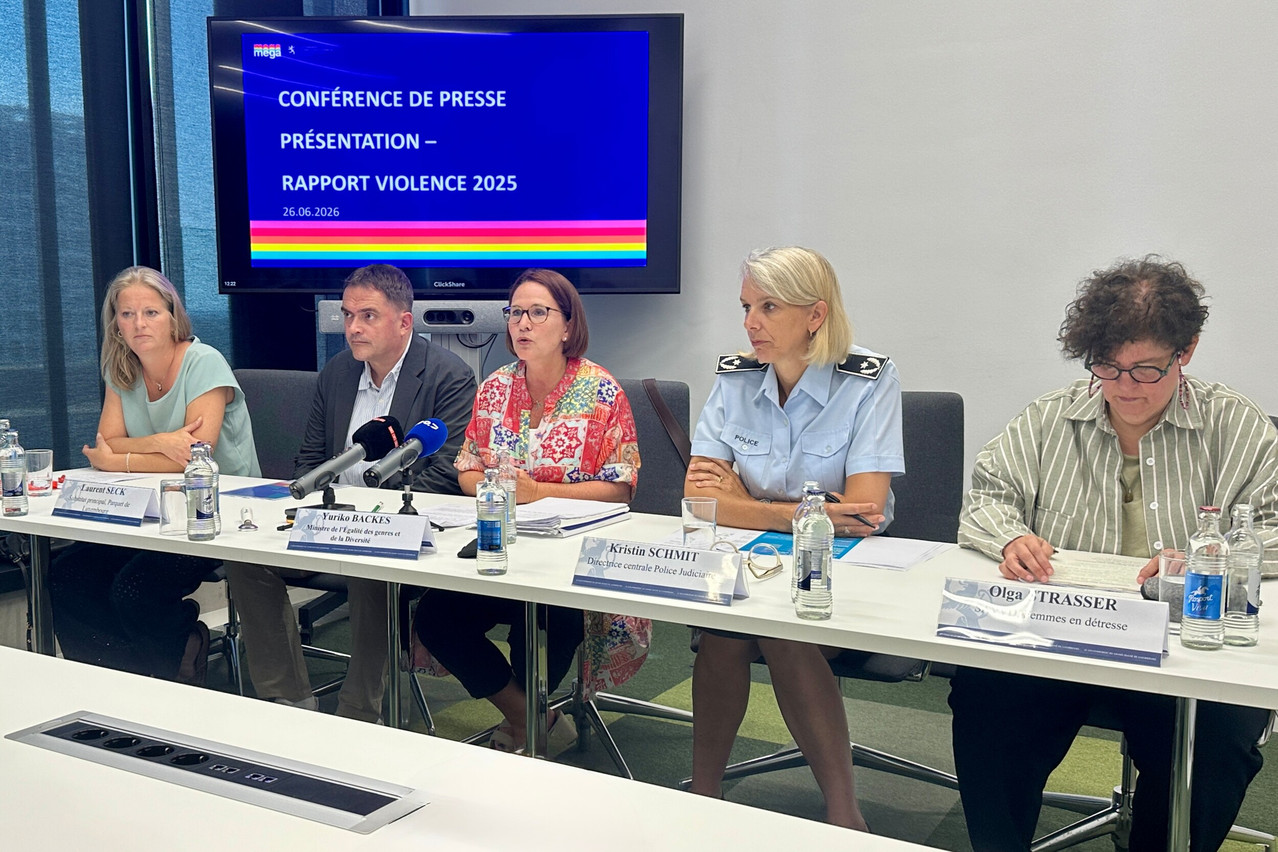
Gender Equality and Diversity Minister Yuriko Backes presented the 2025 annual report of the cooperation committee on domestic violence on Thursday 26 June, alongside representatives from police, prosecutors, victim-support services and Riicht Eraus, the perpetrator-support service run by the Luxembourg Red Cross.
Police recorded 1,297 domestic-violence interventions last year, up 10.1% from 1,178 in 2024. Prosecutors ordered 334 emergency removals from the home, the domestic-violence protection measure known in Luxembourg as an expulsion, up from 287 a year earlier.
“The trend in police interventions and removals from the home is not going in the right direction,” Backes said. “But this has to be put in the broader context of stronger awareness work and a growing population.”
The figures show domestic violence becoming more visible, without proving by themselves that violence is rising at the same pace as reported cases. The report also cautioned that changes in how victim data was collected in 2025 created a break in the series, meaning victim counts are not directly comparable with previous years.
Daily pressure
Police recorded 2,802 people as presumed victims during interventions in 2025, including 58% women and 42% men. The number of people recorded by police as presumed perpetrators rose to 2,075, including 1,318 men and 755 women.
The report said one intervention can involve several presumed perpetrators, while one perpetrator can also be linked to several victims. It said the higher victim count reflected changes that made it possible to identify offences and people concerned more precisely.
Kristin Schmit, director of Luxembourg’s central judicial police directorate, said officers were dealing with around three domestic-violence interventions a day, including almost one removal from the home.
She said police training had been adapted to include more input from victims and to help officers understand why police may be called repeatedly to the same household before a victim is able to leave. Officers also began using a national risk-assessment system in 2025, after a pilot in the east of the country.
The system asks officers to look more closely at previous incidents, sexual violence, suicide attempts, threats involving children and other warning signs. Schmit said the aim was to identify immediate or longer-term danger earlier and give specialised police teams a clearer picture of high-risk cases.
Repeat cases
The removals ordered by prosecutors showed a more pronounced gender pattern than overall police interventions. Among people removed from the home, 87.7% were men and 12.3% women; among victims in those cases, 81.6% were women and 18.4% men.
Prosecutors said 81% of domestic-violence situations covered by the removal figures occurred within couples. Prosecutors in Luxembourg and Diekirch handled 1,343 domestic-violence files in 2025.
Laurent Seck, a senior prosecutor at Luxembourg’s prosecutors’ office, said the higher number of police interventions partly reflected a lower threshold for calling police after years of awareness campaigns. He said police were now more often called to domestic-violence situations that did not meet the legal threshold for removing someone from the home.
But Seck said those cases were still reviewed. Every police intervention leads to a report, he said, and prosecutors in Luxembourg and Diekirch have specialised teams that review domestic-violence files.
“All new information about a family is handled by the same prosecutor,” Seck said, adding that prosecutors could draw on police risk assessments, victim-support assessments, information from work with perpetrators and child-protection material when deciding what action to take.
The courts issued 201 judgments linked to domestic violence in 2025, while 130 removals from the home were extended after applications to the family court judge. The report also recorded five homicides that could, at the current stage of investigation, fall within a domestic-violence context.
Riicht Eraus counted 72 repeat cases in 2025. The service uses the term in a non-legal sense for people who were subject to at least two removals from the home between September 2013 and December 2025.
In 55.6% of repeat cases, the person did not comply with the obligation to attend a meeting after removal from the home. Laurence Bouquet, head of Riicht Eraus, said repeat cases were the least likely to lead to an appointment, while people under a judicial obligation were more likely to take part in follow-up support.
“When people are in follow-up, we have very few repeat cases,” Bouquet said, adding that initial motivation could be low but could develop during support work.
Children and shelter
The report also detailed the impact on children in violent households. In 2025, police referred 182 files involving home removals and minors to PSYea and Alternatives, the two services responsible for assisting children and adolescents in domestic-violence households.
Those files involved 376 minors and 11 young adults aged 18 to 21. The two services treat all children present in such households as victims of domestic violence, whether directly or indirectly.
In 97% of the files, families accepted an initial meeting, and just over half accepted continued psychological support beyond the emergency removal period. The services recorded physical violence against children in 115 cases, sexual violence in one case and economic violence in seven cases.
Olga Strasser of Femmes en Détresse’s SAVVD victim-support service said domestic violence had consequences for all members of affected families. She also pointed to housing as a recurring barrier for victims trying to leave violent situations.
Strasser added there was a waiting list of about 60 women and their children for women’s shelters. Backes said Luxembourg had seven women’s shelters with 166 emergency beds, 17 beds for vulnerable men or male victims of domestic violence, and a new women’s shelter in Rumelange expected to add 28 beds by the end of the year.
The National Centre for Victims of Violence had supported 554 victims between its opening and the end of May 2026, including 131 in May alone, Backes also said. The centre has operated around the clock since 1 May and offers psychological, medical, legal and police support in one place.
Backes said 40 of the 62 measures in Luxembourg’s national action plan against gender-based violence were under way, while four had been completed. The government is also waiting for a study on repeat cases by the end of the year, which Backes said should help strengthen work with perpetrators and Luxembourg’s domestic-violence protection framework.