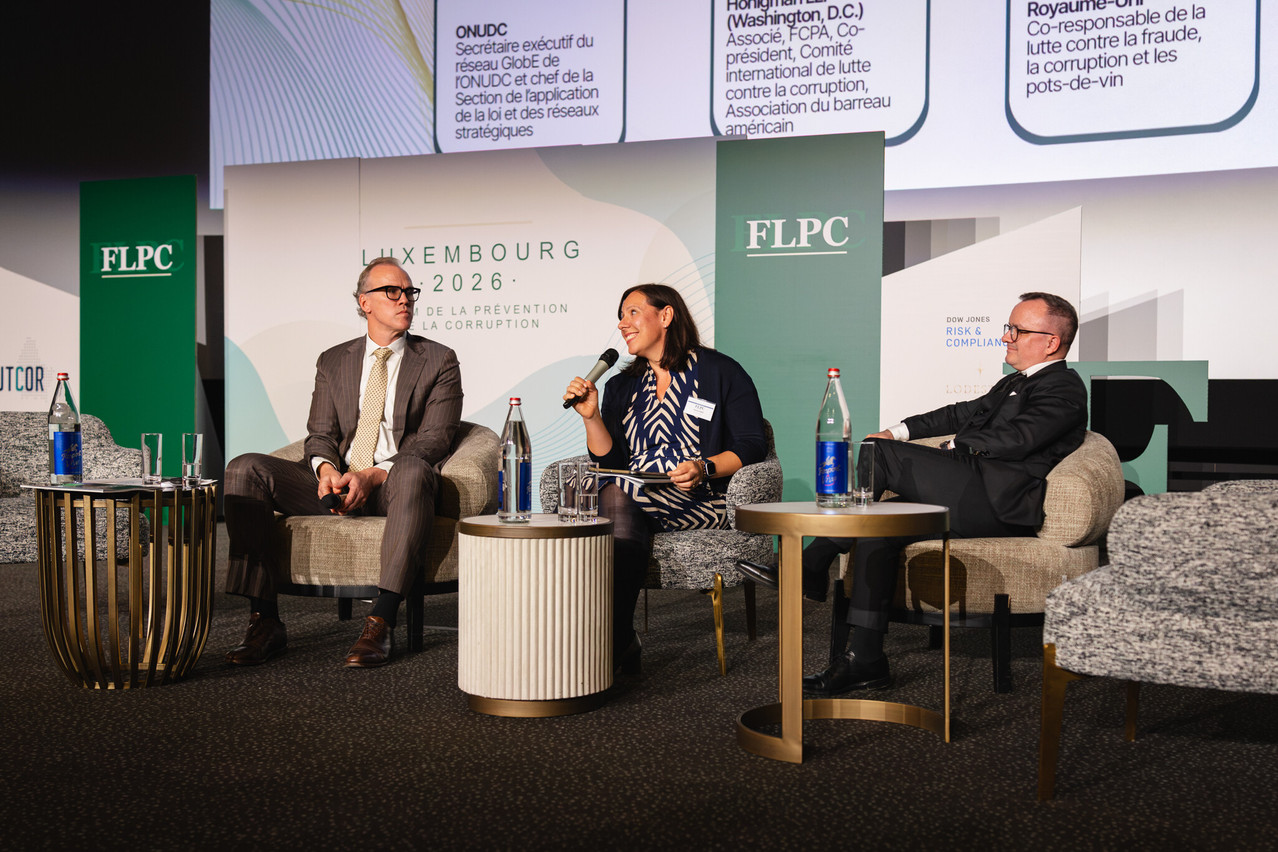
The law remains a national matter. Corruption, money and evidence, however, are becoming increasingly transnational. This is the common problem described on Thursday at the first Corruption Prevention Forum at Utopolis Kirchberg by Daniel Patrick Wendt, a partner at Honigman in Washington and co-chair of the American Bar Association’s International Anti-Corruption Committee; Emma Isaac, co-head of the Fraud, Corruption and Bribery Division at the UK’s Serious Fraud Office (SFO); and Neil J. Walsh, executive secretary of the GlobE Network at the United Nations Office on Drugs and Crime (UNODC).
The first examines how US law seeks to address offences committed elsewhere. The second aims to translate this legal jurisdiction into investigations and sanctions. The third seeks to facilitate communication between investigators from different countries.
Who has the right to bring legal proceedings?
This is one of the long-standing criticisms levelled at the United States: does the Foreign Corrupt Practices Act (FCPA) allow it to impose its own system of justice on the rest of the world, or even to use the law as an economic weapon?
“Yes and no,” replies Daniel Patrick Wendt. The FCPA requires a connection to the United States, which may, for example, involve transactions or communications taking place on US territory. Companies listed in the United States provide another point of entry. This does not mean that Washington can prosecute any company in the world. Mr Wendt gives the example of a Chinese company with insufficient links to the United States: the US authorities may not have jurisdiction over it. The lawyer acknowledges, however, a historical peculiarity: European companies have long been over-represented among the largest FCPA fines. He used to refer to the top 10 as the ‘Holy Roman Empire’, such was the prevalence of German and European groups on the list.
In particular, he sees this as the legacy of an era when certain forms of international corruption were still regarded elsewhere as a way of doing business, but also as differences in behaviour towards the US authorities. US boards of directors, he explains, were particularly wary of the Department of Justice (DOJ) and the Securities and Exchange Commission (SEC) and were therefore more inclined to cooperate and disclose their records. Foreign companies sometimes chose to ‘play hardball with the DOJ’. However, this more confrontational attitude could lead to tougher proceedings and harsher penalties.
The UK has also expanded its safety net
The UK has, in the meantime, developed its own extraterritorial arm. Emma Isaac says she identifies more with the idea of ‘universal justice’ than with that of ‘economic warfare’. But there has to be a connection: ‘The key question for us really is: what is the link with the UK?’
An act of corruption may have been committed elsewhere. The question then becomes: who committed it, on behalf of which company, and what links exist with the United Kingdom? The presence of a British national or the operations of a company in the United Kingdom may, depending on the circumstances described, be a factor in this equation.
For a multinational company, the same conduct may therefore be of interest to several national authorities at the same time, each of which applies its own rules. And, in the absence of a uniform territorial approach to corruption at European level, companies must navigate their way through the various sets of legislation that may apply to them.
Where has the evidence gone?
But having legal jurisdiction is of no use if the investigator cannot find the evidence. A company may be based in one country, the suspect in another, their bank account in a third and their data hosted in a fourth. Payments may also pass through several other jurisdictions. And the traditional process of international mutual legal assistance cannot keep up with the speed of the cloud. Neil J. Walsh sums it up with a quip: “I could retire before a request comes back.” The GlobE Network, which he heads, aims precisely to bridge this gap. Its approach is based on a fundamental distinction: before obtaining evidence, one must first gather intelligence.
The investigator does not necessarily need, on the first day of their investigation, to obtain through the courts all the certified documents that they will subsequently produce in court. They must first understand what evidence is available.
In which country is the information located? Which authority has access to it? Is there a bank account? Where is the data? How long will it be retained? Is another jurisdiction already investigating? Obtaining these answers quickly enables a decision to be made on where to focus the investigation’s time and resources. The formal procedure then comes into play when this lead needs to be turned into legally admissible evidence.
Emma Isaac describes almost exactly the same practice as it is carried out by the SFO. She calls it ‘police-to-police’. Before setting the whole machinery of mutual legal assistance in motion, a British investigator can contact a foreign investigator directly. Take a bank account, for example. The SFO may need to know quickly whether one exists, whether money is going in or out of it, and whether the lead is worth pursuing further. This initial information will not necessarily be the same as that which is produced in court. But it helps to determine whether a formal request is worth making. The slowness of mutual legal assistance must not, therefore, become an excuse for allowing an investigation to stall. Behind this legal mechanism lies something far more human: you need to know who to call. Ms Isaac emphasises the need to build relationships with her counterparts and to understand their legal systems. Rather than sending a request to a foreign authority that it is legally unable to comply with, one must be able to ask them which procedure, within their own system, would enable the desired outcome to be achieved.
In particular, she cites the work carried out with the French National Financial Prosecutor’s Office. These relationships are gradually building trust. In one of its investigations, she explains, the SFO knew who to contact in a foreign jurisdiction because a colleague had previously worked with the person in question. Contact was established and, ‘within two weeks’, the data sought had been provided in a format that allowed the case to move forward.
In Mr Walsh’s view, this is precisely what international networks need to institutionalise: not to start looking for someone to talk to only once a scandal breaks.
The mobile phone becomes a crime scene
This speed becomes all the more important as the evidence itself changes. Data is no longer necessarily stored in a filing cabinet, or even on a computer located in the country where the offence was committed. It may be stored in the cloud, hosted in another jurisdiction, moved or deleted. The geographical scope of the investigation therefore no longer necessarily corresponds to that of the offence.
Emma Isaac cites the example of the smartphone. A considerable part of a suspect’s life can now be found on their phone: communications, relationships and other digital traces. The challenge is no longer simply to extract this data, but to understand the connections it reveals. Encrypted messaging apps further complicate this work. Investigators must adapt their way of thinking because the methods used today will not necessarily work tomorrow.
This same upheaval is affecting money. Ms Isaac points out that tracking the movements of crypto-assets can prove to be far more complex than tracking a traditional bank account. The SFO’s model offers an advantage here: investigators and prosecutors work within the same organisation, and cases are handled by multidisciplinary teams. A single case may bring together investigators, lawyers, accountants and other specialists to address the legal, financial and technological aspects simultaneously.
AI also speeds up investigations
Daniel Patrick Wendt observes a further paradox. From the authorities’ perspective, changes in the way people communicate can make it more difficult to gather evidence. Business communications no longer take place solely via email. WhatsApp and other apps scatter the available digital traces. Yet these same technological developments make internal investigations carried out by companies considerably easier.
A few years ago, he explains, it was necessary to mobilise ‘armies of accountants’ to sift through vast quantities of emails and transactions. Artificial intelligence tools now make it possible to carry out some of this research much more quickly. Technology is thus fuelling a race between new ways of disseminating information and new capabilities for retrieving it.
Can you buy peace of mind?
The question then remains as to whether sanctions should be imposed. Do the negotiated agreements simply allow companies to buy their way out of trouble rather than face a trial? Emma Isaac rejects this interpretation of UK deferred prosecution agreements (DPAs). The agreement is not merely the result of negotiations between the company and the SFO. The judge oversees the process and must, in particular, ensure that the outcome is ‘fair, reasonable and proportionate’ and in the interests of justice. Nor does the settlement relate solely to the amount of the fine. It may require changes to the company’s compliance system and monitoring measures designed to prevent the same behaviour from recurring. Ms Isaac cites the Ultra Electronics case, in which the settlement amounted to around 50 million pounds. To determine a penalty, she explains, it is necessary, in particular, to examine what the company actually gained from the corruption.
Mr Wendt points out that the very severe US penalties now associated with the FCPA far exceed what the Act originally provided for. The Alternative Fines Act and the sentencing guidelines have made it possible, in particular, to take into account the proceeds of the offence and to apply multipliers to determine a range of penalties. However, the fine published by the DOJ or the SFO is only the tip of the iceberg.
Mr Wendt refers to ‘hidden penalties’: directors and managers being replaced, employees being made redundant, internal investigations, lawyers and consultants to be paid, and then investments – sometimes long-term – in new compliance systems. In his view, however, plea bargaining has one weakness: there is no trial and therefore no full public disclosure of the evidence.
Emma Isaac believes that taking legal action against a company until it goes out of business can cost employees who have not been involved in any wrongdoing their jobs, cause shareholders to lose money, or affect pensions.
Ultimately, this is what links the three interventions. Borders always determine who can investigate, gather evidence and impose sanctions, whilst businesses, money, communications and evidence constantly cross them.