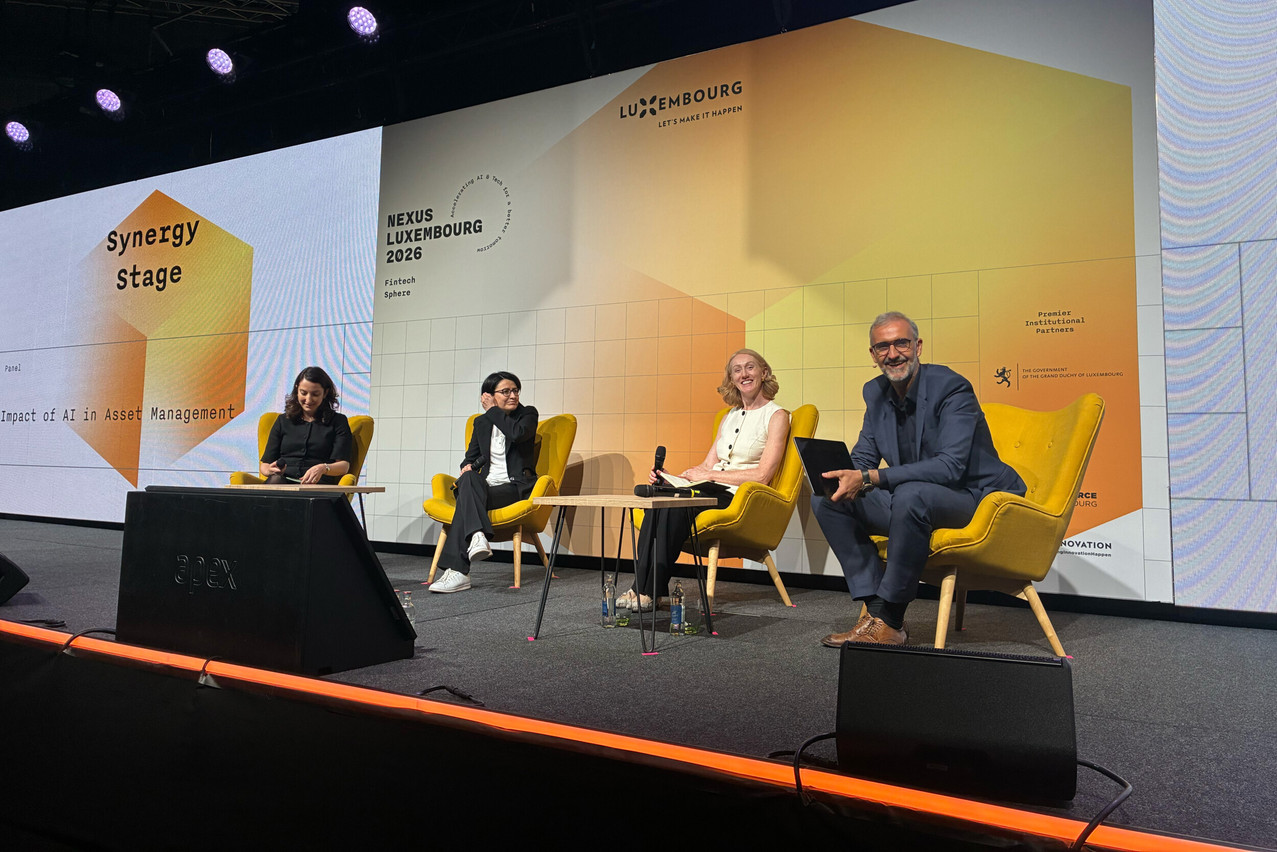
Artificial intelligence is steadily making its way into Luxembourg’s asset management industry. Yet despite the enthusiasm surrounding the technology, one message emerged clearly from the panel discussion “Impact of AI in asset management” at Nexus Luxembourg: AI is not yet transforming the way investment decisions are made. Instead, it is quietly reshaping the operational backbone of the fund industry.
Gathering representatives from the regulator, the asset management sector and the consulting world, the discussion provided a realistic snapshot of where the industry stands today. While AI adoption is accelerating, the most advanced use cases remain concentrated in operational processes, compliance functions, risk management and data handling rather than portfolio construction or alpha generation.
An industry still in the early stages
According to Anna Curridori, fintech analyst at the CSSF Innovation Hub, Luxembourg’s asset management sector is still relatively early in its AI journey. Based on recent regulatory surveys, adoption levels remain modest compared with other industries and most existing initiatives focus on internal efficiency gains rather than investment innovation.
The finding is significant for a country that hosts more than €5trn in investment fund assets and positions itself as one of the world’s leading fund domiciles.
While headlines often focus on AI-powered investment strategies, the reality inside management companies appears far more pragmatic.
“Most use cases are centred around efficiency,” was effectively the conclusion shared by all speakers.
Where AI is already creating value
For Grainne Goodman, head of IT governance & risk at M&G Luxembourg, the strongest use cases are already visible in highly repetitive and data-intensive processes.
Among the most mature applications are reconciliation activities, anomaly detection, data quality controls, investor onboarding processes, AML and KYC documentation reviews, signature recognition and fraud detection. Many of these activities involve analysing large volumes of structured and unstructured data, making them particularly suitable for AI tools.
Investment teams themselves are also experimenting with AI, particularly in research and information gathering. However, these initiatives remain largely exploratory and continue to operate under strict human supervision.
Goodman stressed that portfolio managers are increasingly using AI to support research activities, but not to replace investment judgement. Human oversight remains essential throughout the process. The distinction is important.
Despite growing excitement around generative AI and autonomous agents, the panel offered little evidence that AI is currently delivering a measurable performance advantage to asset managers.
Instead, the technology is helping firms process information faster, reduce manual work and improve operational resilience.
Why adoption remains slower than expected
If the technology is becoming increasingly accessible, why is adoption progressing more slowly than many predicted? Several explanations emerged during the discussion.
Data protection remains a major concern for financial institutions, particularly in Luxembourg where confidentiality, investor protection and regulatory compliance are deeply embedded in the industry’s DNA. Yet speakers argued that technical solutions already exist, including local deployments, sovereign cloud infrastructures and open-source models capable of operating within controlled environments.
Another challenge relates to regulation. While the European AI Act is now entering into force, many organisations are still trying to understand its practical implications. Anna Curridori noted that industry surveys revealed persistent misunderstandings regarding risk classifications and regulatory obligations. However, she also pointed out that asset management is not directly exposed to the highest-risk categories defined by the regulation.
Perhaps the most interesting obstacle identified was organisational rather than technological. Many Luxembourg entities operate within large international groups where technology strategies, AI budgets and specialist teams are located abroad. As a result, local management companies often depend on decisions taken elsewhere before they can deploy new solutions.
In other words, innovation may be available, but implementation is not always under local control.
Governance becomes the new frontier
If AI promises efficiency gains, it also introduces new categories of risk. Hatice Baskaya, director in cyber governance & compliance at Deloitte Luxembourg, argued that firms should view AI primarily through the lens of governance and risk management. The challenge is no longer limited to protecting infrastructure and data. Organisations must now also protect the models themselves, ensure that their behaviour remains consistent over time and understand how decisions are being generated. This raises fundamental questions about transparency and accountability.
Many firms rely on third-party AI models that operate as black boxes. While organisations can observe outputs, they often have limited visibility into how those outputs are produced. In a heavily regulated industry such as asset management, this lack of explainability creates obvious concerns.
Hatice Baskaya also highlighted another emerging challenge: employees now have direct access to powerful AI tools. Unlike previous technology waves, adoption no longer depends entirely on IT departments. Employees can independently use generative AI tools for research, analysis or content creation, creating both opportunities and governance challenges.
The result is that governance frameworks may become just as important as the technology itself.
Changing culture, not just systems
Technology is only part of the equation. At M&G Luxembourg, Goodman explained that one of the biggest challenges remains cultural. While senior management strongly supports AI adoption, employees must also be willing to rethink their daily processes and identify areas where automation can create value.
To encourage adoption, the company has launched AI awareness programmes, mandatory AI risk training, dedicated AI champions and internal competitions designed to identify practical use cases across business functions. The objective is straightforward: help teams move beyond experimentation and identify tangible efficiency gains. For many organisations, the challenge is no longer whether AI works, but whether employees are prepared to redesign the way they work.
The rise of AI agents
Looking ahead, all three speakers pointed to AI agents as the next major frontier. Rather than simply generating content or answering questions, these agents could eventually execute complex workflows, interact with multiple systems and collaborate with other agents across an organisation. For management companies, potential applications include risk monitoring, delegate oversight, regulatory reporting, board reporting, operational controls and internal governance processes.
The promise is significant: remove repetitive administrative work while allowing employees to focus on higher-value tasks. At the same time, speakers repeatedly stressed the need to keep humans involved in critical decisions and maintain clear controls over access rights, responsibilities and accountability.
From innovation to infrastructure
Perhaps the most revealing comparison came at the end of the session. Goodman compared AI’s current trajectory to the rise of cloud computing two decades ago. What initially appeared as a specialised technology eventually became standard infrastructure. The same may happen with AI.
Within five years, speakers suggested, AI could become embedded across virtually every process within asset management organisations. The distinction between “AI projects” and traditional business processes may disappear altogether as intelligent systems become a standard component of operational and governance frameworks.
For Luxembourg’s fund industry, the question is, therefore, no longer whether AI will be adopted. The real question is whether the sector can move from experimentation to industrialisation quickly enough to remain competitive while preserving the governance, regulatory credibility and investor confidence that have long defined the financial centre.
For now, the industry’s message remains cautious but clear: AI is entering the fund industry through the back office. Whether it eventually reaches the portfolio manager’s chair remains an open question.