Luxembourg officially launched the third edition of Nexus Luxembourg at LuxExpo The Box on Wednesday morning with a clear ambition: to make Europe a leading player in artificial intelligence, rivalling the United States and China. One after another, the prime minister, 


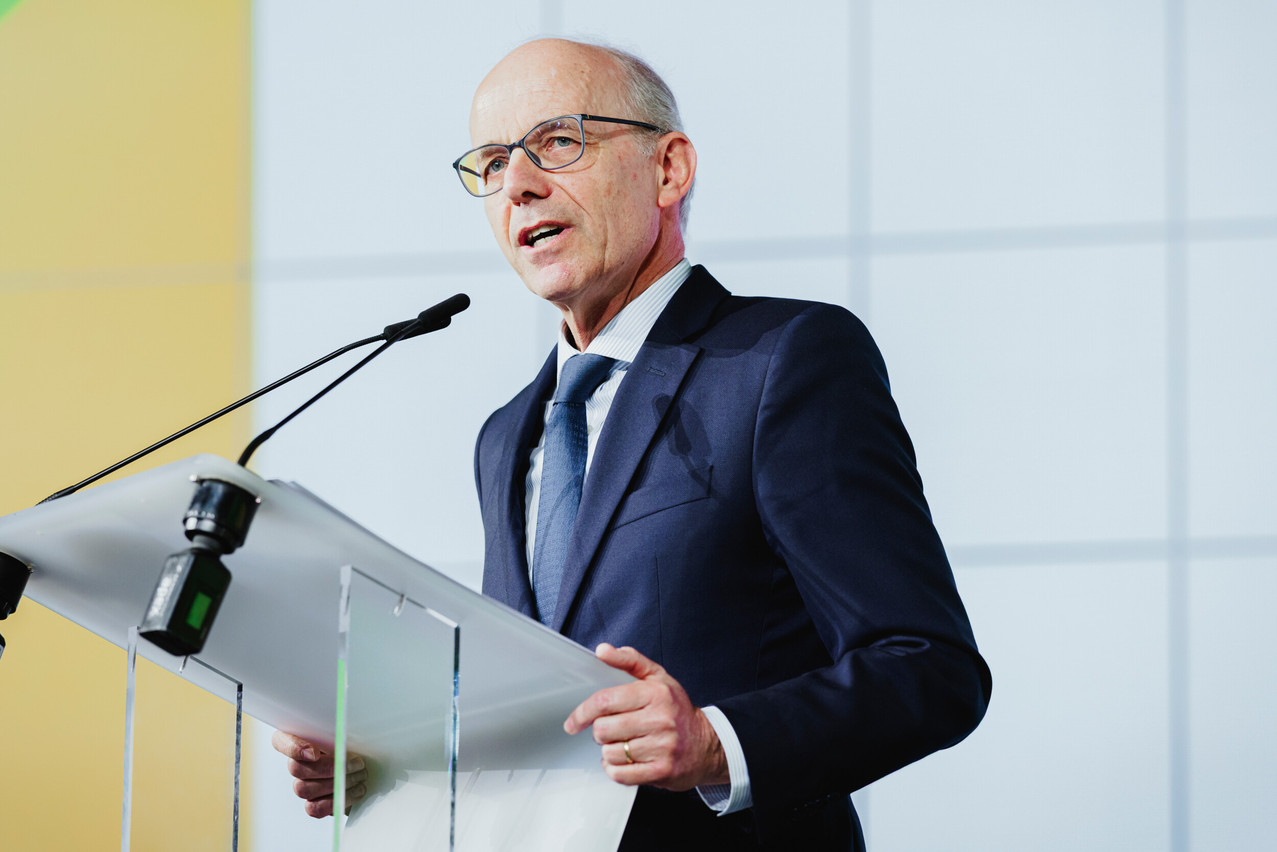
“Welcome to Luxembourg. Welcome to a pro-European, pro-business, pro-tech and pro-AI culture,” said Luc Frieden to the participants at Nexus Luxembourg. The head of government emphasised the need for Europe not to remain a bystander in the global race for AI. “This is not just a race between the United States and China. Europe has an important voice in this race,” he stated, calling for “AI of Europe, by Europe and for Europe”.
The prime minister believes that AI must reflect European values. “Europe is known throughout the world for its values and principles: freedom, human rights, democracy and the rule of law,” he pointed out. “Progress needs meaning.” Luc Frieden also emphasised that AI should not replace humans but “help humans to be more efficient and make better decisions”. “Humans must make the final decision and will continue to do so,” he insisted, referring to “human dignity” as an “intrinsically European value”.
Central to the government’s message was also the concept of technological sovereignty. “Sovereignty is not just a matter of borders. Being sovereign means being free to make one’s own choices,” said Luc Frieden. In the age of AI, he believes this means “controlling the data, the cloud, the models and the backend”. “The question is who owns the data, who operates the cloud and who builds the models.”
Promoting European leaders in strategic fields such as AI is not a protectionist argument.

The prime minister was careful, however, to distinguish this approach from a protectionist mindset. “I am not advocating a ‘fortress Europe’,” he stated. “Promoting European champions in strategic fields such as AI is not a protectionist argument. It is a pro-competition argument.” In his view, Europe must be able to offer “European alternatives capable of competing with foreign companies”.
A balance between innovation and regulation
Luc Frieden also advocated striking a balance between innovation and regulation. “AI cannot remain a completely unregulated environment,” he said, whilst warning against “over-regulation”. “We need general safeguards to ensure that AI solutions remain within a framework aligned with our values.”
The head of government highlighted three priorities to ensure Europe can hold its own in global competition: “Scale, speed and investment.” “We must be faster,” he insisted, calling on businesses to integrate AI “into their core operations” and on governments to stimulate demand through public procurement. He cited the contract signed by the Luxembourg government with Mistral AI as an example of this strategy, as well as several pilot projects designed to use AI to help citizens understand legislation or to map the skills available in the labour market.
Luc Frieden also put the issue into a European financial context. “We have around €12trn in household savings sitting idle in European banks,” he pointed out. In his view, part of these savings should be redirected towards funding tech start-ups and AI, as part of the Savings and Investment Union (SIU).
Carlo Thelen welcomes a €200bn European plan
In a highly confrontational speech,
The United States has developed 40 [fundamental AI] models, China 15, and Europe, as a whole, three. That’s not a gap; it’s a chasm.

Carlo Thelen hailed the European plan to invest €200bn in AI as “a historic initiative” aimed at strengthening European technological sovereignty. He also cited the recent €180m tender awarded by the European Commission to several European sovereign cloud providers, including Luxembourg-based companies.
The business leader particularly emphasised Europe’s lag in fundamental AI models. “The United States has developed 40 models, China 15, and Europe, as a whole, three,” he said. “That’s not a gap, it’s a chasm.”
For Carlo Thelen, European sovereignty “does not mean isolation”. “It means having the ability to make our own choices and to engage with the world on our own terms and according to our own values.” The Director General of the Chamber of Commerce also highlighted Luxembourg’s investments in high-performance computing, AI and quantum computing, referring in particular to the future AI-optimised supercomputer expected in early 2027.
“We have the right blueprint, but now we need to build the house,” he summarised, noting that the widespread adoption of AI by Luxembourg companies was still insufficient. “Last year, I said that we must be builders, not users. Today, I’m going one step further: we must be builders, not passengers.”
We have always been successful in this country when we have adapted early on and opened up to the wider European market.
Crucial international matches
The official opening of Nexus Luxembourg has thus confirmed the Grand Duchy’s position as a European hub seeking to combine technological sovereignty, international appeal and European integration. “We have always succeeded in this country when we have changed early on and opened up to the wider European market,” noted Luc Frieden, citing steel, the media, satellites and investment funds in turn. “We will do the same with AI and technology.”