Since the constitutional reform of January 2023 – a reform adopted under the Bettel 2 government and which came into force in July 2023 – access to culture has become a constitutional right. Article 42 stipulates that “the State guarantees access to culture and the right to cultural fulfilment”. This wording imposes an obligation on the State to take action to remove the barriers that hinder citizens’ participation. The coalition agreement has taken this constitutional ambition into account. Access to culture is described therein as “a major concern for the government”. An absolute priority even for the Minister for Culture 
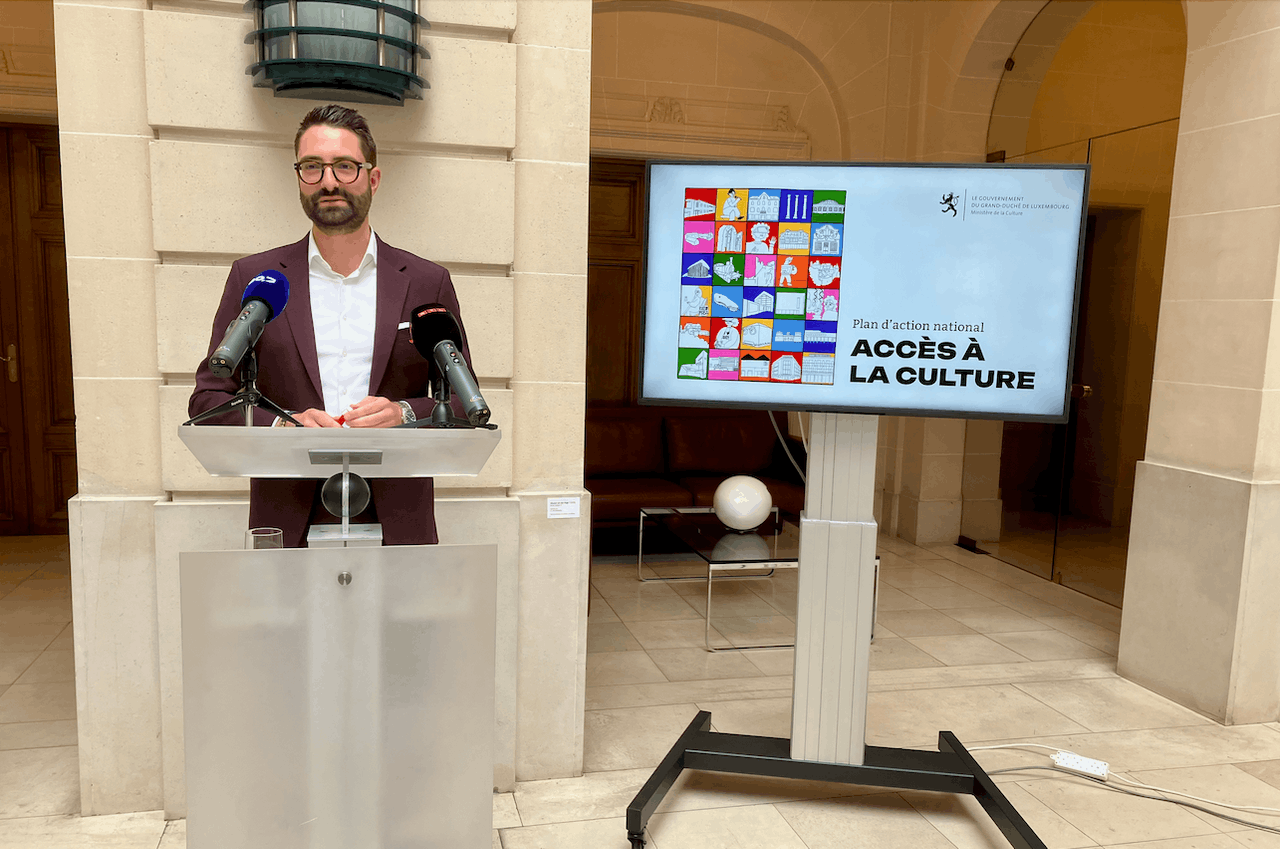
Against this backdrop, the action plan presented by the government on Tuesday 21 April aims to transform Luxembourgish society by making culture accessible to all, regardless of age, background or life experience. The political philosophy underpinning this project is clear: “culture is the mirror of an open society and the guarantor of the country’s democratic vitality”. By asserting that without culture there is no democracy, the government wishes to place creativity and heritage at the heart of its vision for society, the minister explains.
From vision to action: a cross-cutting approach
This political commitment has not been limited to mere declarations of intent; it has been translated into a rigorous and inclusive working method that builds on the Kulturentwécklungsplang 2018–2028, a pre-existing strategic framework, the minister continues. He emphasised that the plan was not conceived in a purely theoretical manner. In fact, it is based on three major studies carried out or commissioned by the Ministry of Culture to identify the real barriers to access to culture. These include the 2023 survey on young people’s cultural practices, the 2024 national survey “Cultural Life in Luxembourg”, which polled residents across the country’s five regions, and a specific qualitative study conducted in 2025 among people with disabilities to understand their accessibility needs,
The drafting process itself followed a participatory approach involving more than 300 stakeholders who gathered at the Cultural Conference on Access to Culture on 25 June to discuss accessibility. In parallel, an online consultation and thematic workshops (on visibility, volunteering, education, digital technology and partnerships) enabled contributions from the field to be gathered. Finally, given the cross-cutting nature of the subject, the Ministry of Culture conducted close inter-ministerial consultations with key departments such as National Education, Health and Family Affairs (via Info-Handicap) and Home Affairs (via Syvicol).
The seven pillars of culture
In essence, the proposed strategy aims to safeguard every citizen’s constitutional right to cultural fulfilment by removing social, physical and geographical barriers. How? By identifying seven key priorities, broken down into 33 objectives and 99 concrete actions. These seven pillars are as follows:
– citizen participation, diversity and cultural inclusion in all their societal dimensions;
– raising awareness of and promoting cultural activities;
– balanced regional cultural development and equitable cultural provision;
– education through and by culture;
– cultural mediation;
– promoting cultural heritage;
– cultural tourism.
A budget of €13.5m
Among the key measures resulting from this segmentation, the first to mention is the creation of an “Access to Culture” Advisory Council, designed to facilitate dialogue between the government, public authorities and professionals. The Kulturpass will be reformed to broaden its impact and scope. It will thus be integrated into the single-point-of-contact social services ecosystem. A “culture, health and well-being” campaign aimed at raising awareness of the positive impact of culture on health will be launched. A unified national platform — culture.lu — will be created to integrate the entire cultural ecosystem, and cultural infrastructure will be mapped. Financial support for local authorities, non-profit organisations and foundations will be introduced to support the accessibility of cultural infrastructure.
Since we are talking about money, the government has set aside a total budget of €13.5m for the period 2026–2030, covering the phased implementation of the plan. Of this, €9m is available for commitment by 2028, in other words, by the end of the parliamentary term.
A final review will be carried out in 2031. This review will be preceded by annual reports, the first of which is expected in early 2028.